
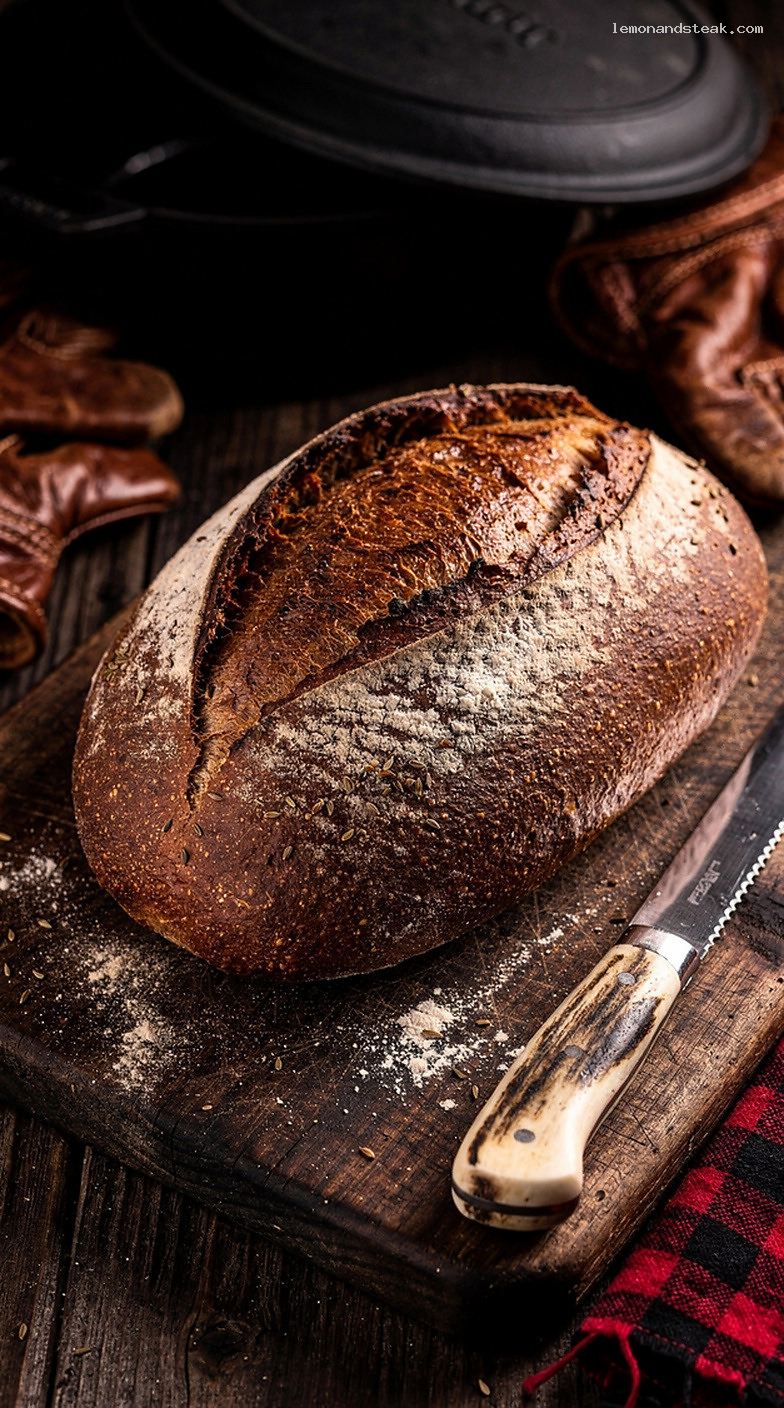
Quick Recipe Version (TL;DR)
Quick Ingredients
- 100 g active sourdough starter (100% hydration)
- 325 g water, room temperature (about 24°C)
- 350 g bread flour
- 150 g rye flour (medium or dark)
- 10 g fine sea salt
- 15 g molasses
- 5 g caraway seeds (optional)
- Rice flour or extra rye flour (for dusting)
Do This
- 1. Mix starter + water + molasses; add flours until shaggy. Rest 30 minutes.
- 2. Add salt (and caraway). Mix 3–5 minutes until cohesive.
- 3. Bulk ferment 3.5–5 hours at 24–26°C, doing 3 sets of stretch-and-folds every 30 minutes.
- 4. Pre-shape, rest 20 minutes, then shape into a tight boule or batard.
- 5. Proof in a floured banneton 12–16 hours in the refrigerator (4°C).
- 6. Bake in a preheated Dutch oven: 245°C covered 20 minutes, then 232°C uncovered 25 minutes.
- 7. Cool completely 2–3 hours before slicing for the best chewy rye crumb.
Why You’ll Love This Recipe
- Big flavor with minimal fuss: Tangy sourdough depth plus earthy rye and a hint of molasses.
- Chewy, hearty crumb: Perfect for sandwiches, toast, and soup-dunking.
- Reliable structure: A rye-forward loaf that still gets a nice rise and a crisp crust.
- Great make-ahead: An overnight cold proof fits easily into a home schedule.
Grocery List
- Produce: None
- Dairy: None
- Pantry: Active sourdough starter, bread flour, rye flour, fine sea salt, molasses, caraway seeds (optional), rice flour (for dusting)
Full Ingredients
For the Dough
- Active sourdough starter (100% hydration): 100 g (fed and bubbly)
- Water: 325 g, room temperature (about 24°C)
- Molasses: 15 g
- Bread flour: 350 g
- Rye flour (medium or dark): 150 g
- Fine sea salt: 10 g
- Caraway seeds (optional): 5 g
For Dusting and Baking
- Rice flour or extra rye flour: 10–20 g, for the banneton and dough surface
- Parchment paper: 1 sheet (optional but helpful for transferring)
Step-by-Step Instructions
Step 1: Make sure your starter is active
Your starter should be at or near peak activity when you mix the dough: bubbly, risen, and smelling pleasantly tangy (not harshly acidic). If needed, feed your starter so it peaks at mixing time (typically 4–6 hours at about 24°C, depending on your starter).
If you keep starter in the refrigerator, take it out and do at least one room-temperature feeding before baking day for best rise and flavor.
Step 2: Mix the dough and let it rest (30 minutes)
In a large bowl, whisk together 325 g water, 100 g active starter, and 15 g molasses until the starter loosens and the mixture looks evenly cloudy.
Add 350 g bread flour and 150 g rye flour. Mix with your hand or a sturdy spoon until no dry flour remains and you have a shaggy, sticky mass. Cover and rest for 30 minutes at room temperature. This rest helps the flour hydrate and makes the dough easier to handle.
Step 3: Add salt and strengthen the dough (3–5 minutes)
Sprinkle 10 g fine sea salt over the dough (and 5 g caraway seeds if using). Pinch and fold the dough repeatedly to work the salt in, then continue mixing by folding and squeezing for 3–5 minutes, until the dough feels more elastic and cohesive.
The dough will still feel tacky (rye flour stays sticky), but it should hold together and look smoother than it did after the initial mix.
Step 4: Bulk ferment with folds (3.5–5 hours at 24–26°C)
Cover the bowl and let the dough bulk ferment at a warm room temperature, ideally 24–26°C, for 3.5–5 hours.
During the first 90 minutes, do 3 sets of stretch-and-folds, spaced 30 minutes apart:
With a slightly damp hand, lift one side of the dough, stretch it up gently, and fold it over itself. Rotate the bowl and repeat 3 more times (4 folds total per set). After the last set, leave the dough to rise undisturbed until it looks aerated and slightly domed, with bubbles along the edges. A good target is about 50–75% rise (rye dough may not double).
Step 5: Pre-shape and rest (20 minutes)
Lightly flour your counter (use a mix of rye flour and rice flour if you have it). Turn the dough out and gently tuck the edges underneath to form a loose round. Don’t try to make it perfect; the goal is to organize the dough without deflating it.
Let it rest, seam-side down, for 20 minutes. This short rest relaxes the dough so final shaping is easier.
Step 6: Shape, then cold proof (12–16 hours at 4°C)
Dust a banneton (or a bowl lined with a clean towel) generously with rice flour or rye flour. Shape the dough into a tight boule or batard by pulling the surface taut: gently stretch the outer edges toward the center, then roll or stitch to build tension on the outside.
Place the dough seam-side up in the prepared banneton. Cover tightly and refrigerate at 4°C for 12–16 hours. This long cold proof develops tangy flavor and makes scoring and baking easier.
Step 7: Bake in a Dutch oven (245°C then 232°C; 45 minutes total)
Place a Dutch oven with its lid in your oven and preheat to 245°C for 45 minutes (this fully heats the pot for a strong oven spring).
Cut a piece of parchment (optional). Remove the dough from the refrigerator. Turn it out onto parchment or a floured surface so it is seam-side down. Score the top with a sharp lame or knife (one long slash about 1 cm deep works well for rye-forward dough).
Carefully transfer the dough into the hot Dutch oven, cover with the lid, and bake at 245°C for 20 minutes. Remove the lid, reduce heat to 232°C, and bake for 25 minutes more, until the crust is deeply browned.
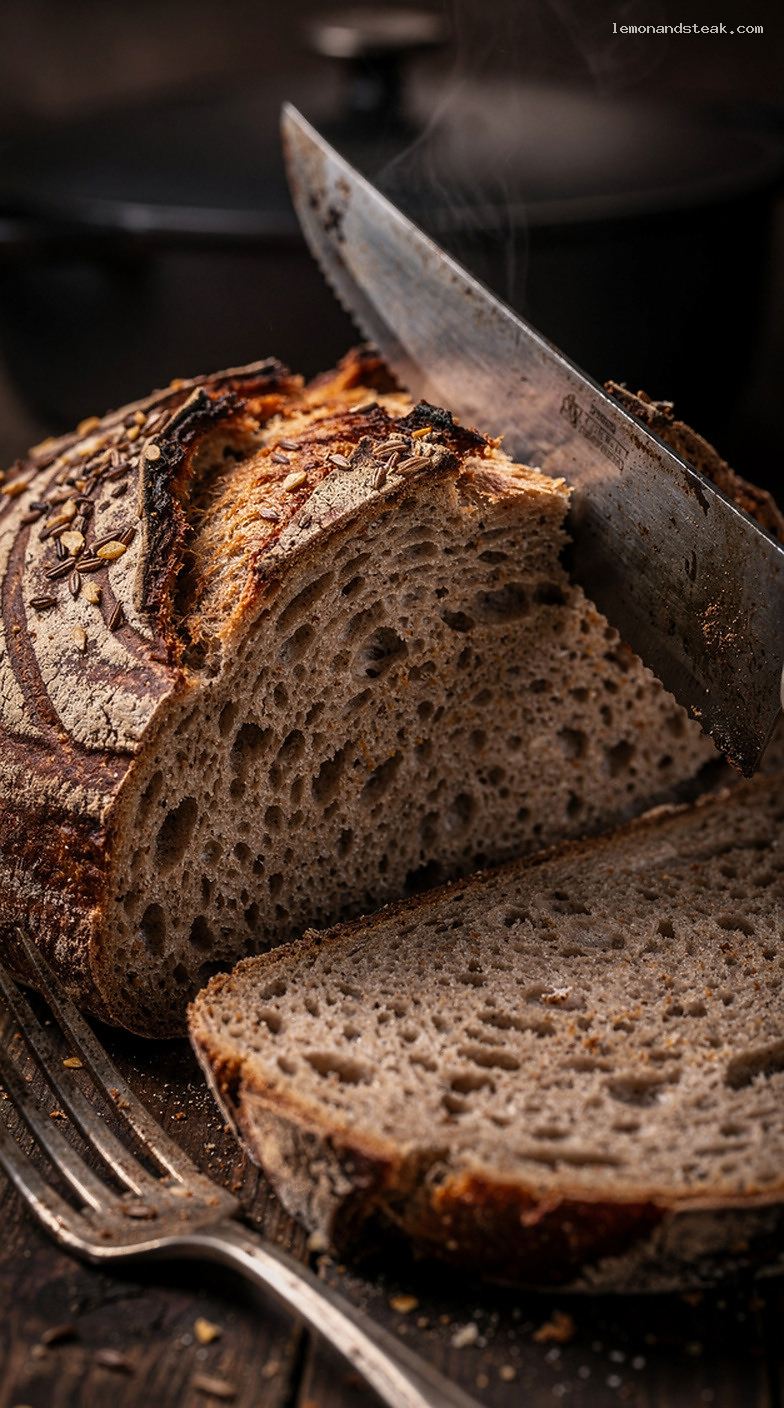
For doneness, aim for an internal temperature of 98–99°C. Cool on a rack for 2–3 hours before slicing (rye breads set as they cool; slicing early can make the crumb gummy).
Pro Tips
- Stickiness is normal with rye: Use slightly damp hands for mixing and folding, and dust with rice flour to prevent sticking without adding too much extra flour.
- Watch the dough, not the clock: In a cooler kitchen (below 22°C), bulk fermentation may need closer to 5 hours; in a warmer kitchen, it can be faster.
- Don’t chase a “double” rise: Rye dough typically shows less dramatic expansion; look for bubbles, a puffy feel, and a gentle dome.
- Go darker for better flavor: A deep brown crust enhances the rye’s nutty notes and balances sourness.
- For clean slices: Let the loaf cool fully, then use a serrated knife and a gentle sawing motion.
Variations
- Seeded rye: Add 30 g sunflower seeds and 20 g pumpkin seeds during the first fold; optionally sprinkle sesame on the crust before baking.
- More classic deli-style aroma: Increase caraway to 8 g and add 2 g fennel seed (lightly crushed).
- Higher-rye loaf: Use 250 g rye flour and 250 g bread flour, and increase water to 350 g. Expect a slightly denser, more moist crumb.
Storage & Make-Ahead
Let the bread cool completely, then store it at room temperature in a paper bag or loosely wrapped in a clean towel for up to 2 days (this keeps the crust from turning soft). For longer storage, wrap tightly and freeze for up to 2 months. Slice before freezing for easy toast-ready portions; thaw slices at room temperature for 15 minutes or toast straight from frozen.
Make-ahead friendly: keep the shaped dough in the refrigerator for the full 12–16 hours, then bake directly from cold. If you need to extend proofing, you can push to 18 hours (flavor will be tangier), but avoid going much longer if your starter is very active.
Nutrition (per serving)
Approximate per slice (1/10 loaf): 175 calories, 36 g carbohydrates, 6 g protein, 1.5 g fat, 4 g fiber, 390 mg sodium.
Leave a Reply