
Quick Recipe Version (TL;DR)
Quick Ingredients
- 1 whole turkey (12–14 lb), thawed, giblets removed
- 3 tbsp kosher salt, divided, plus 3–4 tsp black pepper, divided
- 1 1/8 cups unsalted butter (1 cup softened for rub + 2 tbsp melted for onions)
- 3–4 tbsp fresh sage (minced), 2 tbsp fresh thyme leaves, 1 tsp minced rosemary
- 4 garlic cloves (minced), zest of 1 lemon, 1 lemon (quartered)
- 2 yellow onions (1 quartered for cavity, 1 for roasting pan)
- 2 carrots, 2 celery stalks (for roasting pan)
- 3–4 cups low-sodium chicken or turkey broth (for roasting and gravy)
- 2 cups crispy fried onions (store-bought, green-bean-casserole style)
- 1/4 cup panko breadcrumbs and 2 tbsp grated Parmesan (both optional)
- 1/3 cup all-purpose flour (for optional gravy)
Do This
- 1. Pat dry a 12–14 lb turkey. Season the cavity with salt and pepper, then stuff with lemon wedges, onion wedges, and herb sprigs.
- 2. Mix softened butter with minced sage, thyme, rosemary, garlic, lemon zest, salt, pepper, and paprika. Gently loosen the turkey skin and rub half the butter under the skin and the rest over the outside.
- 3. Set the turkey on a rack over chopped carrots, celery, onion, and 2 cups broth in a roasting pan. Roast at 425°F (218°C) for 30 minutes, then at 325°F (163°C) until almost done, about 2½–3 hours total.
- 4. While it roasts, toss crispy fried onions with melted butter, thyme, panko, and Parmesan (if using).
- 5. When the turkey is nearly done, mound the onion mixture thickly over the top. Roast 10–15 minutes more until onions are deep golden and turkey reaches 165°F (74°C) in the thigh.
- 6. Rest 20–30 minutes. Meanwhile, make gravy from the pan drippings if desired. Carve and serve turkey topped with extra crispy onions and pan juices.
Why You’ll Love This Recipe
- All the cozy flavors of green bean casserole show up on your turkey in the form of a sage-butter roast with a crunchy fried-onion crust.
- The method gives you juicy meat and deeply golden, flavorful skin without fussy techniques.
- The crispy onion topping looks dramatic on the table but is simple to throw together with store-bought fried onions.
- Pan drippings become an easy gravy that already tastes like herbs, butter, and roast turkey.
Grocery List
- Produce: Fresh sage, fresh thyme, fresh rosemary, garlic, yellow onions, lemon, carrots, celery
- Dairy: Unsalted butter, grated Parmesan cheese (optional), heavy cream for gravy (optional)
- Pantry: Whole turkey (12–14 lb), kosher salt, black pepper, paprika, low-sodium chicken or turkey broth, store-bought crispy fried onions, panko breadcrumbs, all-purpose flour, olive oil (optional)
Full Ingredients
For the Turkey
- 1 whole turkey (12–14 lb), thawed, giblets and neck removed
- 1 tbsp kosher salt (for seasoning turkey and cavity)
- 2 tsp freshly ground black pepper
- 1 medium yellow onion, quartered
- 1 lemon, quartered (zest it first for the butter, then quarter)
- 6 fresh sage sprigs
- 4 fresh thyme sprigs
- 2 cups low-sodium chicken or turkey broth (for the roasting pan)
- 2 medium carrots, roughly chopped
- 2 celery stalks, roughly chopped
For the Sage-Butter Rub
- 1 cup (2 sticks / 226 g) unsalted butter, very soft
- 3 tbsp fresh sage, finely minced
- 1 tbsp fresh thyme leaves
- 1 tsp fresh rosemary, finely minced
- 4 garlic cloves, minced
- Zest of 1 lemon (from the lemon above)
- 2 1/2 tsp kosher salt
- 1 1/2 tsp freshly ground black pepper
- 1 tsp paprika (sweet or smoked, optional but delicious)
For the Crispy Onion Topping
- 2 cups crispy fried onions (store-bought, the kind used for green bean casserole)
- 2 tbsp unsalted butter, melted
- 1/4 cup panko breadcrumbs (optional, for extra crunch)
- 2 tbsp grated Parmesan cheese (optional, for savory depth)
- 1 tsp fresh thyme leaves, or 1/2 tsp dried thyme
For the Roasting Pan and Optional Gravy
- 1/3 cup all-purpose flour
- 1–2 cups additional low-sodium chicken or turkey broth, as needed to thin gravy
- 2–4 tbsp heavy cream (optional, for a richer gravy)
- Kosher salt and black pepper, to taste
Step-by-Step Instructions
Step 1: Thaw and Dry the Turkey
If your turkey is frozen, thaw it in the refrigerator in its original packaging: allow about 24 hours per 4–5 lb of turkey. For a 12–14 lb bird, that is roughly 3 days in the fridge. Do not rush this step; an evenly thawed turkey cooks more predictably and stays juicier.
On cooking day, remove the turkey from the fridge 30–45 minutes before roasting to take off some of the chill. Remove the packaging, neck, and giblets (often tucked in the cavity or neck area). Pat the turkey very dry, inside and out, with paper towels. Dry skin is key for browning and crispiness.
Sprinkle about 1 tsp of the kosher salt and 1 tsp of the pepper inside the cavity and massage gently so it coats the interior. Set the turkey on a cutting board or clean tray while you make the sage-butter.
Step 2: Make the Sage-Butter Rub
In a medium bowl, combine the softened butter, minced sage, thyme leaves, minced rosemary, minced garlic, lemon zest, 2 1/2 tsp kosher salt, 1 1/2 tsp black pepper, and paprika if using. Mix thoroughly with a spatula or fork until the herbs and seasonings are evenly distributed and you have a smooth, fragrant compound butter.
If the butter is too firm to spread easily, let it sit at room temperature for another 5–10 minutes. It should be very soft, like a thick mayonnaise, so it can glide under the skin without tearing it.
Step 3: Season and Butter the Turkey
Position the turkey breast-side up. Starting at the cavity end of the breast, gently slide your fingers under the skin to separate it from the meat, going as far toward the neck and down over the drumsticks as you can without tearing the skin. Work slowly; this pocket is where much of the sage-butter will go.
Scoop up about half of the sage-butter and distribute it under the skin, over both breasts and as far down over the thighs and drumsticks as possible. Massage gently from the outside so the butter spreads into an even layer. Spread the remaining butter all over the outside of the turkey, including the legs and wings. This will feel like a lot of butter; that is what gives the turkey its rich, deeply browned skin.
Tuck the onion wedges, lemon wedges, and herb sprigs (sage and thyme) into the main cavity. Use kitchen twine to tie the legs together, and tuck the wing tips under the bird so they do not burn. Sprinkle the remaining kosher salt and pepper over the outside of the turkey.
Step 4: Set Up the Roasting Pan and Start Roasting
Preheat your oven to 425°F (218°C) with a rack in the lower third of the oven. This hotter initial temperature helps the skin begin to crisp and brown.
Scatter the chopped carrots, celery, and the second onion (cut into large chunks) in the bottom of a large roasting pan. Pour in 2 cups of chicken or turkey broth. Set a roasting rack over the vegetables and place the butter-rubbed turkey breast-side up on the rack. The vegetables and broth form a flavorful, steamy base that will later become your gravy.
Roast the turkey at 425°F (218°C) for 30 minutes. Then, without opening the oven for long, reduce the temperature to 325°F (163°C). Continue roasting, basting once or twice with the pan juices if you like, until an instant-read thermometer inserted into the thickest part of the thigh (not touching bone) registers 150–155°F (66–68°C). For a 12–14 lb turkey, this usually takes about 2 to 2 1/2 more hours, for a total cook time of roughly 2 1/2 to 3 hours.
If the skin starts to brown too deeply before the turkey is near that temperature, tent it loosely with foil and continue roasting.
Step 5: Mix the Crispy Onion Topping
While the turkey roasts, prepare the green-bean-casserole-inspired topping. In a medium bowl, combine the crispy fried onions, melted butter, panko breadcrumbs (if using), grated Parmesan (if using), and thyme. Toss gently with your hands or a spoon until everything is evenly coated and lightly moistened with butter.
You want a loose, chunky mixture that will mound nicely on top of the turkey without turning into a paste. If it looks very dry, add another 1–2 tsp of melted butter. Set aside at room temperature until the turkey is nearly done.
Step 6: Finish Roasting with the Crispy Fried Onions
When the turkey thigh registers about 150–155°F (66–68°C) and the breast is around 145–150°F (63–66°C), it is time to add the onion topping. This is usually about 20–30 minutes before the turkey will be fully cooked.
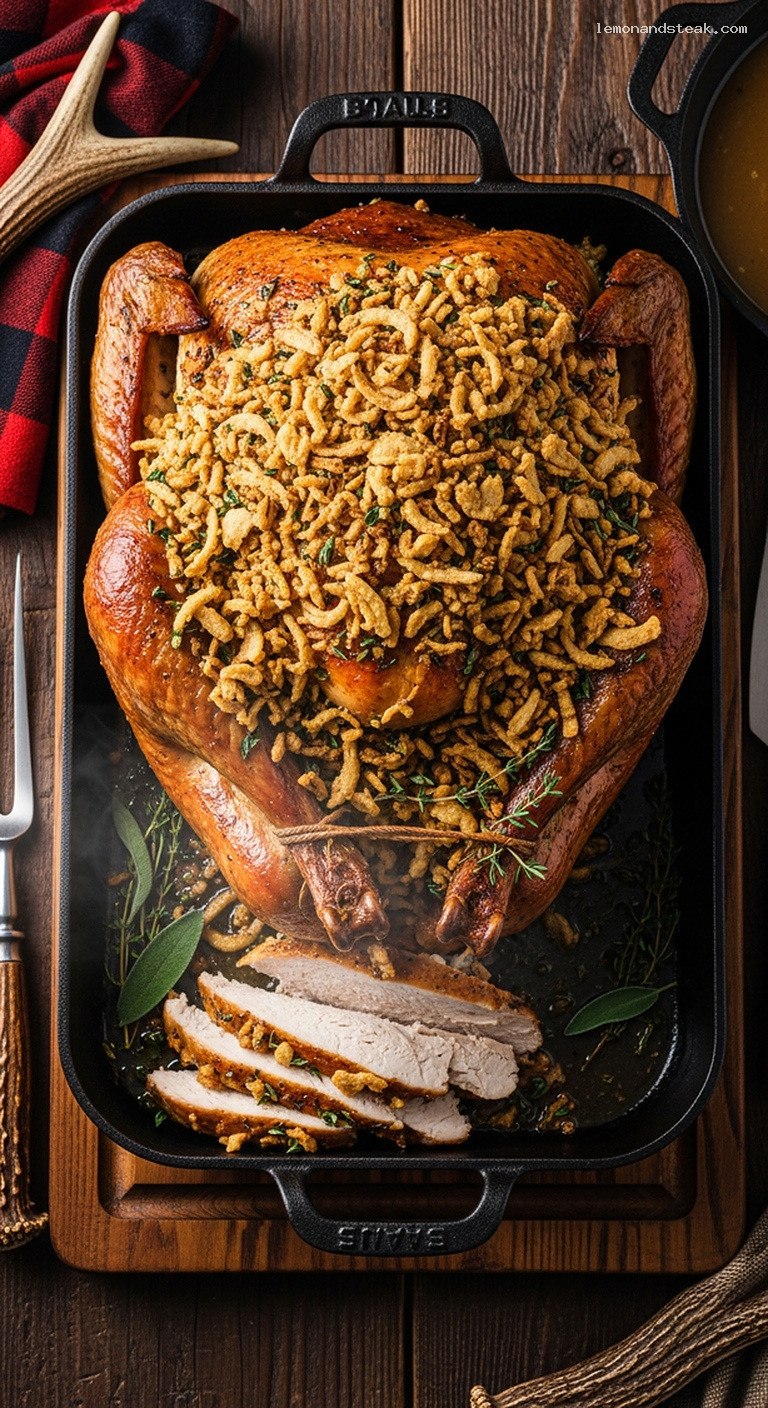
Carefully slide the roasting pan out of the oven and close the door to keep the heat in. Working quickly but carefully (the pan and turkey are very hot), use a spoon or your hands to mound the crispy onion mixture over the top of the turkey, focusing on the breast and upper thighs. Press gently so the mixture clings to the buttery skin, forming a rough crust. Some pieces will tumble onto the sides and pan; that is fine and delicious.
Return the pan to the oven and continue roasting at 325°F (163°C) for 10–15 minutes, until the onions are deep golden and crackling and the turkey reaches 165°F (74°C) in the thickest part of the thigh and at least 160°F (71°C) in the thickest part of the breast. If the onions brown too quickly, tent lightly with foil for the last few minutes.
Step 7: Rest, Carve, and Serve
When the turkey has reached proper temperature, carefully transfer it to a large cutting board or serving platter, along with any onions that are piled on top. Let it rest, loosely tented with foil, for at least 20 minutes and up to 30 minutes. Resting allows the juices to redistribute, giving you moist slices instead of dry meat.
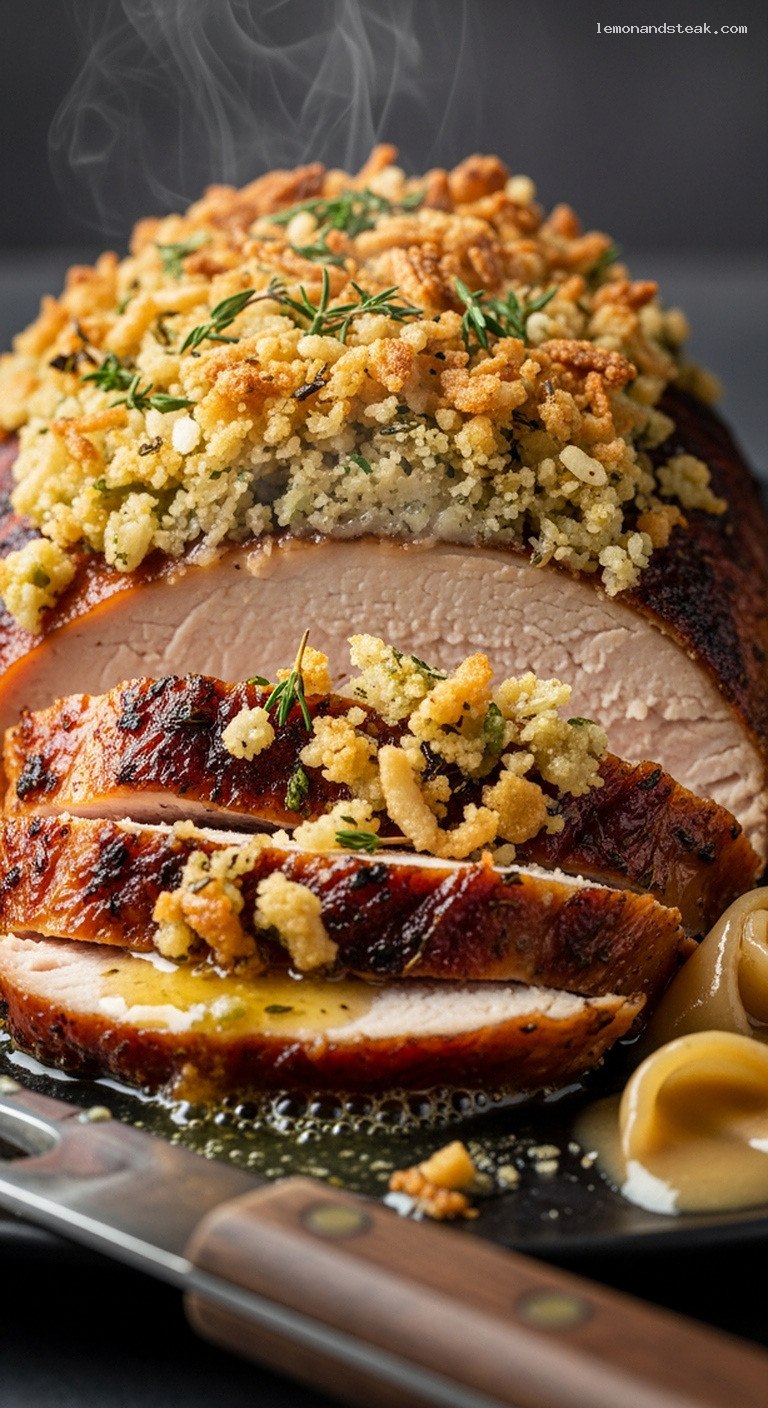
To carve, remove the crispy onion crust in large pieces and reserve. Slice the breasts, thighs, and drumsticks as desired, then lay slices on a platter and spoon some of the crispy onions back over the top, scattering extra around the sides. This way every serving gets some crunchy, green-bean-casserole-style topping.
Step 8: Make a Simple Pan Gravy (Optional)
While the turkey rests, make the gravy. Pour the pan drippings and vegetables through a strainer into a fat separator or a heatproof measuring cup. Let the fat rise to the top, then skim off 3–4 tbsp of fat and transfer it to a medium saucepan. Discard the remaining excess fat, keeping the flavorful juices.
Set the saucepan over medium heat. Whisk in the flour and cook, stirring constantly, for 1–2 minutes to form a blond roux. Slowly whisk in the reserved pan juices plus enough extra broth to total about 3 cups of liquid. Bring to a gentle simmer, whisking, until gravy thickens, 5–8 minutes. Add a splash of cream if you like a richer gravy. Taste and season with salt and pepper as needed. Serve warm alongside the sliced turkey and crispy onions.
Pro Tips
- Use an instant-read thermometer rather than relying only on time; turkeys vary, and this is the best way to ensure juicy meat.
- Patting the turkey very dry before adding the butter ensures the sage-butter sticks well and the skin crisps instead of steaming.
- If you are nervous about the onion topping burning, you can add only half at first and scatter the rest over the turkey and platter after roasting for fresh crunch.
- For extra flavor, refrigerate the butter-rubbed turkey (uncovered) for up to 12 hours before roasting; this helps dry the skin and deepen the seasoning.
- Let the turkey rest; slicing too early causes the juices to run out and the meat to seem dry, even if it is perfectly cooked.
Variations
- Turkey Breast Only: Use a 6–7 lb bone-in turkey breast and the same sage-butter and onion topping. Roast at 425°F (218°C) for 15 minutes, then at 325°F (163°C) until the thickest part of the breast reaches 160°F (71°C), about 1 1/2–2 hours total. Add the onion topping during the last 10 minutes.
- Extra Green-Bean-Casserole Vibes: Serve the carved turkey over a platter of quickly sautéed green beans and mushrooms, then blanket the whole thing with extra crispy fried onions.
- Smoky Herb Version: Replace the paprika with smoked paprika and add a pinch of cayenne to the onion topping for a subtle smoky, lightly spicy kick.
Storage & Make-Ahead
Refrigerate leftover turkey and onions within 2 hours of cooking. Store carved turkey in an airtight container for up to 4 days. The crispy onions are best the day of, but you can store them separately in a container at room temperature for up to 24 hours; re-crisp briefly in a 350°F (177°C) oven for 3–5 minutes if needed. Gravy keeps in the refrigerator for up to 3 days; reheat gently with a splash of broth to loosen. For longer storage, freeze sliced turkey and gravy for up to 2 months, tightly wrapped. To get ahead, you can make the sage-butter up to 3 days in advance and refrigerate it, then let it soften before rubbing on the turkey. You can also chop the vegetables for the roasting pan a day ahead and refrigerate them in a sealed container.
Nutrition (per serving)
Approximate values for 1 of 12 servings (including skin, some sage-butter, crispy onions, and a small amount of gravy): about 520 calories; 47 g protein; 35 g fat; 14 g carbohydrates; 2 g fiber; 3 g sugar; 860 mg sodium. Actual values will vary based on the size of your turkey, how much skin and butter are eaten, and how much gravy and onion topping you add to each plate.
Leave a Reply