
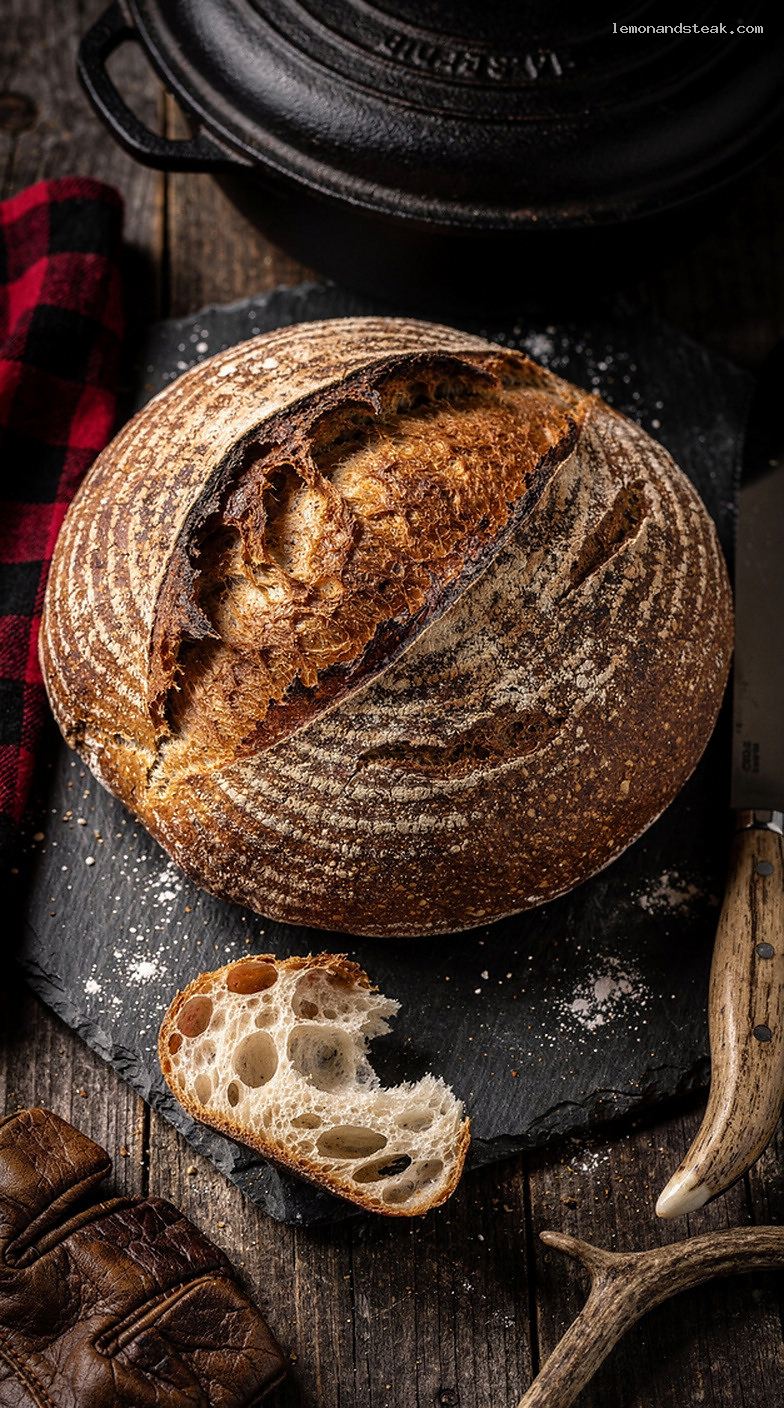
Quick Recipe Version (TL;DR)
Quick Ingredients
- 12 g active sourdough starter (100% hydration), for building the levain
- 60 g bread flour (for levain)
- 60 g water, room temperature (for levain)
- 440 g bread flour (for dough)
- 100 g whole wheat flour (for dough)
- 390 g water, room temperature (for dough)
- 12 g fine sea salt
- Rice flour, for dusting (optional but helpful)
Do This
- 1. Build levain (12 g starter + 60 g flour + 60 g water); ferment 8–12 hours at 70–75°F (21–24°C).
- 2. Mix flours + 380 g of the water; rest 30 minutes (autolyse).
- 3. Add 120 g ripe levain + salt + remaining 10 g water; mix until cohesive.
- 4. Bulk ferment 4 1/2–5 1/2 hours at ~75°F (24°C), doing 3 sets of stretch-and-folds every 30 minutes.
- 5. Pre-shape, rest 20 minutes; shape tight; place in a floured basket/bowl.
- 6. Cold proof 12–16 hours at 38–40°F (3–4°C).
- 7. Bake in preheated Dutch oven: 20 min covered at 475°F (245°C), then 25 min uncovered at 450°F (232°C); cool 2 hours.
Why You’ll Love This Recipe
- Big bakery vibe at home: crackly crust, chewy interior, and that classic open crumb.
- Real sourdough flavor: gentle tang and deeper wheat notes from long fermentation.
- Simple ingredients: flour, water, salt, and starter.
- Forgiving schedule: the overnight cold proof makes timing easier (and improves flavor).
Grocery List
- Produce: None
- Dairy: None (optional: butter for serving)
- Pantry: Bread flour, whole wheat flour, fine sea salt, rice flour (optional), active sourdough starter
Full Ingredients
Levain (build the night before)
- Active sourdough starter: 12 g (100% hydration)
- Bread flour: 60 g
- Water: 60 g, room temperature (70–75°F / 21–24°C)
Dough
- Bread flour: 440 g
- Whole wheat flour: 100 g
- Water: 390 g, room temperature (hold back 10 g to help dissolve the salt)
- Fine sea salt: 12 g
- All of the ripe levain: 120 g (from above)
For shaping and baking
- Rice flour or bread flour: 2–3 tablespoons, for dusting basket and dough
- Cornmeal or semolina (optional): 1 tablespoon, to help prevent sticking on the parchment
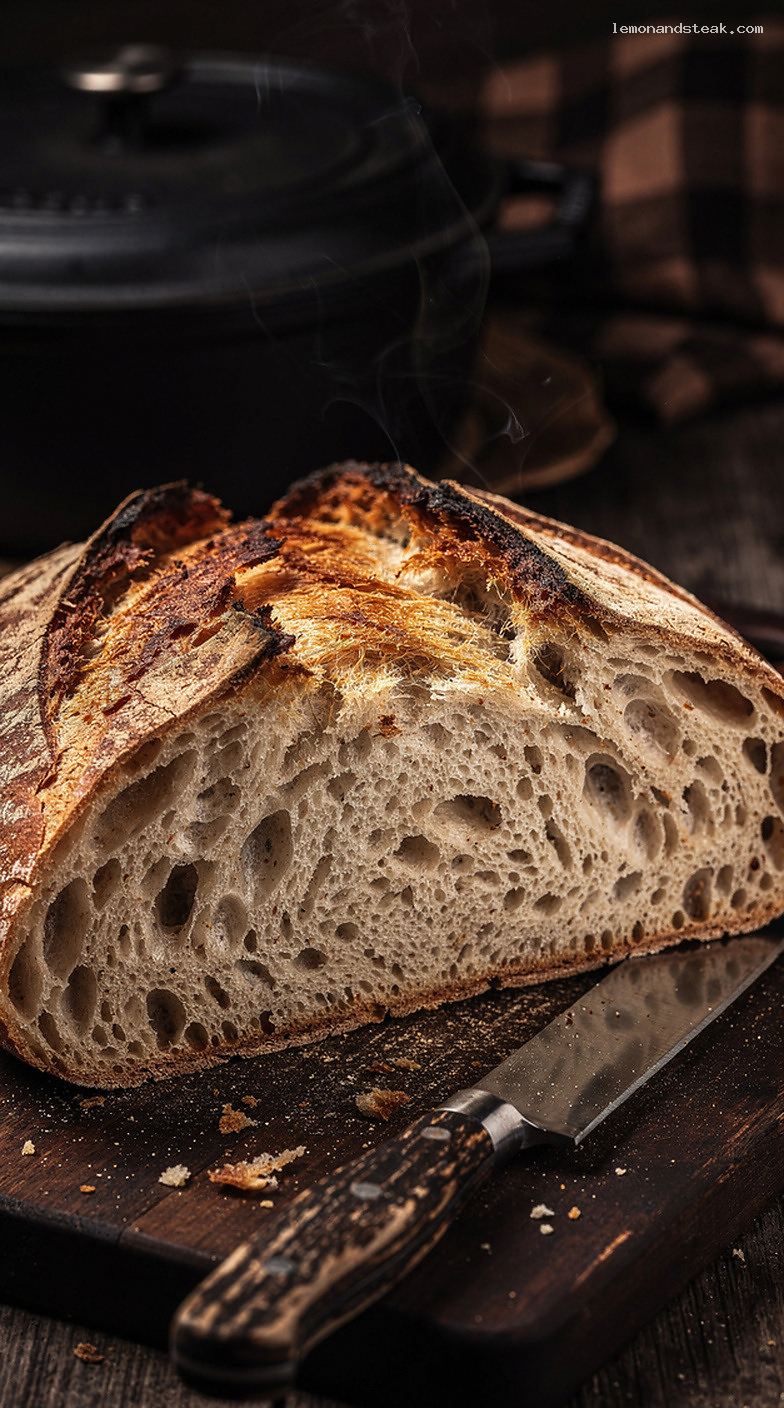
Step-by-Step Instructions
Step 1: Build a ripe levain
In a small jar or bowl, mix 12 g active starter, 60 g bread flour, and 60 g room-temperature water until no dry flour remains. Cover loosely.
Let it ferment at 70–75°F (21–24°C) for 8–12 hours, until it has doubled (or tripled) and looks domed and bubbly. It should smell pleasantly tangy and slightly sweet, not sharply acidic.
Step 2: Autolyse the dough (build strength with a simple rest)
In a large bowl, combine 440 g bread flour and 100 g whole wheat flour. Add 380 g of the water (reserve 10 g for later) and mix until you have a shaggy dough and no dry patches.
Cover and rest for 30 minutes at room temperature. This helps the flour hydrate and makes the dough easier to handle later.
Step 3: Add levain and salt
Add 120 g ripe levain to the dough. Sprinkle in 12 g fine sea salt. Drizzle the remaining 10 g water over the salt to help it dissolve.
Mix by hand until the levain and salt are fully incorporated and the dough looks smoother and more elastic, 3–5 minutes. A good method is to pinch the dough between your fingers and fold it over itself repeatedly around the bowl.
Step 4: Bulk ferment with stretch-and-folds
Cover the bowl and let the dough rise at about 75°F (24°C) for 4 1/2 to 5 1/2 hours. The exact time depends on your room temperature and starter strength.
During the first 1 1/2 hours, perform 3 sets of stretch-and-folds, one set every 30 minutes:
- With damp hands, lift one side of the dough up until it stretches, then fold it over itself.
- Rotate the bowl 90 degrees and repeat 4 times (north, south, east, west).
After the last fold, let the dough continue fermenting undisturbed. You’re looking for a dough that has risen about 30–50%, looks airy with bubbles along the sides, and feels lighter and slightly jiggly when you gently shake the bowl.
Step 5: Pre-shape and rest
Lightly flour your counter. Turn out the dough and gently pre-shape it into a round by folding the edges toward the center, then flipping seam-side down and using your hands to tuck and tighten the surface.
Let it rest uncovered for 20 minutes. This “bench rest” relaxes the gluten so final shaping is easier.
Step 6: Shape into a tight boule and cold proof overnight
Dust a banneton (or a bowl lined with a clean kitchen towel) generously with rice flour (or bread flour). Rice flour is great here because it resists sticking.
Final shape: Flip the dough seam-side up. Gently stretch it into a loose rectangle, then fold left over center, right over center, then roll/fold from top to bottom to create surface tension. Pinch the seam closed if needed.
Place the dough seam-side up in the prepared basket. Cover and refrigerate at 38–40°F (3–4°C) for 12–16 hours.
Step 7: Preheat the oven and Dutch oven
The next day, place a 5–6 quart (4.7–5.7 L) Dutch oven (with lid) on the middle rack. Preheat the oven to 500°F (260°C) for 45 minutes. A long preheat helps you get a bold, blistered crust and strong oven spring.
Step 8: Score and bake for crisp crust and open crumb
Cut a piece of parchment paper slightly larger than your loaf. Remove the dough from the refrigerator, invert it onto the parchment, and dust off any excess flour.
Score the loaf with a sharp lame or knife: one confident slash about 1/4 to 1/2 inch (6–12 mm) deep. A simple single slash works beautifully for a rustic country loaf.
Carefully transfer the dough (on parchment) into the hot Dutch oven. Cover with the lid and bake:
- 20 minutes covered at 475°F (245°C)
- Remove the lid, reduce heat to 450°F (232°C), and bake 25 minutes uncovered
The loaf is done when the crust is a deep brown and the internal temperature reaches 208–210°F (98–99°C).
Step 9: Cool completely before slicing
Transfer the bread to a wire rack and cool for at least 2 hours. This is when the crumb finishes setting; slicing too early can make the interior gummy even if the bread is fully baked.
Pro Tips
- Control dough temperature: If your kitchen is cool, use slightly warmer water so the dough stays near 75°F (24°C) during bulk fermentation.
- Don’t rush bulk: Under-fermented dough can bake up dense. Look for a lighter, bubbled, jiggly dough rather than focusing only on the clock.
- Use rice flour for the basket: It dramatically reduces sticking and keeps the surface of the loaf clean.
- Score with confidence: A quick, decisive slash helps the loaf expand where you want it to.
- For extra crunch: After baking, leave the loaf directly on the oven rack with the oven turned off and the door cracked for 5 minutes.
Variations
- Seeded country loaf: Add 60 g toasted sunflower seeds and 30 g toasted sesame seeds during the first stretch-and-fold.
- More whole grain: Increase whole wheat to 150 g and reduce bread flour to 390 g. Add an extra 15–25 g water if the dough feels tight.
- Rustic batard: Shape into an oval and proof in an oval banneton. Bake the same way; scoring can be one long slash down the length.
Storage & Make-Ahead
Let the loaf cool completely, then store it cut-side down on a cutting board for up to 24 hours for the best crust. For longer storage, wrap in a clean towel or paper bag and keep at room temperature for up to 3 days.
For freezing, slice the loaf, wrap tightly, and freeze for up to 2 months. Toast slices straight from frozen, or thaw at room temperature.
Make-ahead note: The 12–16 hour cold proof is built in. If needed, you can extend the cold proof to 18 hours for a slightly tangier loaf, but don’t push much longer unless your fridge runs very cold.
Nutrition (per serving)
Approximate, based on 10 slices per loaf: 220 calories, 1 g fat, 45 g carbohydrates, 7 g protein, 2 g fiber, 390 mg sodium.
Leave a Reply