
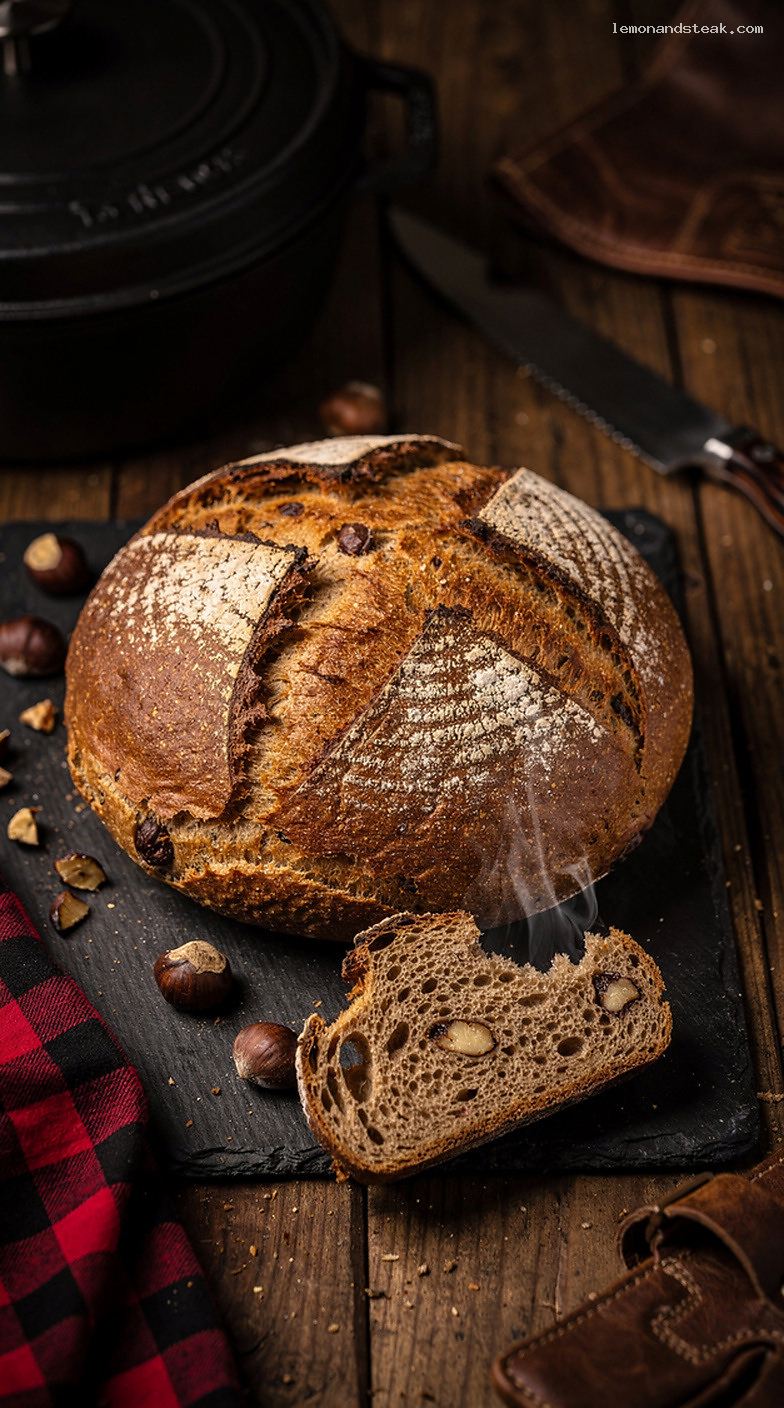
Quick Recipe Version (TL;DR)
Quick Ingredients
- 300 g (2 1/2 cups) bread flour
- 100 g (1 cup) chestnut flour
- 320 g (1 1/3 cups) warm water (38–40°C / 100–104°F)
- 7 g (2 1/4 tsp) instant yeast
- 20 g (1 tbsp) honey
- 10 g (1 3/4 tsp) fine sea salt
- 14 g (1 tbsp) olive oil
- 150 g (about 1 cup) cooked, peeled chestnuts, roughly chopped
- 2–3 tbsp bread flour (for dusting)
Do This
- 1. Mix flours, yeast, warm water, and honey; rest 20 minutes.
- 2. Add salt and olive oil; knead 8–10 minutes until elastic.
- 3. Knead in chopped chestnuts; rise 75–90 minutes until doubled.
- 4. Shape into a tight round; proof 45–60 minutes.
- 5. Preheat Dutch oven at 232°C / 450°F for 30 minutes.
- 6. Score and bake: 25 minutes covered at 232°C / 450°F, then 15 minutes uncovered at 218°C / 425°F.
- 7. Cool at least 60 minutes before slicing.
Why You’ll Love This Recipe
- Rustic and cozy: A crackly crust with a tender crumb and little pockets of sweet, earthy chestnut.
- Approachable for home bakers: Straightforward kneading and simple timing—no special starter required.
- Subtle sweetness: Chestnut flour plus a touch of honey makes it flavorful without tasting like dessert.
- Perfect with savory food: Excellent alongside soups, roast chicken, or a board of cheeses.
Grocery List
- Produce: Fresh rosemary (optional)
- Dairy: Unsalted butter (optional, for greasing the bowl)
- Pantry: Bread flour, chestnut flour, instant yeast, honey, fine sea salt, olive oil, cooked/peeled chestnuts (vacuum-packed or jarred are easiest)
Full Ingredients
For the Dough
- 300 g (2 1/2 cups) bread flour, plus 2–3 tbsp extra for dusting
- 100 g (1 cup) chestnut flour
- 7 g (2 1/4 tsp) instant yeast
- 320 g (1 1/3 cups) warm water (38–40°C / 100–104°F)
- 20 g (1 tbsp) honey
- 10 g (1 3/4 tsp) fine sea salt
- 14 g (1 tbsp) olive oil
Mix-In
- 150 g (about 1 cup) cooked, peeled chestnuts, roughly chopped
Optional (Nice Touches)
- 1 tsp chopped fresh rosemary (adds a woodsy aroma that pairs beautifully with chestnut)
- 1 tbsp bread flour to lightly toss with the chopped chestnuts (helps keep them from clumping)
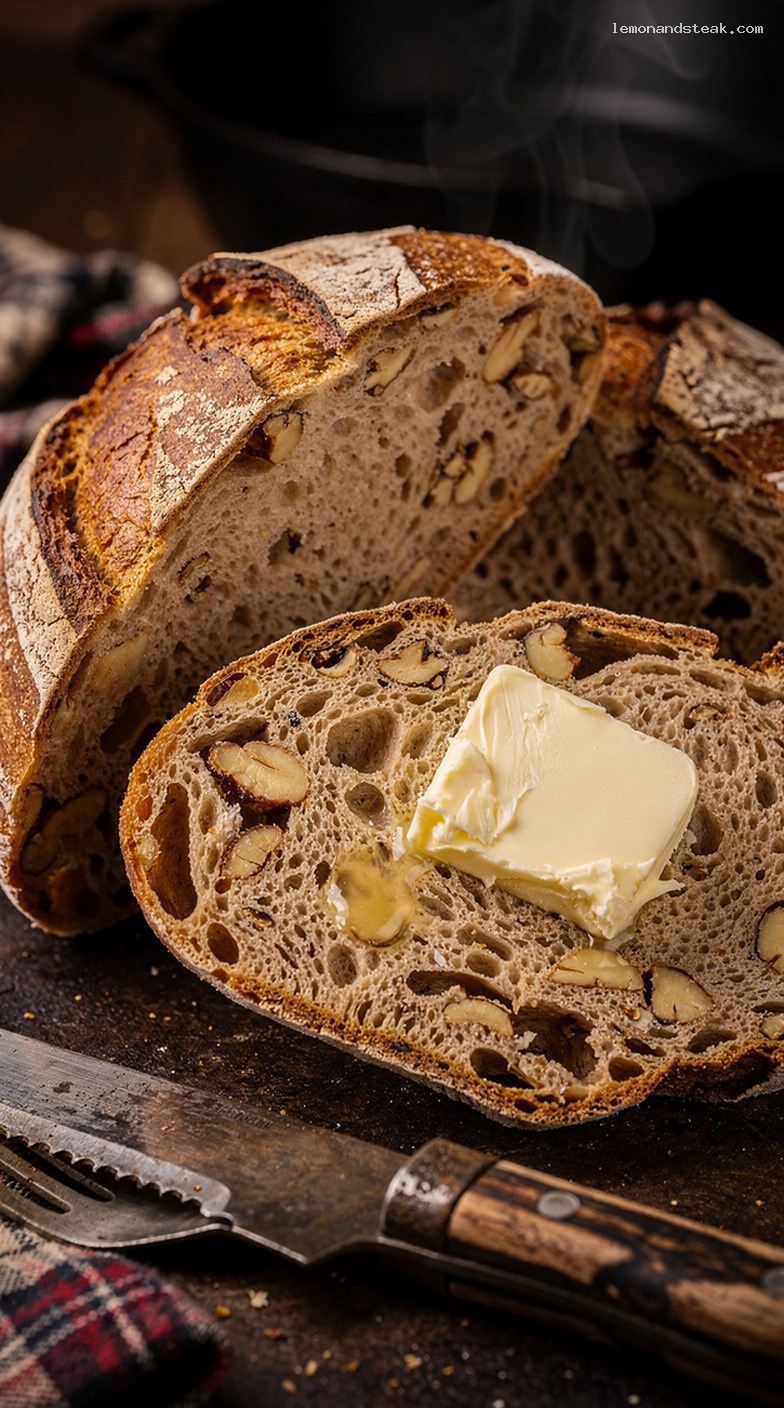
Step-by-Step Instructions
Step 1: Prep the chestnuts and set up your bowl
Roughly chop 150 g cooked, peeled chestnuts into bite-size pieces (think: pea to almond size). If they seem moist or sticky, toss them with 1 tbsp bread flour (optional) to help distribute them through the dough.
Lightly grease a large bowl with a tiny bit of olive oil or butter (optional). Set aside.
Step 2: Mix the first dough and let it rest (quick autolyse)
In a large mixing bowl, whisk together:
- 300 g bread flour
- 100 g chestnut flour
- 7 g instant yeast
Add 320 g warm water (38–40°C / 100–104°F) and 20 g honey. Stir with a sturdy spoon (or your hand) until no dry flour remains. The dough will look shaggy and slightly sticky.
Cover the bowl and let the dough rest for 20 minutes. This short rest helps the flour hydrate and makes kneading easier.
Step 3: Add salt and oil, then knead until smooth
Sprinkle 10 g fine sea salt over the dough and drizzle in 14 g olive oil. Knead until the dough becomes smoother and more elastic, 8–10 minutes by hand on a lightly floured surface (or 6–8 minutes with a stand mixer on medium-low using a dough hook).
The dough should feel pliable and springy. It may remain slightly tacky because chestnut flour behaves differently than wheat flour, but it should hold its shape.
Step 4: Knead in the chestnuts (and rosemary, if using)
Flatten the dough gently into a rough rectangle. Scatter the chopped chestnuts (and 1 tsp chopped fresh rosemary if using) over the dough. Fold the dough over itself and knead just until the chestnuts are evenly distributed, about 1–2 minutes.
If a few chestnut pieces pop out, just press them back in—totally normal.
Step 5: First rise (bulk fermentation)
Place the dough in your greased bowl, turning once so the top is lightly coated. Cover and let rise at warm room temperature (about 24°C / 75°F) until doubled in size, 75–90 minutes.
How to tell it’s ready: the dough should look noticeably puffier, and a lightly floured finger pressed into the dough should leave an indentation that slowly springs back.
Step 6: Shape the loaf and proof
Turn the dough onto a lightly floured surface. Gently press into a round to release large bubbles, then shape into a tight boule (round loaf) by folding the edges toward the center and turning seam-side down. Cup your hands around the dough and rotate it to build surface tension.
Place the loaf seam-side down on a piece of parchment paper. Lightly dust the top with bread flour. Cover loosely and proof until slightly puffy, 45–60 minutes.
Step 7: Preheat the oven and Dutch oven
About 30 minutes before baking, place a heavy Dutch oven with its lid on the middle rack and preheat the oven to 232°C / 450°F.
This preheat is important: the hot pot helps the loaf spring up quickly and develop a bold crust.
Step 8: Score and bake (covered, then uncovered)
Carefully remove the hot Dutch oven (use good oven mitts). Lift the loaf in by the parchment. Score the top with a sharp blade: one long slash about 1 cm (1/2 inch) deep, or a simple cross pattern.
Cover with the lid and bake at 232°C / 450°F for 25 minutes. Then remove the lid, reduce the oven temperature to 218°C / 425°F, and bake 15 minutes more.
The bread is done when the crust is deep golden brown and the internal temperature reaches 96°C / 205°F (measured in the center with an instant-read thermometer).
Step 9: Cool fully for the best texture
Transfer the loaf to a wire rack and cool for at least 60 minutes before slicing. This cooling time finishes the crumb structure; slicing too early can make the inside gummy.
Pro Tips
- Weigh the flours if you can: Chestnut flour varies a lot by brand; a scale gives the most consistent dough.
- Don’t over-flour the dough: A slightly tacky dough bakes up more tender. Dust your hands and surface lightly as needed.
- Keep chestnut pieces moderate in size: Large chunks can create weak spots that make the loaf harder to slice cleanly.
- Use the thermometer: Aim for 96°C / 205°F internally so the crumb sets and the loaf stays sliceable.
- Let the flavor deepen: If you have time, a slower rise in the fridge (see Storage & Make-Ahead) makes the bread even more aromatic.
Variations
- Chestnut-walnut loaf: Replace 50 g of the chestnuts with 50 g chopped walnuts for extra crunch and a slightly bitter edge that balances the sweetness.
- Savory herb version: Add 1 tsp chopped rosemary plus 1/2 tsp cracked black pepper to lean into the rustic, woodsy vibe.
- Honey-free: Omit the honey and add 10 g (2 tsp) extra water. The chestnut flour still gives gentle sweetness.
Storage & Make-Ahead
Room temperature: Store the fully cooled loaf wrapped in parchment or in a paper bag inside a bread box for up to 2 days. For a crisper crust, avoid airtight plastic at room temp.
Freeze: Slice the loaf, then freeze slices in a sealed bag for up to 2 months. Toast from frozen for best texture.
Make-ahead (overnight proof): After shaping (Step 6), cover and refrigerate for 8–12 hours. Bake straight from the fridge (you may need an extra 3–5 minutes uncovered at the end).
Nutrition (per serving)
Approximate per slice (1/10 loaf): 210 calories, 3 g fat, 40 g carbohydrates, 6 g protein, 3 g fiber, 3 g sugar, 380 mg sodium.
Leave a Reply