
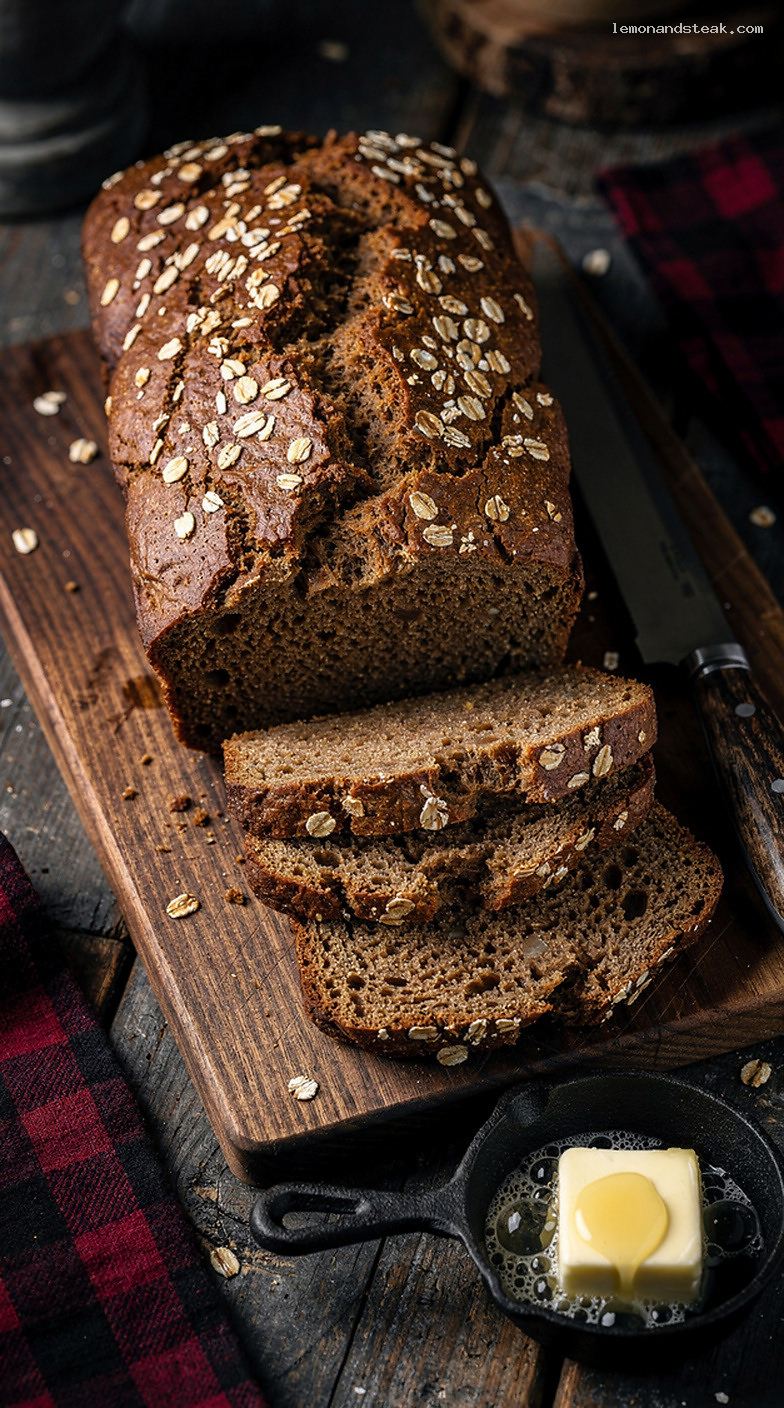
Quick Recipe Version (TL;DR)
Quick Ingredients
- 1 cup (90 g) old-fashioned rolled oats
- 1 cup (240 g) boiling water
- 1/4 cup (85 g) unsulphured molasses
- 2 tbsp (28 g) unsalted butter
- 3/4 cup (180 g) whole milk, warmed to 105–110°F (40–43°C)
- 2 1/4 tsp (7 g) active dry yeast
- 3 1/2 cups (420 g) bread flour
- 1/2 cup (60 g) whole wheat flour
- 1 1/2 tsp (9 g) fine sea salt
- 1 tbsp neutral oil for bowl/pan
- 1 tbsp melted butter + 1 tbsp rolled oats (optional finish)
Do This
- 1. Pour boiling water over oats; stir in molasses and butter. Cool to 105–110°F (about 15 minutes).
- 2. Stir in warm milk, then yeast; rest 5 minutes until slightly foamy.
- 3. Mix in flours and salt; knead 8–10 minutes until smooth and slightly tacky.
- 4. Rise covered in an oiled bowl until doubled, 60–90 minutes.
- 5. Shape into a loaf; proof in a greased 9 x 5-inch pan until dough crowns 1 inch above rim, 45–60 minutes.
- 6. Bake at 350°F (177°C) for 40–45 minutes to 195–200°F (90–93°C) internal.
- 7. Brush with melted butter, sprinkle oats, cool 2 hours before slicing.
Why You’ll Love This Recipe
- Old-fashioned flavor: Molasses brings a gentle sweetness and deep, toasty notes without being dessert-sweet.
- Moist, tender crumb: The oat soaker keeps the loaf soft for days.
- Great for everyday: Perfect for toast, sandwiches, or a thick slice with butter.
- Home-bakery vibe: Your kitchen will smell like a cozy, classic bread shop while it bakes.
Grocery List
- Produce: None (optional: 1 orange for zest)
- Dairy: Whole milk, unsalted butter
- Pantry: Old-fashioned rolled oats, unsulphured molasses, active dry yeast, bread flour, whole wheat flour, fine sea salt, neutral oil (canola/vegetable)
Full Ingredients
Oatmeal Molasses Soaker
- 1 cup (90 g) old-fashioned rolled oats
- 1 cup (240 g) boiling water
- 1/4 cup (85 g) unsulphured molasses
- 2 tbsp (28 g) unsalted butter
Yeast & Dough
- 3/4 cup (180 g) whole milk, warmed to 105–110°F (40–43°C)
- 2 1/4 tsp (7 g) active dry yeast
- 3 1/2 cups (420 g) bread flour, plus 1–3 tbsp (8–24 g) as needed for dusting
- 1/2 cup (60 g) whole wheat flour
- 1 1/2 tsp (9 g) fine sea salt
For the Pan & Finish (Optional, but Lovely)
- 1 tbsp neutral oil (for greasing the bowl and pan)
- 1 tbsp (14 g) unsalted butter, melted (for brushing after baking)
- 1 tbsp rolled oats (for sprinkling on top)
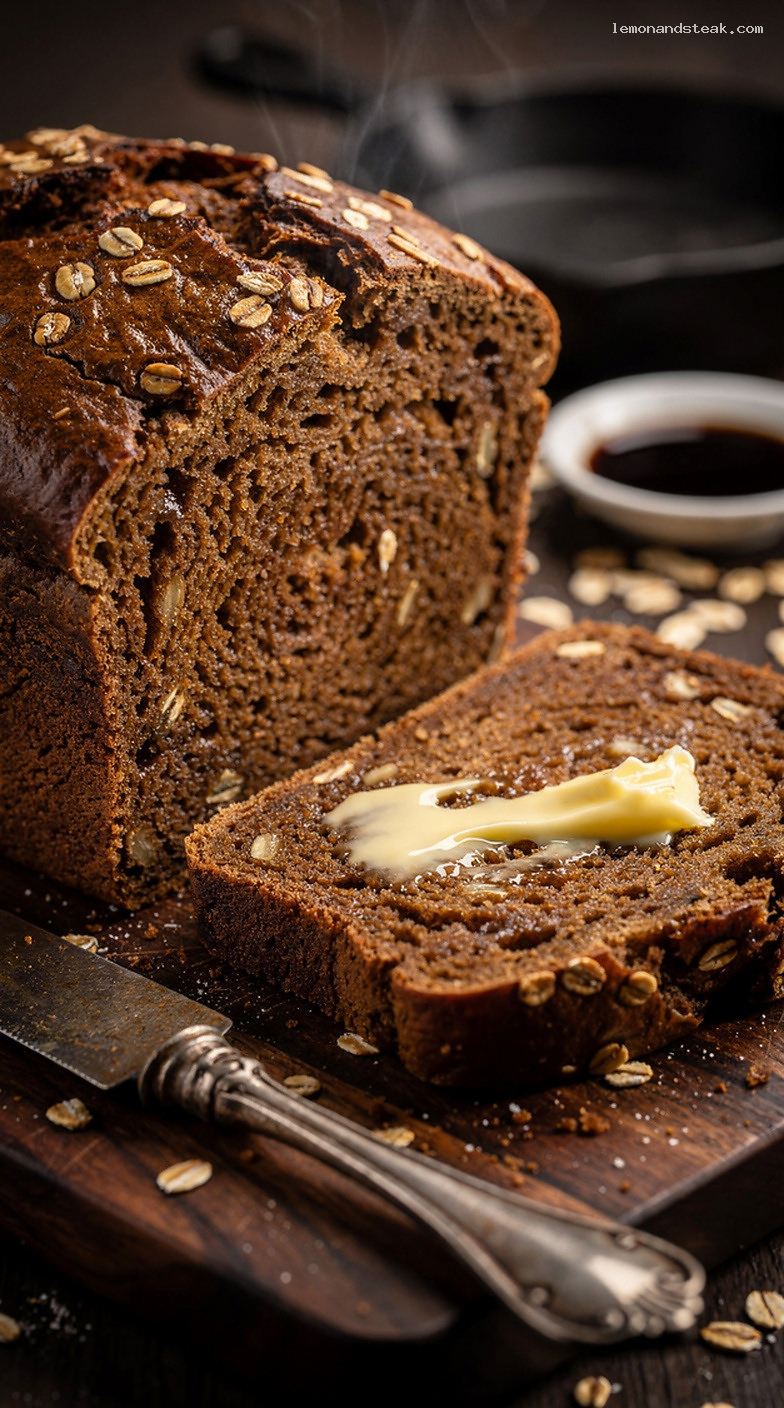
Step-by-Step Instructions
Step 1: Make the oat soaker and cool it down
Place the rolled oats in a large mixing bowl. Pour the 1 cup (240 g) boiling water over the oats and stir well.
Immediately stir in the 1/4 cup (85 g) molasses and 2 tbsp (28 g) butter until the butter melts. Let the mixture sit until it cools to 105–110°F (40–43°C), about 15 minutes. (If it’s hotter, it can weaken or kill the yeast.)
Step 2: Activate the yeast
Stir the 3/4 cup (180 g) warm milk into the cooled oat mixture. Sprinkle the 2 1/4 tsp (7 g) active dry yeast over the top and stir to combine.
Let stand for 5 minutes. You’re looking for a slightly foamy, creamy surface. (If nothing happens, your yeast may be old or the mixture may have been too hot or too cold.)
Step 3: Mix the dough
Add the 3 1/2 cups (420 g) bread flour, 1/2 cup (60 g) whole wheat flour, and 1 1/2 tsp (9 g) salt. Stir with a sturdy spoon until a shaggy dough forms.
If the dough looks very wet and won’t come together, add additional bread flour 1 tbsp (8 g) at a time just until it becomes workable. The dough should feel soft and slightly tacky, not dry.
Step 4: Knead until smooth and springy
Turn the dough out onto a lightly floured surface and knead for 8–10 minutes (or knead in a stand mixer with a dough hook on medium-low for 6–8 minutes).
The dough is ready when it looks smoother, feels elastic, and springs back slowly when you press it. Because of the oats and molasses, it may stay a bit tacky; avoid adding lots of extra flour unless it’s truly sticking to everything.
Step 5: First rise (bulk fermentation)
Lightly grease a large bowl with a little of the 1 tbsp neutral oil. Place the dough in the bowl and turn it once so the top is lightly oiled. Cover tightly.
Let rise in a warm spot until doubled in size, 60–90 minutes (aim for about 75–78°F / 24–26°C for the most predictable timing).
Step 6: Shape the loaf and proof in the pan
Grease a 9 x 5-inch (23 x 13 cm) loaf pan with the remaining oil (or use a little butter). Turn the risen dough out onto a lightly floured surface and gently press it into a rectangle about the width of your loaf pan.
Roll it up tightly into a log, pinch the seam closed, and tuck the ends under. Place seam-side down in the prepared pan and gently press to even it out.
Cover and let proof until the dough has risen to about 1 inch (2.5 cm) above the rim, 45–60 minutes.
Step 7: Bake, finish, and cool before slicing
When the loaf is close to ready, preheat the oven to 350°F (177°C).
Bake for 40–45 minutes, until the top is deep brown and the internal temperature in the center reads 195–200°F (90–93°C). If the top is getting too dark near the end, tent loosely with foil for the last 10 minutes.
Remove from the pan after 10 minutes and transfer to a wire rack. Brush the top with 1 tbsp melted butter and sprinkle with 1 tbsp oats if you like.
Let the loaf cool for 2 hours before slicing so the crumb sets and stays moist instead of gummy.
Pro Tips
- Cool the oat mixture properly: Yeast is happiest around 105–110°F (40–43°C). Too hot and the rise will suffer; too cool and it will be slow.
- Expect a darker crust: Molasses naturally bakes up deep brown. Use the internal temperature (195–200°F) as your doneness guide.
- Don’t over-flour the dough: A slightly tacky dough makes a more tender loaf. Add flour only as needed for handling.
- Proof by the look, not the clock: The loaf is ready to bake when it crowns about 1 inch over the pan and springs back slowly when gently pressed.
- Slice cleanly: For neat slices, use a serrated bread knife and let the bread cool fully.
Variations
- Seeded molasses oat bread: Add 2 tbsp sunflower seeds and 1 tbsp flaxseed with the flour. Sprinkle more on top before baking.
- Brown-bread style loaf: Replace 1/4 cup (30 g) of the bread flour with 1/4 cup (30 g) rye flour for a deeper, earthier flavor.
- Oat-topped shine: Before baking, brush the loaf with 1 tbsp milk and press on 2 tbsp oats for a thicker oat crust (skip the post-bake butter if you prefer).
Storage & Make-Ahead
Cool completely, then store the loaf tightly wrapped at room temperature for 3 days. For longer storage, slice the cooled bread and freeze in a freezer bag for up to 2 months. Toast slices straight from frozen.
Make-ahead option: After shaping and placing in the loaf pan, cover tightly and refrigerate for up to 12 hours. Bring to room temperature until the dough crowns about 1 inch above the rim (often 60–120 minutes, depending on your kitchen), then bake as directed.
Nutrition (per serving)
Approximate per slice (1 of 12): 190 calories, 4 g protein, 34 g carbs, 4 g fat, 3 g fiber, 10 g sugar, 300 mg sodium. (Values vary by brand and exact slice size.)
Leave a Reply