
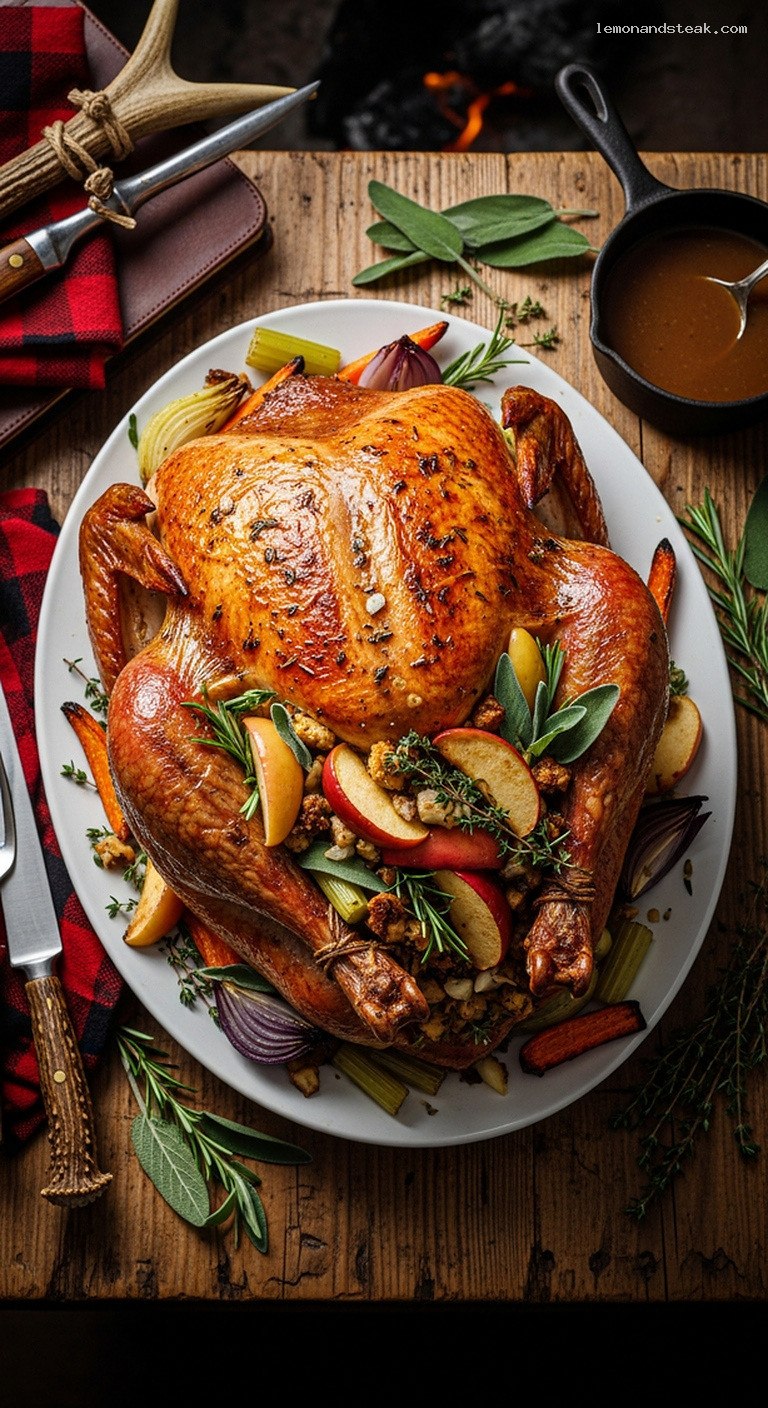
Quick Recipe Version (TL;DR)
Quick Ingredients
- 1 whole turkey (11 to 13 lb), thawed
- 2 tbsp kosher salt; 2 tsp black pepper
- 8 tbsp (1 stick) unsalted butter, softened
- 2 tbsp olive oil
- 2 medium apples, cored and quartered
- 2 medium yellow onions, peeled and quartered
- 5 celery stalks (3 for stuffing, 2 for pan)
- 1 small lemon, halved (optional)
- 6 garlic cloves, lightly crushed
- Fresh herbs: thyme, rosemary, sage, parsley (about 12 to 15 sprigs total)
- 2 carrots, chopped (for roasting pan)
- 2 cups low-sodium chicken or turkey broth (plus more for gravy)
- 4 tbsp all-purpose flour (for simple gravy, optional)
Do This
- 1. Pat turkey very dry; remove giblets. Season all over (and under skin on breasts) with salt and pepper. Optional: refrigerate uncovered up to 24 hours.
- 2. Preheat oven to 425°F. Mix softened butter with chopped fresh herbs. Rub herb butter under breast skin and over the turkey; drizzle with olive oil.
- 3. Stuff cavity loosely with apples, onions, celery, lemon, garlic, and herb sprigs. Tie legs together; tuck wing tips under.
- 4. Scatter remaining onions, celery, and carrots in roasting pan. Pour in 2 cups broth. Place turkey breast-side up on a rack over the vegetables.
- 5. Roast at 425°F for 30 minutes, then reduce oven to 325°F. Roast 2 hours 45 minutes more, basting occasionally, until thigh reaches 175°F and breast 160°F.
- 6. Transfer turkey to a board and tent loosely with foil. Rest 30 minutes before carving so juices redistribute.
- 7. For quick gravy, skim fat from drippings, whisk 4 tbsp fat with 4 tbsp flour, then whisk in 2 to 3 cups broth and pan juices; simmer until thickened.
Why You’ll Love This Recipe
- The cavity is filled with apples, onion, celery, and fresh herbs, which gently perfume the meat and add natural sweetness instead of heavy bread stuffing.
- Simple, straightforward steps designed for home cooks, with clear oven temperatures and timing cues.
- Herb butter under the skin keeps the breast moist and gives the skin deep golden color and rich flavor.
- Makes its own flavorful pan drippings, perfect for an easy, homestyle gravy.
Grocery List
- Produce: Apples, yellow onions, celery, carrots, lemon, garlic, fresh thyme, fresh rosemary, fresh sage, fresh parsley.
- Dairy: Unsalted butter.
- Pantry: Whole turkey (11 to 13 lb), kosher salt, black pepper, olive oil, low-sodium chicken or turkey broth, all-purpose flour.
Full Ingredients
For the Turkey
- 1 whole turkey, 11 to 13 lb, completely thawed, neck and giblets removed
- 2 tbsp kosher salt (use 3 tbsp if your turkey is closer to 13 lb and not pre-brined)
- 2 tsp freshly ground black pepper
- 8 tbsp (1 stick) unsalted butter, softened to room temperature
- 2 tbsp olive oil
For the Apple–Onion–Celery Aromatic Stuffing (for the Cavity)
- 2 medium firm-sweet apples (such as Honeycrisp or Gala), cored and cut into thick wedges or quarters
- 2 medium yellow onions, peeled and quartered
- 3 celery stalks, cut into 2 to 3 inch lengths
- 1 small lemon, halved (optional, for gentle brightness)
- 6 garlic cloves, peeled and lightly crushed
- 6 fresh thyme sprigs
- 4 fresh rosemary sprigs
- 6 fresh sage leaves
- 1 small handful fresh parsley sprigs
For the Roasting Pan and Basting
- 2 medium carrots, cut into large chunks
- 2 additional celery stalks, cut into large chunks
- 1 medium onion, cut into wedges
- 2 cups low-sodium chicken or turkey broth (plus extra as needed to prevent scorching)
- Additional fresh herb sprigs (thyme, rosemary, sage, parsley), optional but nice for extra aroma and garnish
For the Optional Simple Pan Gravy
- 4 tbsp fat skimmed from the turkey drippings (or unsalted butter)
- 4 tbsp all-purpose flour
- 2 to 3 cups low-sodium chicken or turkey broth (and strained turkey drippings), warmed
- Kosher salt and freshly ground black pepper, to taste
Step-by-Step Instructions
Step 1: Thaw and Pre-Salt the Turkey
If your turkey is frozen, thaw it in the refrigerator in its packaging. Plan on about 24 hours of thawing time for every 4 to 5 pounds of turkey; for a 12-pound bird, this usually means about 3 days in the fridge. Once thawed, remove any packaging, the neck, and the bag of giblets from the cavity. Pat the turkey very dry inside and out with paper towels; dry skin is key to beautiful browning.
Sprinkle the turkey all over with the kosher salt and black pepper, including a light sprinkle inside the cavity. For the juiciest meat and best flavor, place the seasoned turkey uncovered on a rimmed tray in the refrigerator for at least 2 hours and up to 24 hours. This “dry brine” time is optional but highly recommended. When ready to roast, let the turkey sit at room temperature for about 45 minutes while you prepare the aromatics and preheat the oven.
Step 2: Prepare the Aromatics and Herb Butter
Preheat your oven to 425°F. Position a rack in the lower third of the oven so the turkey will sit roughly in the center once placed inside.
Prepare the aromatic stuffing: core and cut the apples into thick wedges or quarters; peel and quarter the onions; cut 3 celery stalks into 2 to 3 inch pieces; halve the lemon (if using); lightly crush the garlic cloves. Keep the fresh herb sprigs whole.
In a small bowl, mash together the softened butter with 1 tbsp finely chopped fresh herbs (you can use a mix of thyme, rosemary, sage, and parsley). This creates an herb butter that will melt into the meat while roasting. Set aside. If your butter is very soft, it will spread more easily under the skin.
Step 3: Stuff the Cavity and Season the Turkey
Set the turkey breast-side up on a roasting rack placed inside a large roasting pan. If you do not have a rack, you can lay the turkey directly on top of a thick bed of the carrots, onions, and celery in the pan.
Gently loosen the skin over the breast meat by sliding your fingers under the skin from the cavity end, being careful not to tear it. Spread about half of the herb butter directly onto the breast meat under the skin, then smooth the skin back in place. Rub the remaining herb butter over the top of the turkey: breast, legs, and thighs. Drizzle the olive oil over the skin and rub again to coat; this helps the skin crisp and take on a rich golden color.
Loosely fill the main cavity (do not pack it tight) with the apples, onion chunks, some of the celery pieces, the lemon halves (if using), garlic cloves, and a generous handful of herb sprigs. You may not need all of the aromatics; you want the cavity comfortably full but not crammed, so the hot air can still circulate. Tie the legs together with kitchen twine and tuck the wing tips under the body to prevent burning.
Step 4: Prepare the Roasting Pan Base
Scatter the remaining carrots, celery, and onion in the bottom of the roasting pan around and under the rack. These vegetables, along with the drippings, will flavor the pan juices and help prevent burning. Add a few extra herb sprigs if you like for boosted aroma.
Pour 2 cups of broth into the pan. You want about 1/4 inch of liquid in the bottom; this will steam gently at first, then turn into deeply flavored drippings as the turkey roasts. Avoid pouring the broth directly over the turkey so you do not wash off the butter.
Step 5: Start Roasting at High Heat
Place the turkey in the preheated 425°F oven. Roast for 30 minutes to help the skin start browning and the fat begin to render. During this stage, do not open the oven door more than necessary; you want that initial blast of high heat to do its work.
After 30 minutes, reduce the oven temperature to 325°F without opening the door, if possible. Continue roasting at 325°F until the turkey is cooked through, basting every 30 to 40 minutes with the pan juices. If the pan starts to dry out or the vegetables look like they are scorching, add another 1/2 to 1 cup of broth or water to keep a thin layer of liquid in the bottom.
Step 6: Finish Roasting and Check for Doneness
Plan on a total roasting time of about 13 to 15 minutes per pound at 325°F after the initial high-heat phase. For an 11 to 13 lb turkey, this is usually around 3 hours to 3 hours 15 minutes in total, including the first 30 minutes at 425°F. Begin checking the internal temperature after about 2 hours at 325°F so you do not overcook it.
Use an instant-read thermometer inserted into the thickest part of the thigh, without touching bone. The thigh should register about 175°F, and the thickest part of the breast should reach 160°F. If the breast is browning too quickly before it comes to temperature, loosely tent it with a piece of foil to protect the skin while the legs finish cooking. When the turkey is done, carefully lift it out of the pan and transfer it to a large cutting board or serving platter.
Step 7: Rest, Carve, and Make Simple Gravy
Tent the turkey loosely with foil and let it rest for at least 30 minutes and up to 45 minutes. This resting time lets the juices redistribute so the meat stays moist when carved. While the turkey rests, you can make a simple pan gravy.
For the gravy, pour the drippings and vegetables from the roasting pan through a fine-mesh strainer into a heatproof bowl. Press on the vegetables to extract as much flavor as possible, then discard them. Let the liquid stand for a few minutes so the fat rises to the top. Skim off 4 tbsp of the fat and add it to a medium saucepan (if you do not have enough fat, add butter to make up the difference). Whisk in 4 tbsp flour and cook over medium heat for 2 to 3 minutes, whisking constantly, until the mixture turns pale golden and smells nutty.
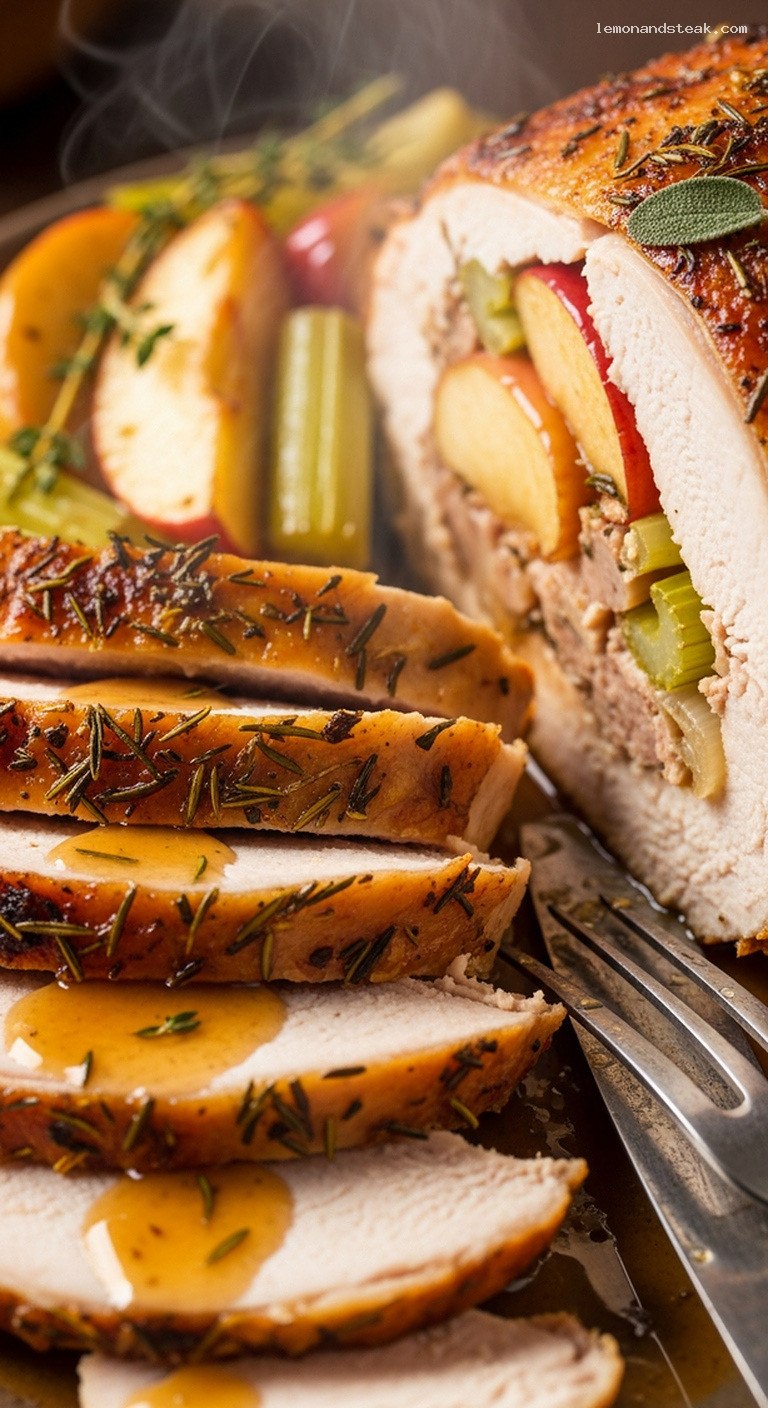
Slowly whisk in 2 to 3 cups of warm broth plus the remaining defatted pan juices, starting with 2 cups and adding more if you like a thinner gravy. Simmer for 5 to 10 minutes, whisking often, until smooth and thickened. Season to taste with salt and pepper. Carve the turkey, spoon some of the naturally sweet apple-onion-celery aromatics from the cavity onto the platter for a rustic presentation, and serve with the warm gravy.
Pro Tips
- Dry the skin thoroughly: Moisture is the enemy of crisp skin. Pat the turkey very dry before salting and again before adding the butter and oil.
- Do not over-stuff the cavity: Pack the apples, onion, celery, and herbs loosely so hot air can circulate; this keeps the cooking time reasonable and ensures even roasting.
- Use a thermometer, not just the clock: Every oven and turkey is different. Rely on internal temperatures (175°F thigh, 160°F breast) for perfectly cooked meat.
- Rotate if your oven has hot spots: If one side is browning faster, rotate the pan halfway through roasting for more even color.
- Let it rest: That 30-minute rest is not optional if you want juicy slices; cutting too soon will cause the juices to run out onto the board.
Variations
- Citrus-Herb Turkey: Replace one apple with an orange and add the orange wedges to the cavity along with the lemon. Use extra fresh parsley and thyme in the herb butter for a brighter, more citrusy aroma.
- Maple-Glazed Finish: During the last 20 minutes of roasting, brush the skin with a mixture of 3 tbsp pure maple syrup and 1 tbsp melted butter for a glossy, slightly sweet glaze that complements the apples.
- Garlic and White Wine Pan Juices: Add an extra 4 to 6 crushed garlic cloves and replace 1 cup of the broth in the roasting pan with dry white wine for deeper, more savory drippings and gravy.
Storage & Make-Ahead
Refrigerate leftover turkey within 2 hours of serving. Slice the meat off the bone for easier storage and cooling, and place it in airtight containers. It will keep in the refrigerator for up to 4 days. To reheat, add a splash of broth and cover, then warm gently in a 300°F oven or on the stovetop over low heat until just heated through.
You can make several components ahead: dry-brine the turkey (salted, uncovered in the refrigerator) up to 24 hours before roasting. Chop the vegetables and herbs up to 1 day in advance and store them in airtight containers in the fridge. Gravy can be made a day ahead using store-bought broth, then reheated and loosened with a bit of pan drippings on the day you roast the turkey.
Nutrition (per serving)
Approximate values for 1 serving (about 6 oz roasted turkey with skin and a small amount of gravy): 380 calories; 22 g protein; 18 g fat; 7 g saturated fat; 10 g carbohydrates; 1 g fiber; 3 g sugars; 780 mg sodium. Actual values will vary depending on the exact size of the turkey, amount of skin consumed, and how much gravy is used.
Leave a Reply