
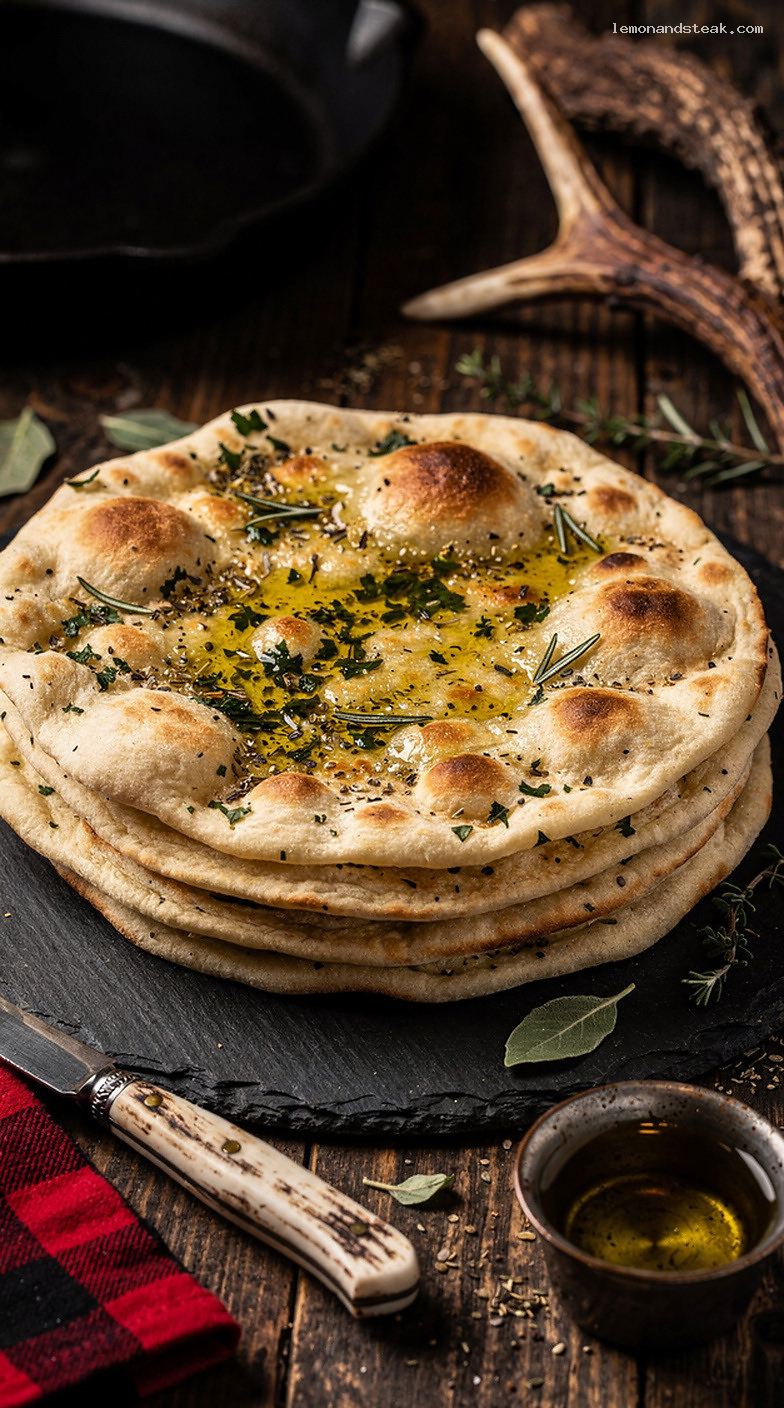
Quick Recipe Version (TL;DR)
Quick Ingredients
- 2 1/4 tsp active dry yeast
- 1 tsp granulated sugar
- 3/4 cup (180 g) warm water (105–110°F / 40–43°C)
- 2 1/2 cups (300 g) all-purpose flour
- 1 tsp fine sea salt
- 1 1/2 tbsp (22 ml) extra-virgin olive oil (in the dough)
- 1 tbsp finely chopped fresh parsley
- 1 tsp finely chopped fresh rosemary
- 1 tsp dried oregano
- 1 tsp dried thyme
- 2 tbsp extra-virgin olive oil (for brushing)
Do This
- 1) Bloom yeast with sugar in warm water for 5–10 minutes until foamy.
- 2) Mix flour, salt, and herbs; stir in yeast mixture and olive oil.
- 3) Knead 6–8 minutes until smooth; cover and rise 60 minutes (until doubled).
- 4) Divide into 8 pieces; rest 10 minutes.
- 5) Roll each into a thin 7–8 inch round (about 1/8 inch thick).
- 6) Cook in a dry, hot cast-iron skillet over medium-high heat, 60–90 seconds per side.
- 7) Brush warm flatbreads with olive oil; serve for dipping or wrapping.
Why You’ll Love This Recipe
- Soft and flexible: Thin enough to wrap, tender enough to tear and dip.
- Big herb flavor: Mixed herbs are kneaded right into the dough for aroma in every bite.
- No oven required: A hot skillet gives you quick, toasty blisters in minutes.
- Great with everything: Pair with soups, stews, hummus, or use as a quick sandwich wrap.
Grocery List
- Produce: fresh parsley, fresh rosemary (optional: extra herbs for serving)
- Dairy: none
- Pantry: all-purpose flour, active dry yeast, granulated sugar, fine sea salt, extra-virgin olive oil, dried oregano, dried thyme
Full Ingredients
Dough
- 2 1/4 tsp (7 g) active dry yeast
- 1 tsp (4 g) granulated sugar
- 3/4 cup (180 g) warm water, 105–110°F (40–43°C)
- 2 1/2 cups (300 g) all-purpose flour, plus more for rolling
- 1 tsp (6 g) fine sea salt
- 1 1/2 tbsp (22 ml) extra-virgin olive oil
Herbs (mixed into the dough)
- 1 tbsp finely chopped fresh parsley
- 1 tsp finely chopped fresh rosemary
- 1 tsp dried oregano
- 1 tsp dried thyme
For Cooking and Finishing
- 1–2 tbsp all-purpose flour (for rolling and preventing sticking)
- 2 tbsp (30 ml) extra-virgin olive oil (for brushing the warm flatbreads)
Step-by-Step Instructions
Step 1: Activate the yeast
In a medium bowl, stir together the warm water (105–110°F / 40–43°C) and sugar. Sprinkle the active dry yeast over the top and stir once. Let it stand for 5–10 minutes, until the surface looks foamy and bubbly.
If it does not foam, your water may have been too hot or too cool, or the yeast may be old. It’s worth starting over so the flatbreads rise properly.
Step 2: Mix the dough and herbs
In a large bowl, whisk together the flour, salt, fresh parsley, fresh rosemary, dried oregano, and dried thyme. Make a well in the center.
Pour in the foamy yeast mixture and add the 1 1/2 tbsp olive oil. Stir with a wooden spoon (or your hand) until a shaggy dough forms and most of the flour is incorporated.
Step 3: Knead until smooth
Turn the dough out onto a lightly floured surface. Knead for 6–8 minutes, until the dough becomes smooth, elastic, and only slightly tacky. If it’s very sticky, sprinkle on 1 tsp flour at a time (avoid adding too much or the flatbreads can turn dry).
Shape the dough into a ball.
Step 4: Let it rise
Lightly oil a clean bowl (a few drops of olive oil is enough). Place the dough inside and turn it once to coat. Cover tightly with a lid or plastic wrap.
Let rise at room temperature (about 70–75°F / 21–24°C) for 60 minutes, or until doubled in size.
Step 5: Divide and rest the dough
Turn the risen dough out onto a work surface. Divide into 8 equal pieces (about 65–70 g each if you’re using a scale). Roll each piece into a tight ball.
Cover the dough balls with a clean kitchen towel and let them rest for 10 minutes. This relaxes the gluten and makes rolling much easier.
Step 6: Roll into thin rounds
Working with one dough ball at a time (keep the others covered), lightly flour your surface and rolling pin. Roll into a thin round 7–8 inches (18–20 cm) wide, about 1/8 inch (3 mm) thick.
If the dough keeps shrinking back, let it rest for 2 more minutes, then roll again. Lightly dust off excess flour so it doesn’t burn in the skillet.
Step 7: Cook in a hot skillet
Heat a dry cast-iron skillet over medium-high heat for 2–3 minutes. The pan is ready when a drop of water sizzles and evaporates quickly.
Cook one flatbread at a time:
Place the rolled dough into the hot skillet and cook for 60–90 seconds on the first side, until you see bubbles and light golden-brown spots. Flip and cook for 45–75 seconds on the second side.
Transfer to a plate and immediately brush with a little of the extra-virgin olive oil. Stack the cooked flatbreads and cover loosely with a clean towel to keep them soft while you finish the rest.
Pro Tips
- Keep it thin for wraps: Roll to about 1/8 inch (3 mm) for a soft, flexible flatbread that folds without cracking.
- Use a hot, dry pan: Oil in the skillet can “fry” the surface and reduce blistering. Brush with olive oil after cooking for the best texture.
- Don’t overcook: Pull the flatbread when it has golden spots and a few blisters; cooking too long makes it brittle instead of soft.
- Cover as you go: Stacking and covering traps steam, keeping the flatbreads tender and easy to wrap.
- Adjust herbs to taste: Rosemary is potent; stick to 1 tsp finely chopped so it perfumes the bread without overwhelming it.
Variations
- Garlic-herb flatbread: Add 1/2 tsp garlic powder to the flour, or brush the hot breads with 2 tbsp olive oil mixed with 1 small grated garlic clove.
- Whole-wheat blend: Replace 3/4 cup (90 g) of the all-purpose flour with 3/4 cup (90 g) whole-wheat flour. Add 1 extra tbsp (15 g) water if the dough feels dry.
- Seeded topping: After rolling, lightly brush one side with water and sprinkle with 1 tbsp sesame seeds total (for all flatbreads). Cook seed-side down first.
Storage & Make-Ahead
Room temperature: Cool completely, then store in a sealed bag or container for up to 2 days. Re-warm in a dry skillet over medium heat for 20–30 seconds per side.
Refrigerator: Store tightly wrapped for up to 4 days. Warm before serving for the softest texture.
Freezer: Freeze flatbreads with parchment between them in a freezer bag for up to 2 months. Thaw at room temperature for 30–45 minutes, then warm in a skillet.
Make-ahead dough: After kneading, place dough in a lightly oiled bowl, cover, and refrigerate up to 24 hours. Bring to room temperature for 45–60 minutes before dividing and rolling.
Nutrition (per serving)
Approximate (per 1 flatbread, 1/8 of recipe): 170 calories, 4 g protein, 27 g carbohydrates, 5 g fat, 1 g saturated fat, 1 g fiber, 1 g sugar, 290 mg sodium.
Leave a Reply