
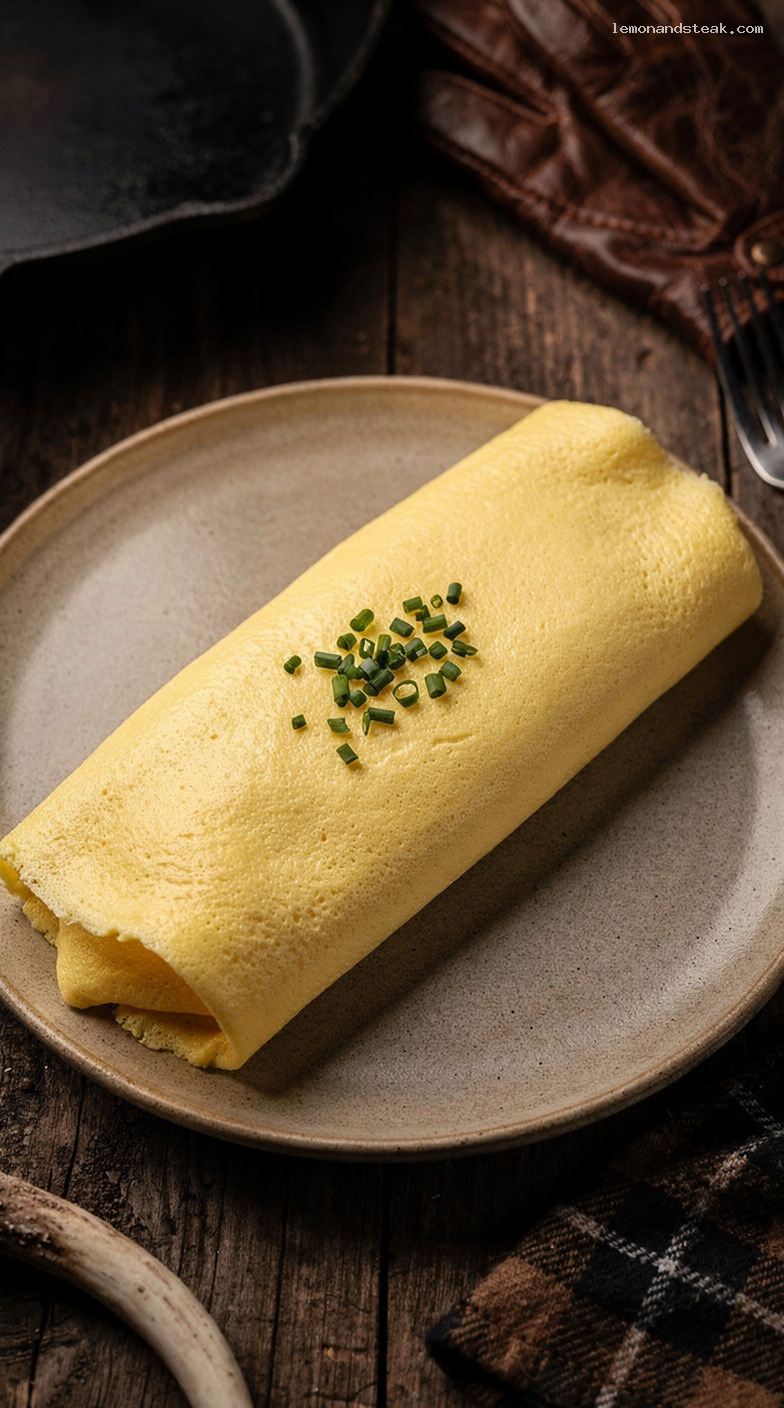
Quick Recipe Version (TL;DR)
Quick Ingredients
- 3 large eggs (about 150 g without shells)
- 1 teaspoon water
- 1/8 teaspoon fine salt
- 1/16 teaspoon white pepper (or a pinch of black pepper)
- 1 1/2 tablespoons unsalted butter, divided (21 g)
- 1 tablespoon finely sliced chives (optional, for serving)
Do This
- 1) Whisk eggs, water, salt, and pepper until fully blended and slightly foamy (about 20–30 seconds).
- 2) Heat an 8-inch nonstick skillet over medium-low for 30 seconds.
- 3) Add 1 tablespoon butter (14 g); swirl until melted and foaming, but not browned.
- 4) Pour in eggs; immediately stir briskly with a silicone spatula while shaking the pan for 20–30 seconds.
- 5) When small curds form, stop stirring; smooth the top and cook until mostly set but still glossy on top (30–60 seconds).
- 6) Add remaining 1/2 tablespoon butter (7 g) along the edge; roll/fold omelette into a pale, tender log.
- 7) Slide onto a warm plate seam-side down; rest 15 seconds; top with chives and serve immediately.
Why You’ll Love This Recipe
- Classic French technique that gives you a smooth, pale omelette with a soft, custardy interior.
- Fast: you can go from eggs to plated omelette in under 10 minutes.
- Simple ingredients, big payoff—butter, eggs, and gentle heat do all the work.
- Great “skill-builder” recipe that makes everyday breakfasts feel special.
Grocery List
- Produce: chives (optional)
- Dairy: large eggs, unsalted butter
- Pantry: fine salt, white pepper (or black pepper)
Full Ingredients
For the classic French omelette
- 3 large eggs (about 150 g without shells), preferably at room temperature
- 1 teaspoon water (5 mL)
- 1/8 teaspoon fine salt (about 0.75 g)
- 1/16 teaspoon white pepper (about 0.15 g), or a small pinch of black pepper
- 1 1/2 tablespoons unsalted butter (21 g), divided: 1 tablespoon (14 g) for the pan + 1/2 tablespoon (7 g) to finish
Optional finishing
- 1 tablespoon finely sliced chives (about 3 g)
- Extra pinch of salt, to taste
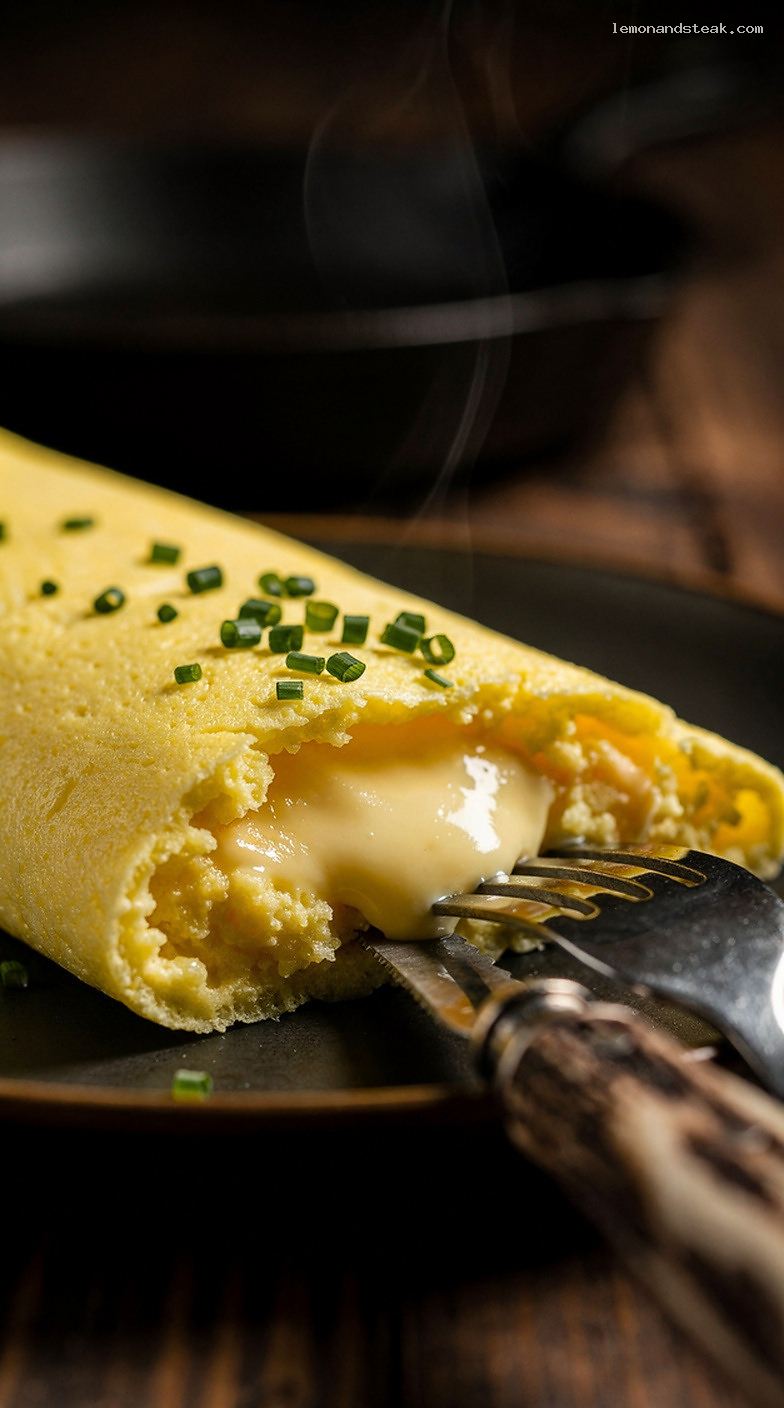
Step-by-Step Instructions
Step 1: Warm your serving plate
A French omelette cools quickly, so it helps to start with a warm plate. Warm a plate in a 200°F (95°C) oven for 5 minutes, or run it under very hot tap water, then dry thoroughly.
Step 2: Whisk the eggs just until unified
Crack 3 large eggs into a bowl. Add 1 teaspoon water, 1/8 teaspoon salt, and 1/16 teaspoon white pepper.
Whisk with a fork or whisk for 20–30 seconds, until the mixture is fully blended and lightly frothy on top. You want it homogeneous (no visible streaks of white), but not aggressively aerated.
Step 3: Preheat the pan gently
Set an 8-inch (20 cm) nonstick skillet over medium-low heat and preheat for 30 seconds.
The goal is gentle, even heat so the omelette stays pale—no browning.
Step 4: Melt butter until foaming (not browned)
Add 1 tablespoon (14 g) unsalted butter to the skillet. Swirl to coat the bottom and lower sides.
Let it melt until it’s fully liquid and foaming, 15–25 seconds. If the butter begins to color or smell nutty, the heat is too high—remove the pan from heat for a few seconds to cool slightly.
Step 5: Form small curds by stirring and shaking
Pour in the egg mixture. Immediately begin stirring briskly with a silicone spatula, while also gently shaking the pan back and forth.
Keep the spatula moving in small circles and short strokes, scraping the bottom as curds form.
Continue for about 20–30 seconds, until you see small, delicate curds throughout and the eggs start to thicken but are still quite soft.
This quick agitation is what gives the omelette its smooth, fine texture.
Step 6: Smooth the surface and cook until barely set
Stop stirring. Use the spatula to quickly smooth and even out the surface. Let the omelette cook undisturbed until it looks mostly set, but still slightly glossy and soft on top, 30–60 seconds.
You’re aiming for no browning and a tender interior. If you see any browning at the edges, lower the heat.
Step 7: Butter-finish, fold into a pale roll, and plate
Add the remaining 1/2 tablespoon (7 g) butter around the edge of the omelette and swirl the pan so it melts and slicks the surface.
To fold: tilt the pan slightly away from you. Use the spatula to fold the far edge toward the center, then fold again (or gently roll) toward the near edge, forming a tidy, pale log.
The exterior should look smooth and light yellow, with the inside still soft.
Slide onto the warm plate seam-side down. Rest 15 seconds so the interior settles into a custardy, tender texture. Top with 1 tablespoon chives if using, and serve immediately.
Pro Tips
- Use medium-low heat: A French omelette is meant to be pale. If you hear aggressive sizzling or see browning, lower the heat right away.
- Nonstick matters: This technique is much easier with a good 8-inch nonstick skillet and a flexible silicone spatula.
- Keep the motion going early: The quick stir-and-shake phase (first 20–30 seconds) creates fine curds and a smooth final texture.
- Finish while it’s still glossy: If it looks fully dry in the pan, it will be overcooked on the plate. Pull it when the top is just a little shiny.
- Warm plate, fast serve: The omelette keeps cooking from carryover heat; plating quickly helps keep the interior soft, not firm.
Variations
- Fines herbes omelette: Add 1 tablespoon mixed chopped chives, parsley, and tarragon to the eggs right before cooking for a classic French finish.
- Soft cheese center: Before the final fold, add 1 ounce (28 g) Boursin or goat cheese in a thin line down the middle, then roll gently.
- Simple ham and chive: Add 1 ounce (28 g) finely diced cooked ham just before folding; keep the amount small so the omelette still rolls smoothly.
Storage & Make-Ahead
This omelette is best eaten immediately for the signature smooth exterior and soft interior. If you must store it, cool for 10 minutes, then wrap tightly and refrigerate for up to 1 day. Rewarm gently in a nonstick skillet over low heat with a small pat of butter, about 1–2 minutes per side, just until warmed through (avoid browning). For make-ahead, you can pre-slice chives and measure the ingredients, but whisk and cook the eggs right before serving for the best texture.
Nutrition (per serving)
Approximate: 370 calories, protein 19 g, fat 33 g, carbohydrates 1 g, fiber 0 g, sugars 1 g, sodium 360 mg.
Leave a Reply