

Quick Recipe Version (TL;DR)
Quick Ingredients
- 4 English muffins, split (8 halves)
- 8 slices Canadian bacon (about 8 oz / 225 g)
- 8 large eggs
- 2 quarts (1.9 L) water + 1 tbsp distilled white vinegar (for poaching)
- Hollandaise: 3 large egg yolks, 1 tbsp water, 1 tbsp fresh lemon juice, 1/4 tsp kosher salt, pinch cayenne, 1 cup (226 g) unsalted butter (melted hot)
- Optional: 1 tbsp finely chopped chives, freshly ground black pepper
Do This
- 1) Melt 1 cup butter until hot (about 180–200°F / 82–93°C); keep warm.
- 2) Blend yolks + water + lemon + salt + cayenne for 15 seconds; slowly stream in hot butter to make hollandaise; keep warm.
- 3) Toast split English muffins until golden; keep warm in a 200°F (93°C) oven.
- 4) Brown Canadian bacon in a skillet over medium heat, 1–2 minutes per side; keep warm.
- 5) Poach eggs in barely simmering water (190–195°F / 88–90°C) with vinegar, 3 minutes; drain on paper towels.
- 6) Assemble: muffin + Canadian bacon + poached egg + hollandaise.
- 7) Finish with chives and black pepper; serve immediately.
Why You’ll Love This Recipe
- Classic brunch comfort food with restaurant-style results at home.
- Rich, buttery hollandaise balanced with bright lemon.
- Clear timing and a simple workflow so everything hits the table hot.
- Perfect for a special breakfast, holiday brunch, or “treat yourself” weekend.
Grocery List
- Produce: 1 lemon, optional chives
- Dairy: unsalted butter, eggs
- Bakery: English muffins
- Meat: Canadian bacon or ham slices
- Pantry: distilled white vinegar, kosher salt, cayenne pepper, black pepper
Full Ingredients
For the Hollandaise Sauce
- 1 cup (226 g) unsalted butter
- 3 large egg yolks
- 1 tbsp water
- 1 tbsp fresh lemon juice
- 1/4 tsp kosher salt
- Pinch cayenne pepper (about 1/16 tsp), plus more to taste
For the Eggs Benedict
- 4 English muffins, split (8 halves)
- 8 slices Canadian bacon (about 8 oz / 225 g) or 8 thin slices ham
- 8 large eggs (cold is fine)
- Optional garnish: 1 tbsp finely chopped chives
- Optional garnish: freshly ground black pepper, to taste
For Poaching the Eggs
- 2 quarts (1.9 L) water
- 1 tbsp distilled white vinegar
- Optional: 1 tsp kosher salt (some cooks skip salt in the poaching water; it’s optional)
Step-by-Step Instructions
Step 1: Set up your warming station
Preheat your oven to 200°F (93°C). Line a plate or small baking sheet with a clean kitchen towel or paper towel and set it in the oven. This is where you’ll hold toasted muffins, warmed Canadian bacon, and poached eggs briefly while you finish the sauce and assemble.
Tip: Eggs Benedict is all about timing. Keeping components warm (not hot) helps everything come together without stress.
Step 2: Melt the butter for hollandaise
In a small saucepan over medium-low heat, melt 1 cup (226 g) unsalted butter until fully liquefied and hot, about 3–5 minutes. You want it around 180–200°F (82–93°C): hot and steamy, but not aggressively boiling or browned.
Once melted, reduce the heat to the lowest setting to keep it warm, or pour into a heatproof measuring cup for easier pouring.
Step 3: Make the hollandaise (blender method)
Add 3 egg yolks, 1 tbsp water, 1 tbsp lemon juice, 1/4 tsp kosher salt, and a pinch of cayenne to a blender. Blend on low to medium speed for 15 seconds until smooth and slightly lighter.
With the blender running, slowly drizzle in the hot melted butter in a thin, steady stream. This should take about 45–90 seconds. The sauce should thicken and turn glossy and pale yellow.
Taste and adjust: add a tiny pinch more salt, cayenne, or a few drops of lemon juice if you want it brighter.
Hold warm: Pour hollandaise into a small bowl and set it over a warm-water bath (a larger bowl with about 1 inch of water at roughly 140°F (60°C)). Stir occasionally. Avoid overheating or the sauce can break.
Step 4: Toast the English muffins
Toast the 8 English muffin halves until golden and crisp around the edges (in a toaster, toaster oven, or under a broiler).
If using a broiler, set to high and toast cut-side up on a sheet pan for about 1–2 minutes—watch closely so they don’t burn.
Transfer toasted muffins to the warm plate in the 200°F (93°C) oven while you cook the bacon and eggs.
Step 5: Warm and brown the Canadian bacon (or ham)
Heat a skillet over medium heat. Add the Canadian bacon slices in a single layer. Cook for 1–2 minutes per side, just until lightly browned and warmed through.
If using ham, you can warm it for about 30–60 seconds per side (ham is usually thinner and warms faster).
Move the meat to the warm plate in the oven.
Step 6: Poach the eggs
Bring 2 quarts (1.9 L) water to a boil in a wide saucepan, then reduce heat until the water is at a bare simmer, about 190–195°F (88–90°C). You should see small bubbles occasionally breaking the surface, not a rolling boil.
Stir in 1 tbsp distilled white vinegar (and 1 tsp kosher salt if using). Crack each egg into a small bowl or ramekin.
Create a gentle whirlpool with a spoon, then slide in 1–2 eggs at a time (don’t overcrowd). Poach for 3 minutes for set whites and a runny yolk. For a slightly firmer yolk, go 3 1/2 minutes.
Lift eggs out with a slotted spoon and let them drain on paper towels for 10–15 seconds. Repeat with remaining eggs, keeping finished eggs warm on the towel-lined plate in the oven for just a few minutes while you finish the batch.
Step 7: Assemble and serve
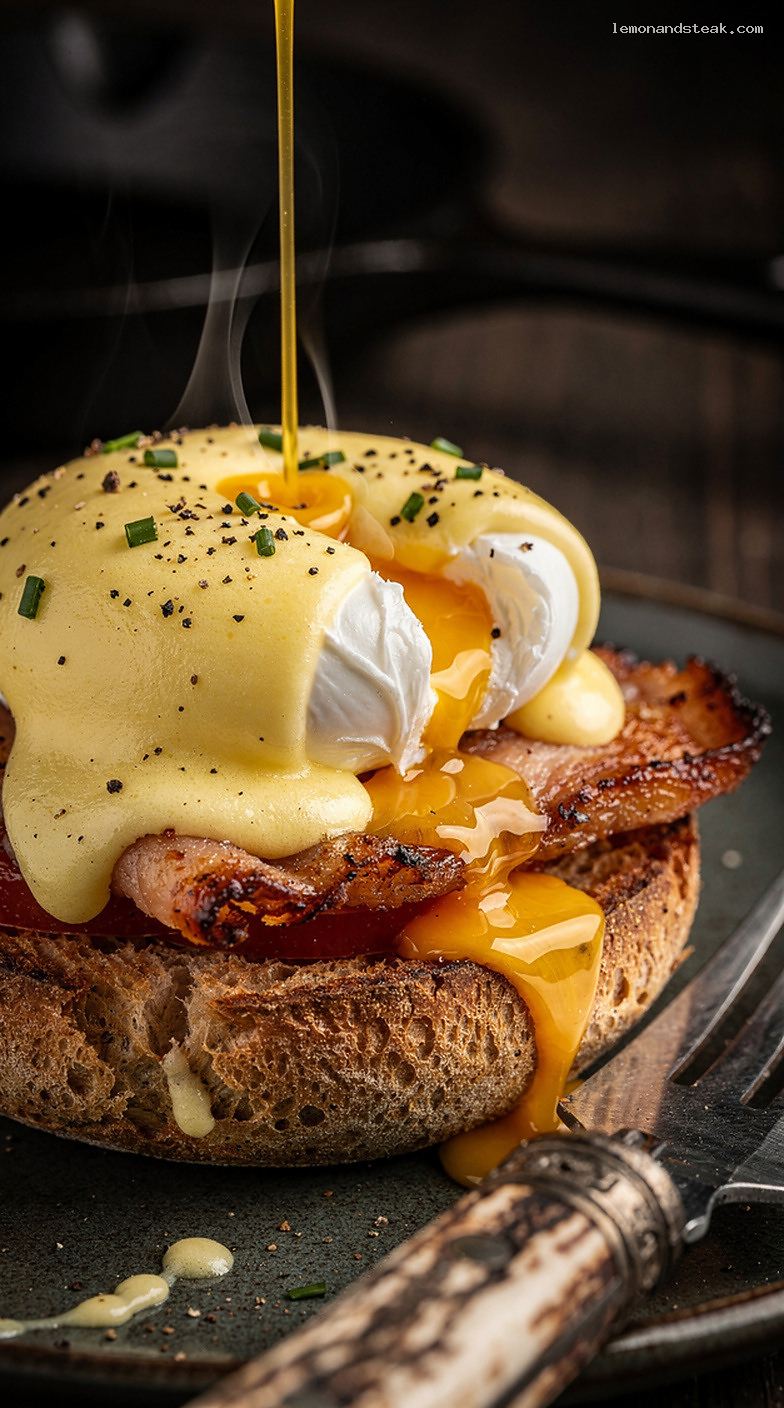
Place 2 toasted muffin halves on each plate. Top each half with a slice of Canadian bacon (or ham), then a poached egg. Spoon hollandaise generously over each egg (about 2–3 tbsp per egg, or to taste).
Finish with chopped chives and a few grinds of black pepper if you like. Serve immediately while everything is warm and the yolks are still soft.
Pro Tips
- Control the poaching temperature: Keep the water at 190–195°F (88–90°C). A hard boil will shred the whites and overcook the yolks.
- Strain for neater eggs: For super-clean poached eggs, crack each egg into a fine-mesh strainer for a few seconds to remove loose watery whites, then transfer to a ramekin before poaching.
- Fix a too-thick hollandaise: Blend in 1 tsp warm water at a time until it loosens to a pourable consistency.
- If hollandaise breaks: Start with 1 egg yolk + 1 tsp water in the blender and slowly drizzle the broken sauce in as if it were butter. It often re-emulsifies.
- Keep components warm, not hot: The oven at 200°F (93°C) is enough to hold food briefly without drying it out.
Variations
- Florentine: Swap Canadian bacon for sautéed spinach (cook spinach with a little butter, salt, and pepper; squeeze out excess moisture before stacking).
- Smoked salmon Benedict: Replace Canadian bacon with 4–8 oz (113–227 g) smoked salmon; add extra lemon and capers if you like.
- Spicy Benedict: Add a few dashes of hot sauce to the hollandaise or sprinkle with a pinch of cayenne on top.
Storage & Make-Ahead
Eggs Benedict is best eaten immediately. That said, you can make it less hectic with a little prep:
- Hollandaise: Best made fresh. You can hold it warm for up to 30–45 minutes in a warm-water bath around 140°F (60°C), stirring occasionally. Do not refrigerate and reheat expecting the same texture; it can separate.
- Canadian bacon/ham: Cook up to 2 days ahead and refrigerate. Rewarm in a skillet over medium heat for 1–2 minutes.
- Poached eggs (make-ahead method): Poach eggs for 2 1/2 minutes, transfer to an ice bath, then refrigerate in cold water up to 24 hours. To serve, rewarm in hot water at 150–160°F (66–71°C) for 45–60 seconds, then drain and assemble.
Nutrition (per serving)
Approximate, based on 2 muffin halves, 2 eggs, 2 slices Canadian bacon, and hollandaise made with 1 cup butter (will vary by brands): Calories: 670; Protein: 28 g; Fat: 49 g; Carbohydrates: 30 g; Sodium: 980 mg; Fiber: 2 g; Sugar: 2 g.
Leave a Reply