
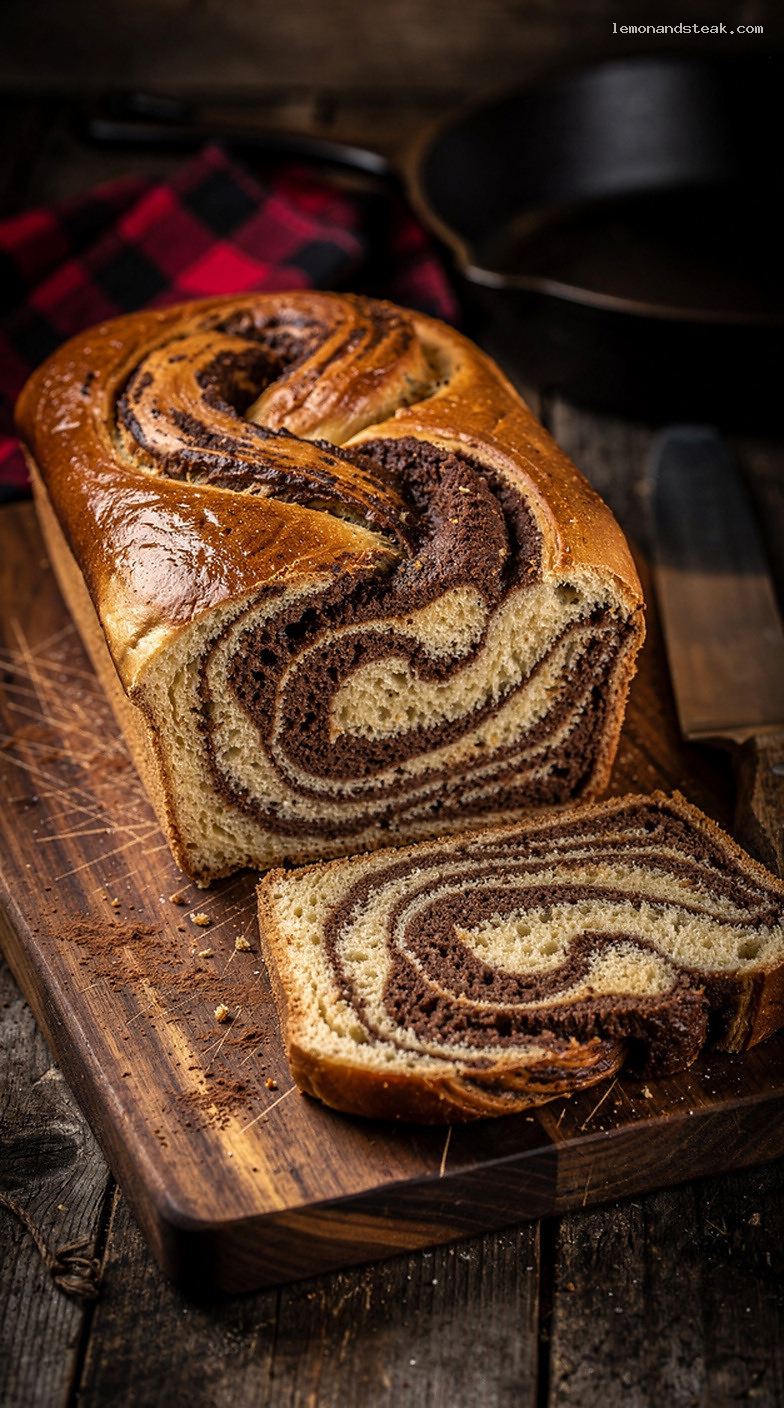
Quick Recipe Version (TL;DR)
Quick Ingredients
- 240 g whole milk (1 cup), warmed to 43°C/110°F
- 7 g active dry yeast (2 1/4 tsp)
- 50 g granulated sugar (1/4 cup)
- 1 large egg (50 g)
- 57 g unsalted butter (4 tbsp), softened
- 360 g bread flour (3 cups), plus a little for shaping
- 6 g fine salt (1 tsp)
- 2 tsp vanilla extract
- 25 g unsweetened cocoa powder (1/4 cup)
- 15 g whole milk (1 tbsp) for the chocolate dough
- 15 g granulated sugar (1 tbsp) for the chocolate dough
- 14 g unsalted butter (1 tbsp), melted, for the chocolate dough
Do This
- 1) Bloom yeast in warm milk + a pinch of sugar for 5 minutes.
- 2) Mix in sugar, egg, butter, flour, salt, and vanilla; knead 8–10 minutes until smooth.
- 3) Rise covered until doubled, 60–75 minutes.
- 4) Divide dough in half; knead cocoa + 1 tbsp milk + 1 tbsp sugar + 1 tbsp melted butter into one half.
- 5) Roll each half into a rectangle, stack, roll up, twist once or twice, and place in a greased 9 x 5 in loaf pan.
- 6) Proof until the dough crowns 2–3 cm (about 1 inch) over the rim, 35–55 minutes. Heat oven to 175°C/350°F.
- 7) Bake 35–40 minutes (target internal temp 88–90°C/190–195°F). Cool 1 hour before slicing.
Why You’ll Love This Recipe
- One base dough becomes two flavors, so the marbling looks impressive without extra fuss.
- Soft, tender crumb that’s lightly sweet and perfect for toast.
- Chocolate swirl is rich but balanced (not cake-sweet), making it great for breakfast or snacking.
- Reliable shaping method that produces bold, high-contrast swirls.
Grocery List
- Produce: None
- Dairy: Whole milk, unsalted butter, 1 large egg
- Pantry: Bread flour, granulated sugar, active dry yeast, fine salt, vanilla extract, unsweetened cocoa powder
Full Ingredients
Vanilla Base Dough
- Whole milk: 240 g (1 cup), warmed to 43°C/110°F
- Active dry yeast: 7 g (2 1/4 tsp)
- Granulated sugar: 50 g (1/4 cup)
- Large egg: 1 (about 50 g without shell), room temperature
- Unsalted butter: 57 g (4 tbsp), softened
- Bread flour: 360 g (3 cups), plus extra for dusting
- Fine salt: 6 g (1 tsp)
- Vanilla extract: 2 tsp
Chocolate Dough Add-Ins (for half the dough)
- Unsweetened cocoa powder: 25 g (1/4 cup)
- Whole milk: 15 g (1 tbsp)
- Granulated sugar: 15 g (1 tbsp)
- Unsalted butter: 14 g (1 tbsp), melted and cooled slightly
For the Pan
- Unsalted butter or neutral oil: 1–2 tsp, for greasing the loaf pan
Optional (Nice Finishing Touches)
- Egg wash: 1 egg + 1 tbsp milk, beaten (for a shinier crust)
- Powdered sugar: 1–2 tbsp, for dusting once cooled
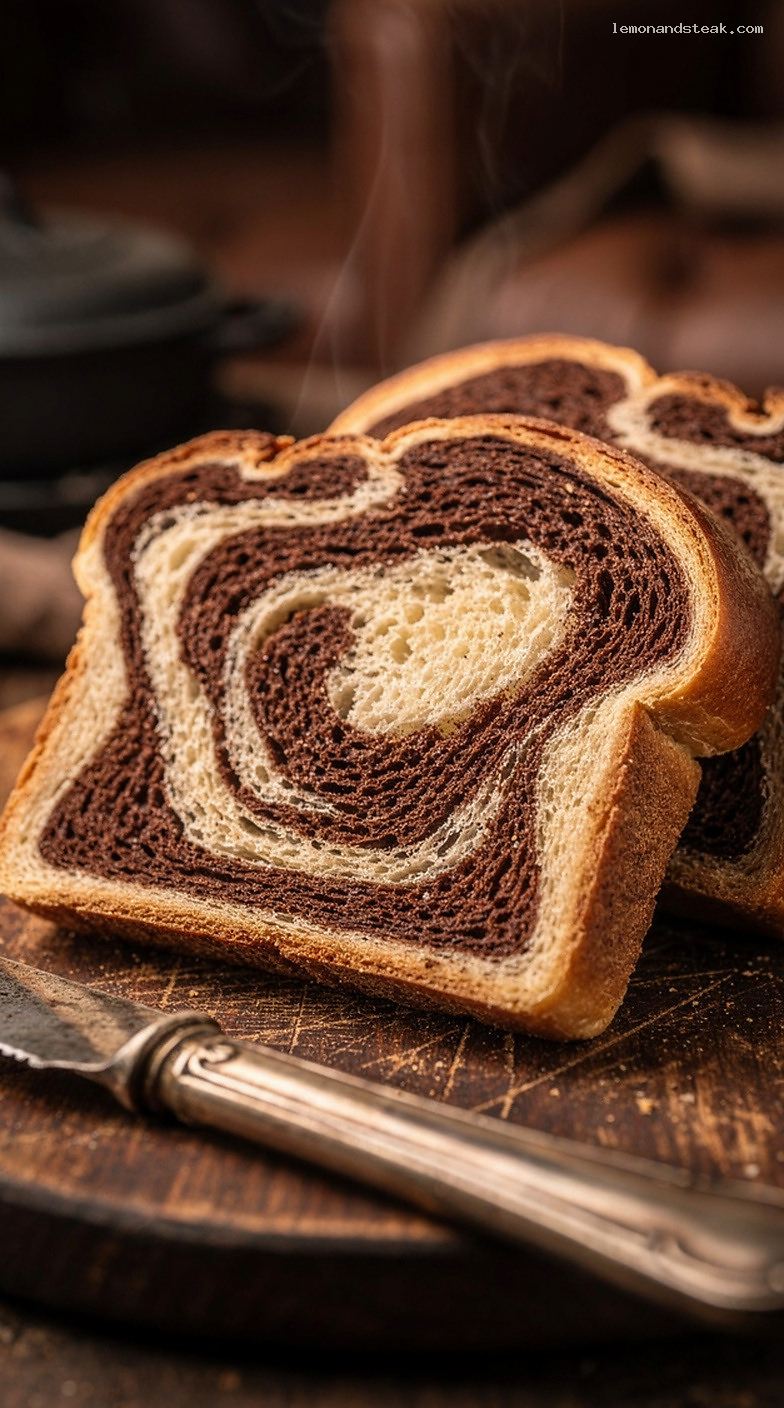
Step-by-Step Instructions
Step 1: Prep the pan and warm the milk
Grease a 9 x 5 inch (23 x 13 cm) loaf pan with butter or neutral oil. Set aside.
Warm the milk to 43°C/110°F. It should feel warm but not hot. If the milk is hotter than 49°C/120°F, let it cool a bit so it won’t harm the yeast.
Step 2: Bloom the yeast
In a large mixing bowl (or the bowl of a stand mixer), combine the warm milk, yeast, and about 1 teaspoon of the measured sugar. Stir and let stand for 5 minutes, until foamy.
If you don’t see any foam after 8–10 minutes, your yeast may be inactive. It’s best to start over with fresh yeast before using the rest of your ingredients.
Step 3: Mix and knead the vanilla dough
Add the remaining sugar, egg, softened butter, flour, salt, and vanilla extract to the bowl.
Stand mixer method: Mix with the dough hook on low speed until a shaggy dough forms, about 2 minutes. Increase to medium-low and knead for 8–10 minutes, until smooth and elastic.
By hand: Stir with a sturdy spoon until you can’t, then knead on a lightly floured counter for 10–12 minutes.
The dough should be soft and slightly tacky but not wet. If it’s very sticky, add flour 1 tablespoon at a time (up to 2–3 tablespoons). If it feels stiff or dry, add milk 1 teaspoon at a time.
Step 4: First rise (bulk ferment)
Form the dough into a ball and place it in a lightly buttered bowl. Cover with a clean towel or plastic wrap.
Let rise at warm room temperature (about 24–27°C/75–80°F) until doubled in size, 60–75 minutes.
Step 5: Make the chocolate half
Gently press down the risen dough to release excess gas. Divide it into 2 equal pieces (a kitchen scale helps: each piece will be about the same weight).
Leave one half as the vanilla dough.
For the chocolate half: flatten the other portion slightly and sprinkle on the cocoa powder. Add the 1 tablespoon milk, 1 tablespoon sugar, and 1 tablespoon melted butter. Knead until the cocoa is fully incorporated and no dry streaks remain, about 2–3 minutes.
If the chocolate dough feels drier than the vanilla dough (cocoa can do that), knead in an extra 1–2 teaspoons milk until both doughs feel similarly soft.
Step 6: Roll, stack, and create the marble swirl
Lightly flour your counter. Roll the vanilla dough into a rectangle about 20 x 30 cm (8 x 12 inches). Roll the chocolate dough into the same size rectangle.
Brush off excess flour. Lay the chocolate rectangle directly on top of the vanilla rectangle, aligning the edges as best you can.
Starting from the short end, roll the stacked dough up into a tight log (like cinnamon rolls, but without filling). Pinch the seam closed.
For a bold marble: use a sharp knife or bench scraper to cut the log lengthwise down the center, exposing the layers. Twist the two halves around each other 2–3 times, keeping the cut sides facing up as much as possible. Tuck the ends under.
Place the twisted loaf into the greased pan.
Step 7: Second rise (proof) and preheat the oven
Cover the pan loosely. Let the loaf rise until it crowns about 2–3 cm (around 1 inch) over the rim of the pan, 35–55 minutes depending on room temperature.
When the loaf is nearly done proofing, preheat the oven to 175°C/350°F (no fan). If using egg wash, gently brush it on right before baking.
Step 8: Bake, cool, and slice cleanly
Bake on the center rack for 35–40 minutes, until deep golden brown. The most accurate check is internal temperature: the center of the loaf should read 88–90°C (190–195°F).
If the top is browning too quickly, tent loosely with foil after 25 minutes.
Cool in the pan for 10 minutes, then remove and cool completely on a rack for at least 1 hour before slicing. This cooling time sets the crumb so the swirls slice neatly.
Pro Tips
- Measure flour with a scale if you can. Too much flour is the fastest way to lose that soft, tender texture.
- Match the dough textures. Cocoa dries dough slightly; adding a teaspoon or two of milk to the chocolate half keeps the bake even and prevents cracks.
- Don’t over-twist. Two or three twists give a clear marble without turning the layers muddy.
- Proof to height, not time. Your loaf is ready when it rises about 1 inch over the pan rim and springs back slowly when gently pressed.
- Cool fully before slicing. Warm bread is tempting, but you’ll get cleaner, more dramatic swirls once it’s set.
Variations
- Mocha marble: Dissolve 2 teaspoons instant espresso powder in the 1 tablespoon milk used for the chocolate dough, then knead it in with the cocoa.
- Chocolate chip ribbon: Sprinkle 60 g (1/3 cup) mini chocolate chips over the chocolate rectangle before stacking and rolling (press lightly so they adhere).
- Cinnamon-vanilla twist: Keep the chocolate half plain and instead mix 2 teaspoons ground cinnamon + 25 g (2 tbsp) brown sugar into one half of the dough.
Storage & Make-Ahead
Let the loaf cool completely, then store tightly wrapped at room temperature for up to 3 days. For longer storage, wrap the whole loaf (or individual slices) in plastic wrap and then foil, and freeze for up to 2 months. Thaw at room temperature, or toast slices straight from frozen.
Make-ahead option: after shaping and placing the loaf in the pan, cover tightly and refrigerate overnight (8–12 hours). The next day, let it sit at room temperature until it rises about 1 inch over the rim (typically 45–90 minutes), then bake as directed.
Nutrition (per serving)
Approximate per slice (1/10 loaf): 260 calories, 7 g protein, 40 g carbohydrates, 8 g fat, 10 g sugar, 2 g fiber, 220 mg sodium. Values vary by brand and exact portion size.
Leave a Reply