
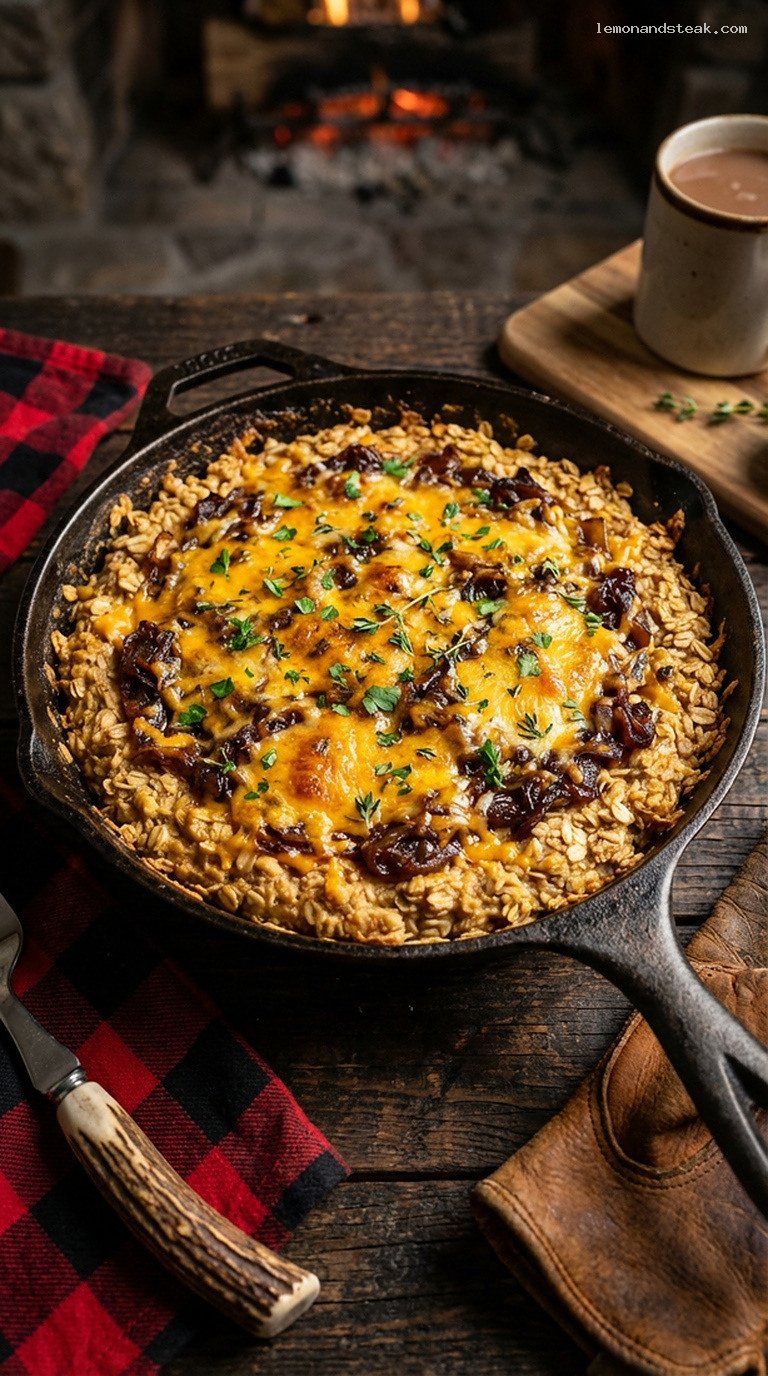
Quick Recipe Version (TL;DR)
Quick Ingredients
- 2 tbsp unsalted butter + 6 tbsp melted butter (for crust)
- 1 tbsp olive oil
- 2 large yellow onions (about 1 1/2 lb), thinly sliced
- 2 cloves garlic, minced
- 1 1/2 cups old-fashioned rolled oats, divided (1/2 cup for crust, 1 cup for filling)
- 1 cup (120 g) all-purpose flour
- 1/2 tsp baking powder
- 1 1/2 tsp salt, divided (fine or kosher; adjust to taste)
- Freshly ground black pepper
- 2 tsp fresh thyme leaves or 1 tsp dried thyme, divided
- 1/2 tsp sugar or honey (optional, for onions)
- 2 tbsp dry white wine, sherry, or water (for deglazing)
- 1 1/4 cups (300 ml) low-sodium vegetable or chicken broth
- 3/4 cup (180 ml) whole milk (or 2%)
- 3 large eggs
- 1 tbsp Dijon mustard
- 1 tsp Worcestershire sauce (optional)
- 1/2 tsp smoked paprika
- 1 1/2 cups (150 g) coarsely grated sharp cheddar, divided
- 2 tbsp chopped fresh parsley or chives (for garnish, optional)
Do This
- 1. Heat 2 tbsp butter and olive oil in a 10-inch cast-iron skillet over medium heat. Add onions, 1/2 tsp salt, thyme, and optional sugar. Cook on medium-low, stirring often, until deeply caramelized, 30–40 minutes. Stir in garlic for 1 minute, deglaze with wine or water, then transfer onions to a bowl.
- 2. Wipe out the skillet, grease lightly, and heat oven to 375°F (190°C). For the crust, mix flour, 1/2 cup oats, baking powder, 1/2 tsp salt, thyme, and pepper. Stir in 6 tbsp melted butter until crumbly. Press firmly into the skillet and halfway up the sides. Par-bake 10 minutes; leave oven on.
- 3. In a saucepan, toast remaining 1 cup oats over medium heat for 3–4 minutes until fragrant. Stir in broth and milk, bring to a simmer, and cook 5–7 minutes until it is a thick, loose porridge. Remove from heat and let cool 5–10 minutes.
- 4. In a large bowl, whisk eggs, Dijon, Worcestershire (if using), smoked paprika, remaining 1/2 tsp salt, and several grinds of pepper. Gradually whisk in the warm oat mixture.
- 5. Fold in caramelized onions, 1 cup cheddar, and herbs. Taste and adjust salt if needed. Pour into the warm crust and smooth the top. Sprinkle with remaining 1/2 cup cheddar.
- 6. Bake 20–25 minutes, until top is deeply golden and the center is just set with a slight wobble. Rest 10–15 minutes, then slice and serve warm, garnished with extra herbs.
Why You’ll Love This Recipe
- Cozy, cabin-worthy comfort: toasted oats, silky onions, and sharp cheddar baked in a buttery crust, all in one skillet.
- Deep, layered flavor from slow-caramelized onions, smoky paprika, and a hint of thyme and Worcestershire.
- Rustic yet impressive: feels special enough for guests, but simple enough for a weeknight or chilly weekend dinner.
- Flexible base recipe: easy to adapt with bacon, mushrooms, or different cheeses, and naturally hearty from the oats.
Grocery List
- Produce: 2 large yellow onions, 2 cloves garlic, fresh thyme (or dried), fresh parsley or chives (optional).
- Dairy: Unsalted butter, whole milk (or 2%), sharp cheddar cheese, large eggs.
- Pantry: Olive oil, old-fashioned rolled oats, all-purpose flour, baking powder, fine sea salt or kosher salt, black pepper, sugar or honey, dry white wine or sherry (or water), low-sodium vegetable or chicken broth, Dijon mustard, Worcestershire sauce, smoked paprika.
Full Ingredients
For the Caramelized Onions
- 2 tbsp unsalted butter
- 1 tbsp olive oil
- 2 large yellow onions (about 1 1/2 lb / 680 g), halved and thinly sliced from root to tip
- 1/2 tsp fine sea salt (or 3/4 tsp kosher salt)
- 1/2 tsp sugar or honey (optional, helps browning)
- 1 tsp fresh thyme leaves, or 1/2 tsp dried thyme
- 2 cloves garlic, minced
- 2 tbsp dry white wine, dry sherry, or water (for deglazing)
For the Buttery Cabin Crust
- 6 tbsp (85 g) unsalted butter, melted and slightly cooled, plus a little extra for greasing the skillet
- 1 cup (120 g) all-purpose flour
- 1/2 cup (45 g) old-fashioned rolled oats
- 1/2 tsp baking powder
- 1/2 tsp kosher salt (or 1/4 tsp fine sea salt)
- 1 tsp fresh thyme leaves, or 1/2 tsp dried thyme
- 1/4 tsp freshly ground black pepper
For the Toasted Oat and Cheddar Filling
- 1 cup (100 g) old-fashioned rolled oats
- 1 1/4 cups (300 ml) low-sodium vegetable or chicken broth
- 3/4 cup (180 ml) whole milk (or 2%)
- 3 large eggs
- 1 tbsp Dijon mustard
- 1 tsp Worcestershire sauce (optional but recommended for depth)
- 1/2 tsp smoked paprika
- 1/2 tsp fine sea salt (or 3/4 tsp kosher salt), plus more to taste depending on your broth and cheese
- 1/2 tsp freshly ground black pepper
- 1 1/2 cups (150 g) coarsely grated sharp cheddar cheese, divided (1 cup / 100 g for the filling, 1/2 cup / 50 g for topping)
- 2 tbsp chopped fresh parsley or chives, plus more for serving (optional)
Step-by-Step Instructions
Step 1: Preheat the oven and prepare your skillet
Place an oven rack in the center of the oven and preheat to 375°F (190°C). Choose a 10-inch cast-iron skillet (2 inches deep is ideal). If your skillet is well-seasoned, a light grease is enough; otherwise, rub the bottom and sides with a thin layer of butter or oil to help prevent sticking.
You will use this same skillet for caramelizing the onions, par-baking the crust, and baking the final oat casserole, so keep it handy on the stovetop.
Step 2: Slowly caramelize the onions
Set the greased skillet over medium heat. Add 2 tbsp butter and 1 tbsp olive oil. Once the butter has melted and is just starting to foam, add the sliced onions and sprinkle with 1/2 tsp salt. Toss to coat everything in fat, then reduce the heat to medium-low.
Cook the onions, stirring every few minutes, for about 25–30 minutes. They will first soften, then release liquid, then slowly turn golden. If they start browning too quickly or sticking hard to the pan, reduce the heat and add a splash of water to loosen the fond. After about 20 minutes, stir in the thyme and optional sugar or honey to encourage deeper caramelization.
When the onions are a deep golden brown and jammy (this usually takes 30–40 minutes total), stir in the minced garlic and cook for 1 minute until fragrant. Deglaze the pan with 2 tbsp white wine, sherry, or water, scraping up any browned bits. Cook until almost all the liquid has evaporated.
Transfer the caramelized onions to a bowl and set aside to cool slightly. Let the skillet cool for a minute, then carefully wipe it out with a folded paper towel, leaving just a thin sheen of fat. You will reuse it for the crust.
Step 3: Mix and press in the buttery cabin crust
In a medium mixing bowl, whisk together the flour, 1/2 cup oats, baking powder, salt, thyme, and black pepper until well combined. Pour in the 6 tbsp melted butter. Stir with a fork or spatula until the mixture looks like damp, clumpy sand and holds together when squeezed in your hand.
Return the wiped-out skillet to your work surface. If it looks dry, add a touch more butter or oil and swirl it around. Tip the crust mixture into the skillet. Using your fingers, the bottom of a measuring cup, or a flat glass, press the crumbs firmly into an even layer across the bottom and at least halfway up the sides of the skillet. Take your time here; compacting the crust well helps it hold together once baked.
Prick the bottom of the crust a few times with a fork to prevent bubbling. Place the skillet in the preheated oven and par-bake for 10 minutes, just until the crust looks dry on the surface and barely starting to color at the edges. Remove from the oven and set on a heatproof surface to cool slightly while you prepare the filling. Leave the oven at 375°F (190°C).
Step 4: Toast and simmer the oats
While the crust is baking, start the filling. In a medium saucepan over medium heat, add the remaining 1 cup (100 g) rolled oats to the dry pan. Toast, stirring frequently, for 3–4 minutes until the oats smell nutty and turn just a shade darker. Watch closely so they do not scorch.
Pour in the broth and milk, stirring to combine and scraping the bottom of the pan. Bring the mixture to a gentle simmer, then reduce the heat to low. Cook, stirring often, for 5–7 minutes, until the oats are soft and the mixture is thick but still loose, like a spoonable porridge rather than a solid mass. If it gets too thick, stir in a splash of water or milk.
Remove the saucepan from the heat and let the oat mixture cool for 5–10 minutes. It should be warm but not piping hot when you add it to the eggs, so they do not scramble.
Step 5: Build the cheddar oat custard
In a large mixing bowl, whisk together the eggs, Dijon mustard, Worcestershire sauce (if using), smoked paprika, 1/2 tsp salt, and 1/2 tsp black pepper until the mixture is smooth and slightly frothy.
Gradually ladle in the warm oat mixture, whisking constantly as you go. Adding it slowly helps temper the eggs so they blend into a silky custard instead of cooking in streaks. When all of the oat mixture is incorporated, you should have a thick but pourable batter.
Fold in the caramelized onions, making sure they are evenly dispersed, and then stir in 1 cup (about 100 g) of the grated cheddar cheese along with the chopped parsley or chives, if using. Give the mixture a final taste (keeping in mind the eggs are still raw; taste a tiny amount at your discretion) and adjust the seasoning with a pinch more salt or pepper if needed.
Step 6: Fill the crust and bake
Stir the filling once more to redistribute the onions, then carefully pour it into the warm par-baked crust in the cast-iron skillet. Use a spatula to smooth the top into an even layer all the way to the edges.
Sprinkle the remaining 1/2 cup (about 50 g) grated cheddar evenly over the surface. For a rustic look, you can leave some clumps of cheese slightly larger so they brown into bubbly, golden patches.
Return the skillet to the center rack of the 375°F (190°C) oven. Bake for 20–25 minutes, until the filling is puffed around the edges, the top is a deep golden brown, and the center only has a slight, gentle wobble when you jiggle the skillet. If you like, you can check that the center has reached about 165°F (74°C) with an instant-read thermometer.
If the top is browning faster than the center is setting, loosely tent the skillet with foil for the last 5–10 minutes of baking. For an extra-toasty top, you can finish under the broiler for 1–2 minutes, watching very carefully.
Step 7: Rest, garnish, and serve
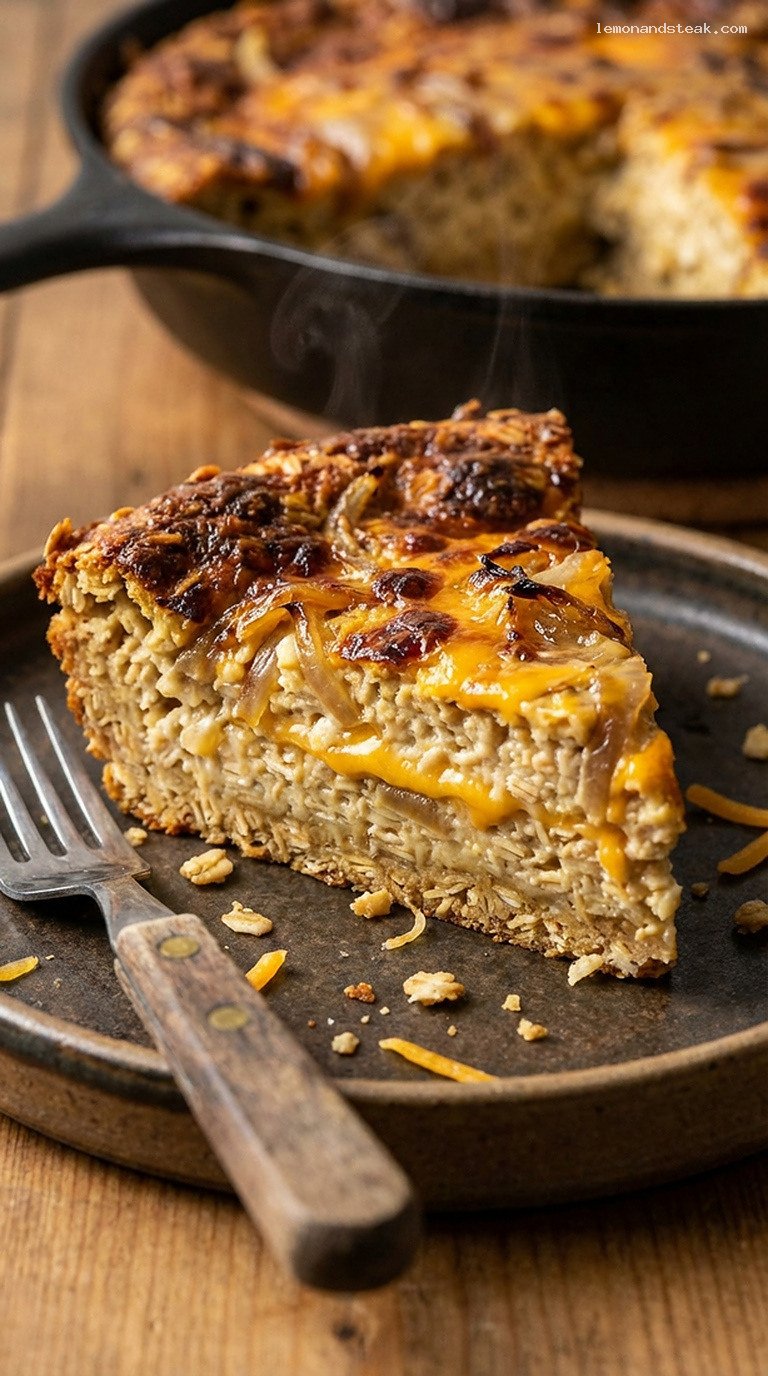
Remove the skillet from the oven and place it on a trivet or cooling rack. Let the oat bake rest for at least 10–15 minutes. This resting time allows the custard to finish setting so you get clean slices instead of a runny center.
Just before serving, scatter additional chopped parsley or chives over the top for a fresh, green contrast to the caramelized onions and cheddar. Cut the bake into 6 wedges right in the skillet and serve warm. It pairs beautifully with a simple green salad or roasted vegetables for a cozy, complete meal.
Pro Tips
- Do not rush the onions. The deep flavor of this dish depends on truly caramelized onions. Keep the heat low, stir often, and add a splash of water if they start to scorch.
- Press the crust firmly. Use the bottom of a measuring cup to compact the crust into the skillet. A tightly packed crust holds together better and stays pleasantly crisp at the edges.
- Temper the eggs. Let the oat mixture cool slightly and whisk it slowly into the eggs. This prevents bits of scrambled egg and gives you a smooth, custardy texture.
- Use flavorful cheddar. A sharp or extra-sharp cheddar melts beautifully but also provides the punchy flavor needed to balance the sweetness of the onions and the earthiness of the oats.
- Let it rest before slicing. Resting is crucial for clean slices and a set, creamy interior. If you cut it too soon, the filling may ooze out and seem undercooked even when it is done.
Variations
- Smoky bacon and onion oat bake: Cook 4–6 slices of chopped thick-cut bacon in the skillet first. Use some of the bacon fat in place of part of the butter for the onions. Stir the crisped bacon into the filling along with the onions.
- Mushroom-thyme version: Add 8 oz (225 g) sliced cremini or button mushrooms to the onions after they have softened for about 10 minutes. Cook until the mushrooms release their liquid and brown slightly, then proceed as directed.
- Extra rustic and nearly gluten-free: Replace the flour in the crust with finely ground oats (oat flour) and add an extra tablespoon or two of melted butter if the crust seems dry. Make sure to use certified gluten-free oats if needed.
Storage & Make-Ahead
Let any leftovers cool completely at room temperature, then cover the skillet tightly or transfer slices to an airtight container. Store in the refrigerator for up to 4 days. Reheat individual slices in a 325°F (165°C) oven or toaster oven for 10–15 minutes, or in a covered skillet over low heat until warmed through. The crust will re-crisp somewhat in the oven. For longer storage, wrap cooled slices tightly and freeze for up to 2 months; thaw overnight in the fridge before reheating. You can also make the caramelized onions up to 3 days ahead and refrigerate them, or assemble the entire bake up to the point of baking, cover, chill overnight, then bake straight from the fridge (add 5–10 extra minutes to the bake time).
Nutrition (per serving)
Approximate values for 1 of 6 servings: Calories: ~470 kcal; Total Fat: ~28 g (Sat Fat ~15 g); Carbohydrates: ~38 g; Fiber: ~3 g; Sugars: ~6 g; Protein: ~17 g; Sodium: ~650 mg. Actual values will vary based on specific brands of broth, cheese, and butter used.
Leave a Reply