
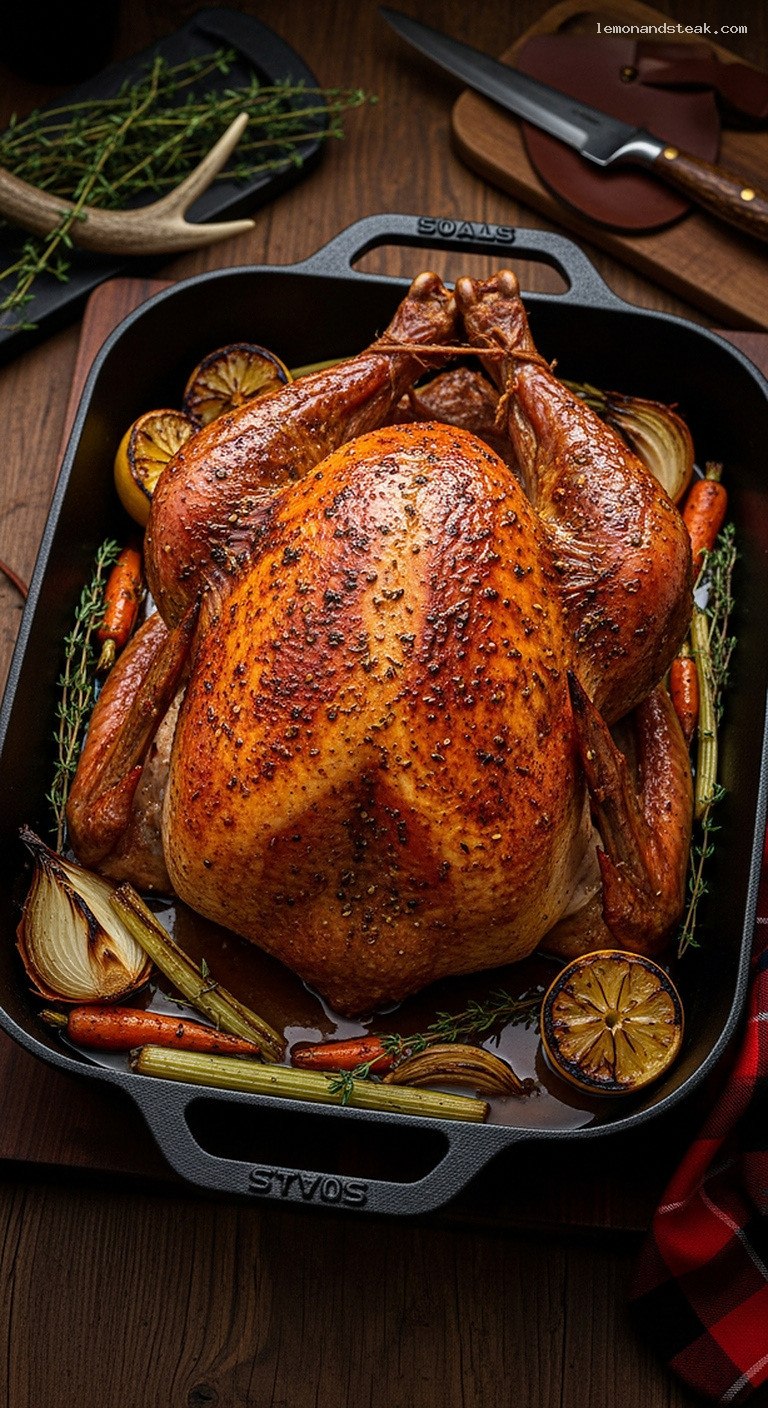
Quick Recipe Version (TL;DR)
Quick Ingredients
- 1 whole turkey, 10–12 lb, thawed
- 8 tbsp (1 stick) unsalted butter
- 2 tbsp olive oil
- 2 tsp celery salt
- 2 tsp sweet paprika
- 1 tsp smoked paprika (optional)
- 2 tsp kosher salt (plus more to taste)
- 1 tsp freshly ground black pepper
- 4 garlic cloves
- 1 large onion, 2 carrots, 2 celery stalks
- 1 lemon, halved
- 4–5 sprigs fresh thyme, 2 sprigs rosemary (optional but ideal)
- 2 cups low-sodium chicken or turkey broth
- 2 tbsp all-purpose flour (for quick gravy, optional)
Do This
- 1. Heat oven to 325°F (163°C). Pat turkey very dry, remove giblets, and tuck wings under.
- 2. Brown butter in a saucepan until deep golden and nutty. Stir in celery salt, paprika(s), kosher salt, and pepper; cool 5 minutes.
- 3. Rub half the browned butter under the turkey skin over breasts and thighs, and the rest all over the outside.
- 4. Place onion, carrots, celery, lemon, and herbs in the roasting pan and in the cavity. Set turkey on top, pour broth into pan.
- 5. Roast at 325°F for about 2 hours 45 minutes to 3 hours 15 minutes, basting occasionally, until breast and thigh reach 160–165°F.
- 6. For extra color, raise oven to 425°F (218°C) for the last 15–20 minutes, watching closely.
- 7. Rest turkey 20–30 minutes. Meanwhile, thicken strained pan juices with flour for a simple gravy. Carve and serve.
Why You’ll Love This Recipe
- Browned butter, celery salt, and paprika create a deep, cozy, Thanksgiving-style flavor without being fussy.
- The technique keeps the meat juicy and the skin bronzed and crisp, even for first-time turkey roasters.
- Everyday pantry ingredients turn into a special-occasion-worthy roast you can make any Sunday.
- Built-in pan gravy option means you have a complete main dish with one roasting pan.
Grocery List
- Produce: 1 large onion, 2 carrots, 2 celery stalks, 4 garlic cloves, 1 lemon, fresh thyme, fresh rosemary (optional but recommended).
- Dairy: 8 tbsp (1 stick) unsalted butter.
- Pantry: 1 whole turkey (10–12 lb), olive oil, kosher salt, celery salt, sweet paprika, smoked paprika (optional), black pepper, low-sodium chicken or turkey broth, all-purpose flour (for gravy, optional).
Full Ingredients
For the Browned Butter Turkey
- 1 whole turkey, 10–12 lb, thawed if frozen
- 8 tbsp (1 stick / 113 g) unsalted butter
- 2 tbsp olive oil
- 2 tsp celery salt
- 2 tsp sweet paprika
- 1 tsp smoked paprika (optional, for a subtle smokiness)
- 2 tsp kosher salt (use 1 tsp if your celery salt is very salty)
- 1 tsp freshly ground black pepper
For the Aromatics & Pan Juices
- 1 large yellow onion, cut into thick wedges
- 2 medium carrots, cut into large chunks
- 2 celery stalks, cut into large chunks
- 4 garlic cloves, smashed
- 1 lemon, halved
- 4–5 sprigs fresh thyme
- 2 sprigs fresh rosemary (optional)
- 2 cups (480 ml) low-sodium chicken or turkey broth
Optional Simple Pan Gravy
- 2 cups (480 ml) strained pan juices (top up with broth if needed)
- 2 tbsp unsalted butter (optional, for richness)
- 2–3 tbsp all-purpose flour
- Salt and black pepper, to taste

Step-by-Step Instructions
Step 1: Thaw and prep the turkey
If your turkey is frozen, thaw it in the refrigerator for about 3 days (roughly 24 hours per 4–5 lb). When ready to roast, remove all packaging, and pull out the neck and giblet bag from the cavity (often in the main cavity and sometimes a smaller pouch in the neck cavity). Pat the turkey very dry with paper towels, inside and out. Dry skin is the key to good browning. Place the turkey breast-side up on a roasting rack set inside a large roasting pan. Tuck the wing tips under the body to prevent burning. If you like, tie the legs loosely with kitchen twine for a neater shape.
Step 2: Make the browned butter paprika rub
In a small saucepan over medium heat, melt the 8 tbsp butter. Continue cooking, swirling occasionally, until the butter foams, then the foam subsides and the milk solids turn a deep golden-brown and smell nutty, 4–7 minutes. Immediately remove from heat so it does not burn. Stir in the olive oil to cool it slightly. Whisk in the celery salt, sweet paprika, smoked paprika (if using), kosher salt, and black pepper. Let the mixture cool until it is warm but spreadable, 5–10 minutes. This browned butter spice mixture will be your flavor-packed rub.
Step 3: Season the turkey inside and out
Scatter the onion wedges, carrot chunks, and celery chunks into the bottom of the roasting pan. Add the smashed garlic cloves and the herb sprigs. Place the lemon halves and a few herb sprigs inside the turkey cavity for fragrant steam as it roasts.
Using your fingers, gently loosen the skin over the breasts and, if possible, over the upper thighs, being careful not to tear it. Spoon or brush about half of the browned butter rub under the skin, spreading it as evenly as you can. Rub the remaining butter mixture all over the outside of the turkey, including the legs and back. This layer of seasoned browned butter is what will give you that bronzed, cozy, holiday-style crust and deeply flavored meat.
Step 4: Start roasting low and slow
Preheat your oven to 325°F (163°C). Pour the 2 cups of broth into the roasting pan around the vegetables, not directly over the turkey (you do not want to wash off the seasoning). Slide the pan into the oven on a lower-middle rack. Roast uncovered for about 2 hours 15 minutes for a 10 lb bird, or up to about 2 hours 45 minutes for a 12 lb bird, basting every 45 minutes with the pan juices. If the pan starts to look dry, add another 1/2–1 cup of broth or water. The turkey will slowly take on a deep paprika-golden color while staying moist.
Step 5: Finish with high heat for crisp, bronzed skin
Once the turkey is approaching done (the breast reads about 150°F / 66°C in the thickest part), usually around the 2 hour 30 minute mark for a 12 lb bird, increase the oven temperature to 425°F (218°C). Continue roasting for 15–30 minutes, basting once, until the skin is deep golden-brown and crackly and the internal temperature reaches 160–165°F (71–74°C) in both the thickest part of the breast and the inner thigh. If any spots are browning too quickly, tent them loosely with a small piece of foil. Total cook time will be approximately 3 hours to 3 hours 15 minutes for a 10–12 lb turkey.
Step 6: Rest, then carve the turkey
Transfer the turkey to a cutting board, tent loosely with foil, and let it rest for 20–30 minutes. This rest lets the juices redistribute so each slice stays moist. While the turkey rests, skim excess fat from the top of the pan juices (reserve some fat if making gravy). To carve, remove the legs and thighs first, then the breasts, then slice the breast meat across the grain into thick, appetizing slices. Arrange the turkey on a warm platter, spoon a little of the warm pan juices over the top, and serve the rest on the side or in a gravy boat.
Step 7: Make a quick pan gravy (optional)
Pour the pan drippings and vegetables through a fine-mesh strainer into a measuring cup, pressing on the solids to extract flavor. You need about 2 cups of liquid; top up with broth if needed. In a medium saucepan over medium heat, melt 2 tbsp butter (or use 2 tbsp of the reserved turkey fat). Whisk in 2–3 tbsp flour and cook, whisking, for 1–2 minutes until lightly golden and it smells toasty. Slowly pour in the strained juices while whisking constantly to avoid lumps. Bring to a gentle simmer and cook 3–5 minutes, until thickened to your liking. Season to taste with salt and pepper. Serve warm alongside the turkey for that comforting, Thanksgiving-everyday feel.
Pro Tips
- Pat the turkey very dry and do not skip loosening the skin; getting the browned butter underneath is a big part of the juicy, flavorful result.
- Watch the browned butter closely; it goes from nutty to burnt quickly. As soon as it smells like toasted nuts and looks deep golden, pull it off the heat.
- Use a reliable instant-read thermometer instead of relying purely on time. Every oven and turkey is a little different.
- If your turkey is very pale near the end, bump the oven to 425°F and leave the bird uncovered; if too dark, tent lightly with foil.
- Make the gravy while the turkey rests so everything is ready to serve at once without rushing.
Variations
- Herb-forward: Add 1 tbsp finely chopped fresh thyme and rosemary directly into the browned butter rub for a more obviously herbaceous, classic Thanksgiving aroma.
- Smokier and spicier: Use 2 tsp smoked paprika and add 1/2 tsp cayenne pepper for a gentle kick that still feels cozy and comforting.
- Butter-basted turkey breast only: Use a 4–6 lb bone-in turkey breast, halve the rub ingredients, and roast at 325°F until it reaches 160°F (about 1 3/4–2 1/4 hours), then brown at 425°F at the end.
Storage & Make-Ahead
Refrigerate leftover turkey in airtight containers within 2 hours of cooking. It will keep for 3–4 days. For best texture, slice only what you will eat right away and store larger pieces whole. Reheat gently in a covered dish with a splash of broth at 300°F (149°C) until just warmed through, or warm slices in a covered skillet over low heat. Turkey can also be frozen: wrap tightly in foil or freezer-safe bags and freeze for up to 3 months; thaw overnight in the refrigerator before reheating. You can make the browned butter rub up to 2 days ahead and refrigerate it; bring to room temperature so it is spreadable before using. You can also prep and chop the aromatics a day in advance and store them in the fridge, tightly covered.
Nutrition (per serving)
Approximate values for 1 serving (about 6 oz roasted turkey with some skin and 2 tbsp gravy): 360 calories; 25 g protein; 22 g fat; 6 g saturated fat; 5 g carbohydrates; 0.5 g fiber; 1 g sugar; 880 mg sodium. Actual numbers will vary based on the exact size of the turkey, how much skin is eaten, and how much salt and gravy are used.
Leave a Reply