
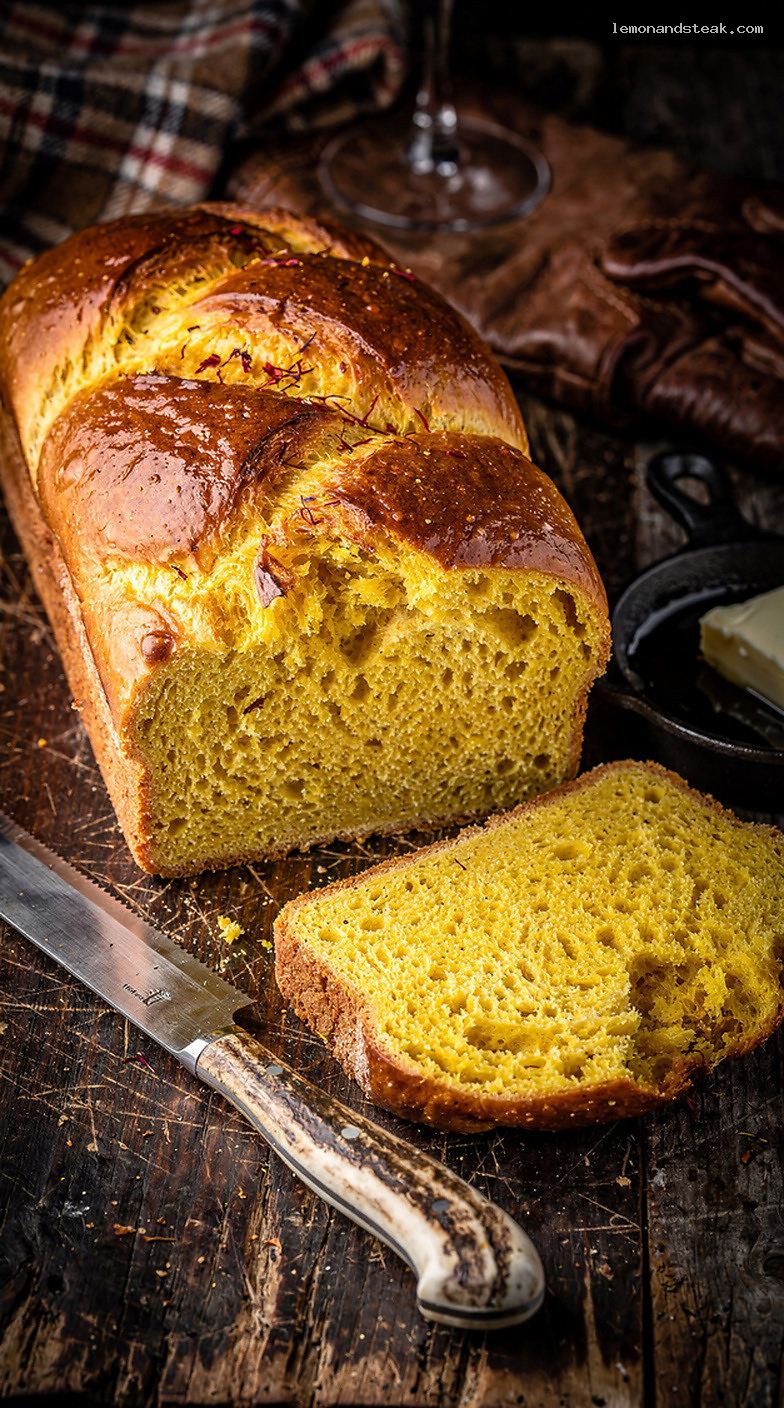
Quick Recipe Version (TL;DR)
Quick Ingredients
- 240 g (1 cup) whole milk
- 0.15 g saffron threads (about 25 threads)
- 7 g (2 1/4 tsp) active dry yeast
- 50 g (1/4 cup) granulated sugar
- 420 g (3 1/2 cups) bread flour
- 7 g (1 1/4 tsp) fine sea salt
- 1 large egg (about 50 g, without shell), room temperature
- 56 g (4 tbsp) unsalted butter, softened
- Optional: 1 tsp vanilla extract
- Optional: 1/4 tsp ground cardamom
- Egg wash: 1 large egg + 15 g (1 tbsp) milk
Do This
- 1) Warm milk to 43°C / 110°F, steep saffron 10 minutes, then whisk in yeast and a pinch of sugar; rest 5 minutes.
- 2) Mix flour, sugar, and salt. Add saffron milk and egg; knead until cohesive.
- 3) Knead in butter until smooth and elastic, 8–10 minutes total kneading.
- 4) Rise covered until doubled, 60–90 minutes at warm room temp.
- 5) Shape into a loaf and place in a greased 23 x 13 cm / 9 x 5 in pan; rise 45–60 minutes.
- 6) Brush with egg wash; bake at 177°C / 350°F for 30–35 minutes (internal temp 88–90°C / 190–194°F).
- 7) Cool 1 hour before slicing for the softest crumb.
Why You’ll Love This Recipe
- Gorgeous golden color: saffron-infused milk naturally tints the crumb a warm yellow.
- Soft, tender texture: enriched dough (milk, egg, butter) bakes up fluffy and sliceable.
- Lightly sweet and aromatic: delicate floral saffron with a gentle sweetness that works for breakfast or snacks.
- Simple techniques: straightforward mixing, kneading, and two rises with clear visual cues.
Grocery List
- Produce: none
- Dairy: whole milk, unsalted butter
- Pantry: saffron threads, active dry yeast, granulated sugar, bread flour, fine sea salt, eggs, vanilla extract (optional), ground cardamom (optional)
Full Ingredients
Saffron Milk & Yeast
- 240 g (1 cup) whole milk
- 0.15 g saffron threads (about 25 threads)
- 7 g (2 1/4 tsp) active dry yeast
- 5 g (1 tsp) granulated sugar (taken from the total sugar; used to help wake up the yeast)
Dough
- 420 g (3 1/2 cups) bread flour (spooned and leveled)
- 45 g (about 3 tbsp + 2 tsp) granulated sugar (remaining after reserving 1 tsp)
- 7 g (1 1/4 tsp) fine sea salt
- 1 large egg (about 50 g without shell), room temperature
- 56 g (4 tbsp) unsalted butter, softened but cool
- Optional: 1 tsp vanilla extract
- Optional: 1/4 tsp ground cardamom
Pan Prep & Finish
- 7 g (1/2 tbsp) unsalted butter, melted (for brushing the pan), or neutral oil spray
- Egg wash: 1 large egg + 15 g (1 tbsp) whole milk
- Optional topping: 1 tbsp pearl sugar or 1 tbsp sesame seeds
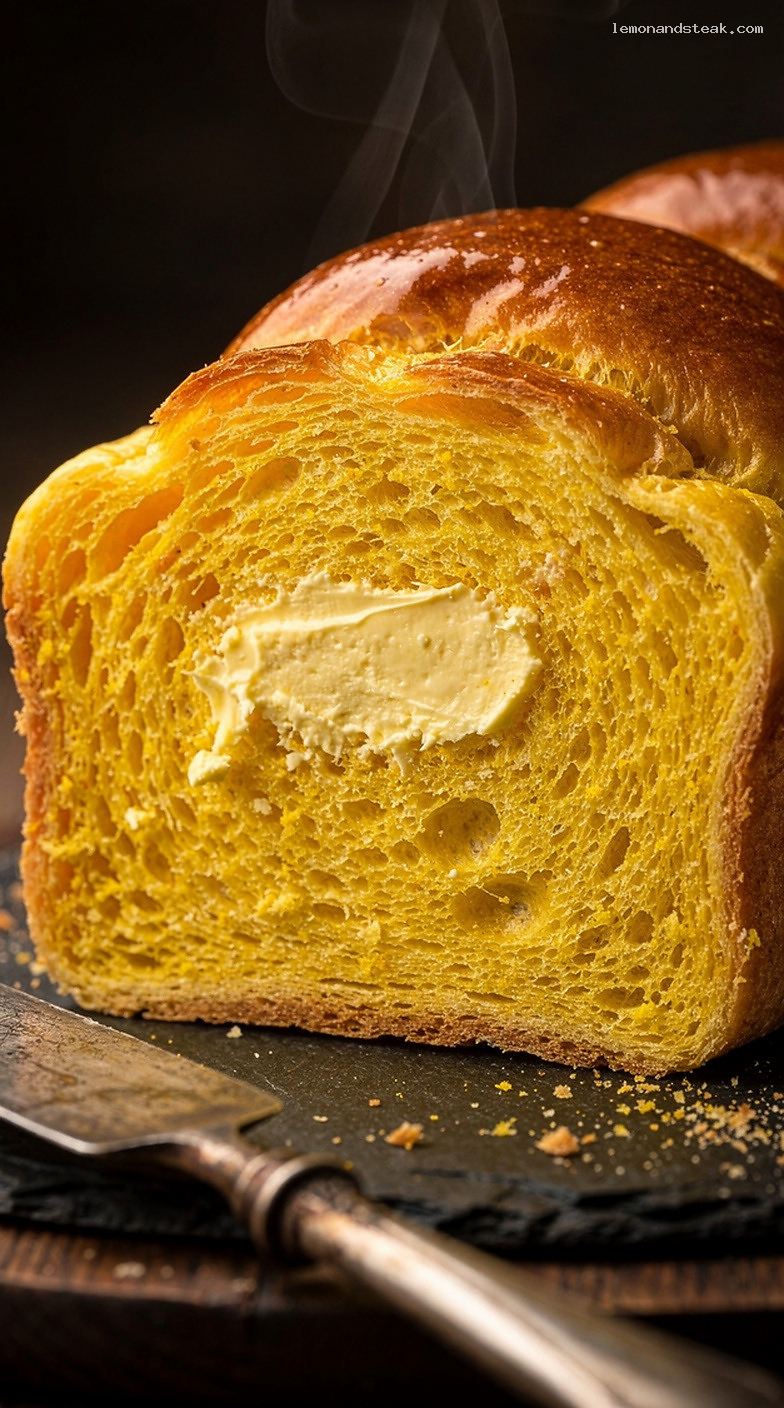
Step-by-Step Instructions
Step 1: Steep the saffron in warm milk
Pour the milk into a small saucepan and warm it over low heat until it reaches 43°C / 110°F (warm to the touch, not hot). Remove from the heat, add the saffron threads, and stir. Let the saffron steep for 10 minutes so the milk turns a deep golden color and becomes fragrant.
Tip: If your kitchen is cool, keep the saucepan covered to hold the warmth while the saffron infuses.
Step 2: Activate the yeast
Whisk the yeast and the reserved 1 tsp sugar into the warm saffron milk. Let it stand for 5 minutes. You should see a light foam on top or a cloudy, activated look.
If there is no activity after 10 minutes, your yeast may be old or your milk may have been too hot or too cool. It is best to restart so the loaf rises properly.
Step 3: Mix the dough
In a large mixing bowl (or the bowl of a stand mixer), combine the bread flour, remaining sugar, salt, and optional cardamom. Make a well, then add the saffron-yeast milk and the egg (and vanilla, if using).
Mix until a shaggy dough forms and there are no dry flour pockets. If the dough feels very sticky, resist adding extra flour right away; it will smooth out during kneading and after the butter is incorporated.
Step 4: Knead, then work in the butter
Knead the dough until it starts to look smoother, about 3 minutes by stand mixer on medium-low or 5 minutes by hand on a lightly floured surface.
Add the softened butter a tablespoon at a time, kneading well after each addition. Continue kneading until the dough is smooth, elastic, and slightly tacky, about 5–7 more minutes in a mixer (or 8–10 more minutes by hand). The dough should pass a simple “windowpane” test: a small piece can be gently stretched thin without tearing immediately.
Step 5: First rise (bulk fermentation)
Form the dough into a ball and place it in a lightly greased bowl, turning once to coat. Cover tightly.
Let rise at 24–27°C / 75–80°F until doubled in size, 60–90 minutes. A warm (but off) oven with the light on is a great spot for consistent rising.
Step 6: Shape the loaf and proof
Grease a 23 x 13 cm / 9 x 5 in loaf pan with melted butter (or use oil spray). Gently press the dough to deflate, then turn it out onto a clean surface.
Pat the dough into a rectangle about 20 x 30 cm / 8 x 12 in. Roll it up tightly from the short end to form a log, pinch the seam closed, and place seam-side down into the prepared pan.
Cover and let proof until the dough crowns about 2–3 cm / 1 inch above the rim of the pan, 45–60 minutes.
Step 7: Egg wash and bake
When the loaf is nearly proofed, preheat the oven to 177°C / 350°F with a rack in the center. Whisk together the egg and milk for the egg wash.
Brush a thin, even layer of egg wash over the top of the loaf. If using, sprinkle with pearl sugar or sesame seeds.
Bake for 30–35 minutes, until the top is deep golden and the internal temperature reads 88–90°C / 190–194°F. If the top browns too quickly, loosely tent with foil for the last 10 minutes.
Remove from the pan after 10 minutes and cool on a rack for at least 1 hour before slicing. This cooling time finishes setting the crumb so the bread stays fluffy, not gummy.
Pro Tips
- Measure milk temperature: Aim for 43°C / 110°F. Hotter can weaken yeast; cooler slows rising.
- Do not rush the proof: Under-proofing can cause a tight crumb and a split top; wait for the dough to crest 1 inch above the pan.
- Use bread flour for the best lift: It provides extra structure for a taller, softer loaf.
- Control stickiness with time, not flour: This is an enriched dough; it often feels tacky at first and becomes smoother as gluten develops.
- For extra sheen: Brush a very thin layer of melted butter on the hot loaf right after baking.
Variations
- Saffron braided bread: Divide the dough into 3 equal ropes, braid, and bake on a parchment-lined sheet at 177°C / 350°F for 25–30 minutes.
- Orange-saffron milk bread: Add 2 tsp finely grated orange zest with the dry ingredients for a brighter aroma.
- Raisin-pistachio loaf: Knead in 80 g (1/2 cup) raisins and 60 g (1/2 cup) chopped pistachios at the end of kneading.
Storage & Make-Ahead
Let the loaf cool completely, then store tightly wrapped at room temperature for up to 3 days. For longer storage, slice and freeze in an airtight bag for up to 2 months. Thaw slices at room temperature or warm gently in a toaster.
Make-ahead option: After shaping and placing in the loaf pan, cover and refrigerate for up to 12 hours. The next day, let it sit at room temperature until it rises to 1 inch above the rim (usually 60–90 minutes), then egg wash and bake as directed.
Nutrition (per serving)
Approximate per slice (1/12 loaf): 190 calories, 6 g protein, 30 g carbohydrates, 5 g fat, 5 g sugar, 1 g fiber, 220 mg sodium.
Leave a Reply