
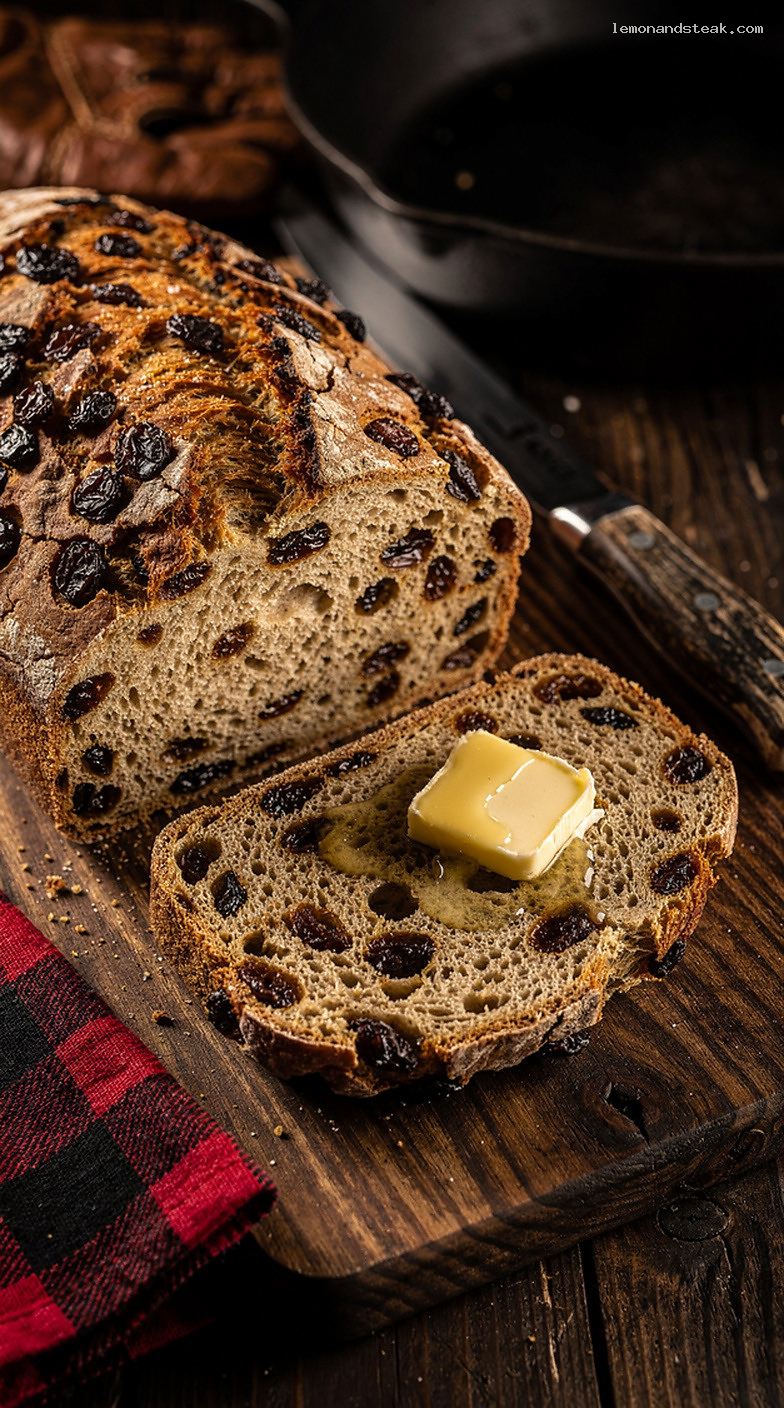
Quick Recipe Version (TL;DR)
Quick Ingredients
- 3/4 cup (180 g) whole milk, warmed to 105–110°F (40–43°C)
- 1/4 cup (60 g) warm water (105–110°F / 40–43°C)
- 2 1/4 tsp (7 g) active dry yeast
- 1/4 cup (50 g) granulated sugar
- 1 large egg, room temperature
- 4 tbsp (56 g) unsalted butter, melted and cooled slightly
- 3 1/4 cups (390 g) bread flour
- 1 1/4 tsp (7 g) fine salt
- 1 tsp ground cinnamon (optional, but classic)
- 1 1/2 cups (225 g) raisins
- 1 tsp neutral oil or softened butter (for the bowl)
- 1 egg + 1 tbsp water (optional egg wash)
Do This
- 1. Soak raisins in hot water 10 minutes; drain and pat very dry.
- 2. Stir warm milk, warm water, yeast, and 1 tsp sugar; rest 5–10 minutes until foamy.
- 3. Mix in remaining sugar, egg, melted butter, flour, salt, and cinnamon; knead 8–10 minutes.
- 4. Knead in raisins just until evenly distributed.
- 5. Rise covered in an oiled bowl 60–90 minutes until doubled.
- 6. Shape into a loaf, place in a greased 9×5-inch pan, and rise 45–60 minutes until domed 1 inch above the rim.
- 7. Bake at 350°F (175°C) for 35–40 minutes (190°F / 88°C internal). Cool 1 hour before slicing.
Why You’ll Love This Recipe
- Soft, tender crumb with a gentle sweetness that’s perfect for breakfast toast.
- Plump raisins in every slice (no dry, burnt bits) thanks to a quick soak.
- Simple pantry ingredients and straightforward steps—great for first-time bread bakers.
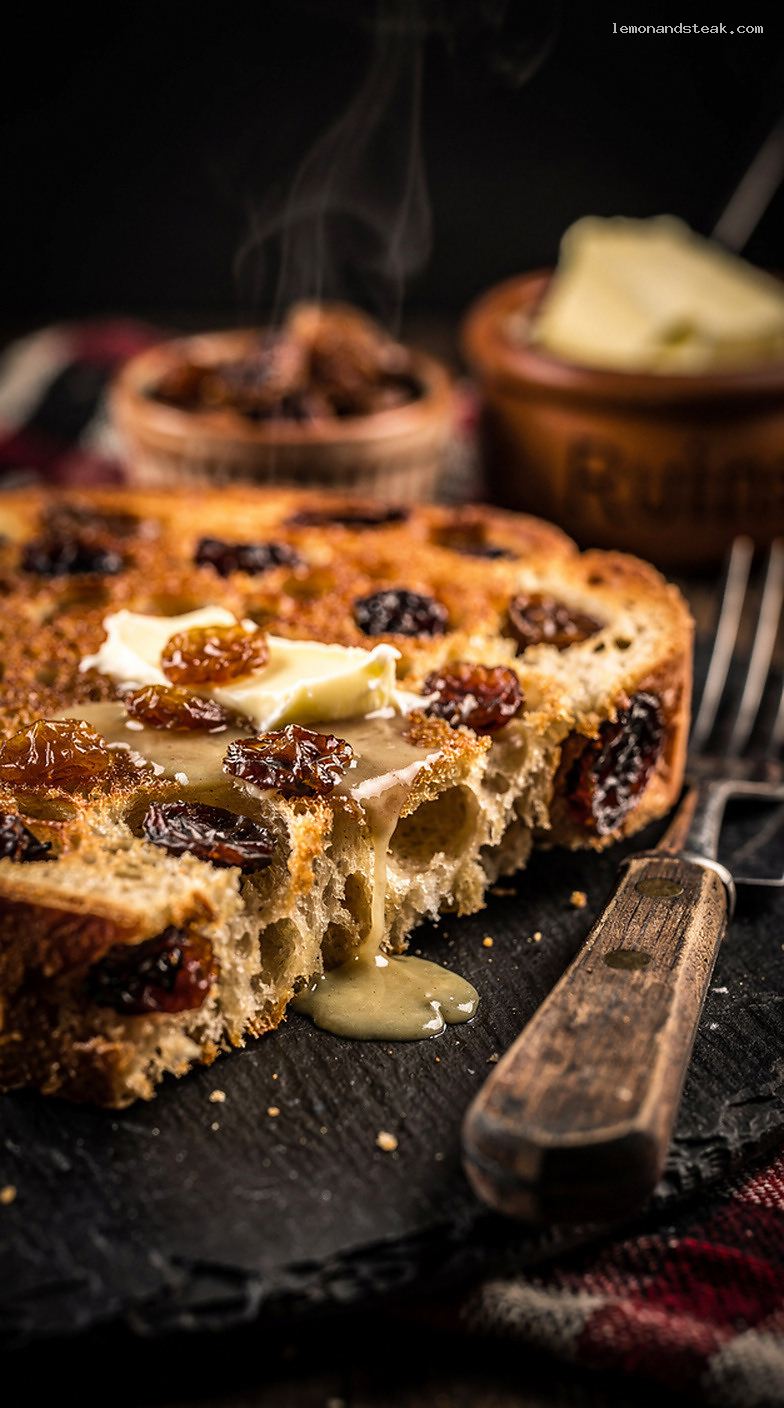
- Fantastic toasted: the edges crisp up while the inside stays buttery-soft.
Grocery List
- Produce: None (optional: 1 orange if making an orange-zest variation)
- Dairy: Whole milk, unsalted butter
- Pantry: Bread flour, granulated sugar, active dry yeast, fine salt, ground cinnamon (optional), raisins, neutral oil
Full Ingredients
Dough
- 3/4 cup (180 g) whole milk, warmed to 105–110°F (40–43°C)
- 1/4 cup (60 g) warm water, 105–110°F (40–43°C)
- 2 1/4 teaspoons (7 g) active dry yeast
- 1/4 cup (50 g) granulated sugar, divided (use 1 teaspoon for proofing)
- 1 large egg (about 50 g without shell), room temperature
- 4 tablespoons (56 g) unsalted butter, melted and cooled slightly (not hot)
- 3 1/4 cups (390 g) bread flour (spooned and leveled, or weighed)
- 1 1/4 teaspoons (7 g) fine salt
- 1 teaspoon ground cinnamon (optional)
Raisins
- 1 1/2 cups (225 g) raisins
- Hot water, for soaking
For the Pan and Finishing
- 1 teaspoon neutral oil or softened butter (to grease the bowl)
- Butter or nonstick spray (to grease a 9×5-inch / 23×13 cm loaf pan)
- Optional egg wash: 1 large egg + 1 tablespoon (15 g) water, whisked
- Optional finishing: 1 tablespoon (14 g) butter, melted (to brush on after baking)
Step-by-Step Instructions
Step 1: Plump the raisins (so they stay juicy in the loaf)
Place the raisins in a heatproof bowl and cover with hot water. Let soak for 10 minutes. Drain well, then spread the raisins on a clean kitchen towel or paper towels and pat dry thoroughly.
Why this matters: Soaked raisins stay tender and plump after baking instead of turning chewy or dry. Drying them well helps prevent the dough from becoming sticky.
Step 2: Proof the yeast
In a large mixing bowl (or the bowl of a stand mixer), combine the warm milk (105–110°F / 40–43°C), warm water (105–110°F / 40–43°C), yeast, and 1 teaspoon of the sugar. Stir and let stand for 5–10 minutes, until foamy on top.
If you don’t see foam, your yeast may be old or the liquid may have been too hot or too cool. It’s best to start over before using all your ingredients.
Step 3: Mix the dough
Add the remaining sugar, the egg, and the melted butter to the yeast mixture and stir until combined. Add the bread flour, salt, and cinnamon (if using).
Mix until a shaggy dough forms, scraping down the bowl as needed. If using a stand mixer, use the dough hook on low speed until the flour is mostly absorbed.
Step 4: Knead until smooth and elastic
Knead by hand on a lightly floured surface for 8–10 minutes, or knead in a stand mixer on medium-low speed for 6–8 minutes, until the dough is smooth, elastic, and slightly tacky but not sticky.
Dough check: If you pinch off a small piece and gently stretch it, it should form a thin “window” before tearing (the windowpane test). If it tears immediately, knead 2 minutes more and test again.
Step 5: Knead in the raisins
Flatten the dough into a rough rectangle. Sprinkle about one-third of the raisins over the dough, fold, and knead gently. Repeat until all raisins are evenly incorporated, about 1–2 minutes.
If raisins pop out while kneading, just press them back in—this is normal.
Step 6: First rise (bulk fermentation)
Lightly oil a large bowl. Place the dough inside, turning once to coat. Cover the bowl with a clean towel or plastic wrap.
Let rise in a warm spot until doubled in size, about 60–90 minutes (aim for around 75–80°F / 24–27°C if possible).
Step 7: Shape the loaf and rise again
Grease a 9×5-inch (23×13 cm) loaf pan. Turn the dough out onto a lightly floured surface and gently press it into a rectangle about 8×12 inches. Starting from a short end, roll it up tightly into a log, pinching the seam closed. Tuck the ends under for a neat shape.
Place the dough seam-side down in the pan. Cover and let rise until the loaf domes about 1 inch above the rim, about 45–60 minutes.
Step 8: Bake until deeply golden and cooked through
About 20 minutes before baking, preheat the oven to 350°F (175°C) with a rack in the center.
If using egg wash, gently brush the top of the risen loaf with the egg wash (try not to deflate it). Bake for 35–40 minutes, until the top is a rich golden brown and the internal temperature reaches 190°F (88°C).
If the top browns too quickly, loosely tent with foil for the last 10 minutes of baking.
Step 9: Cool properly for clean slices
Remove the pan from the oven and let the loaf cool in the pan for 10 minutes. Turn it out onto a wire rack. If you like a softer crust, brush the top with 1 tablespoon (14 g) melted butter while warm.
Cool for at least 1 hour before slicing. Slicing too early can make the bread gummy.
Pro Tips
- Measure flour by weight if you can: Too much flour is the #1 cause of dense bread. Use 390 g for reliable results.
- Keep raisins from sinking or streaking: Soak, drain, and dry them well, then add after the dough is kneaded and strong.
- Use an instant-read thermometer: Pull the loaf at 190°F (88°C) internal for a soft, fully baked crumb.
- Want extra-tall slices? Don’t rush the second rise. Bake when the dough is nicely domed about 1 inch above the pan rim.
- Best toast: Slice, toast until the edges are crisp, and spread with salted butter or honey.
Variations
- Cinnamon swirl raisin bread: Roll the dough into an 8×12-inch rectangle, brush with 1 tbsp melted butter, sprinkle with a mix of 2 tbsp (25 g) sugar + 2 tsp cinnamon, then roll up and pan as directed.
- Orange-raisin loaf: Add 1 tbsp finely grated orange zest to the dough with the flour. Optional: swap 2 tbsp of the water for orange juice.
- Raisin-nut bread: Replace 1/2 cup (75 g) of raisins with 1/2 cup (60 g) chopped toasted walnuts or pecans.
Storage & Make-Ahead
Let the loaf cool completely, then store at room temperature in a bread bag or tightly wrapped for up to 3 days. For longer storage, slice the loaf, wrap well, and freeze for up to 2 months; toast slices straight from frozen.
Make-ahead option: After shaping and placing the dough in the loaf pan, cover tightly and refrigerate for up to 12–16 hours. The next day, let it sit at room temperature until domed about 1 inch over the rim (often 60–90 minutes), then bake as directed.
Nutrition (per serving)
Approximate per slice (1/12 loaf): 220 calories, 5 g protein, 40 g carbs, 5 g fat, 2 g fiber, 15 g sugars, 240 mg sodium. Values vary by brand and exact ingredients.
Leave a Reply