
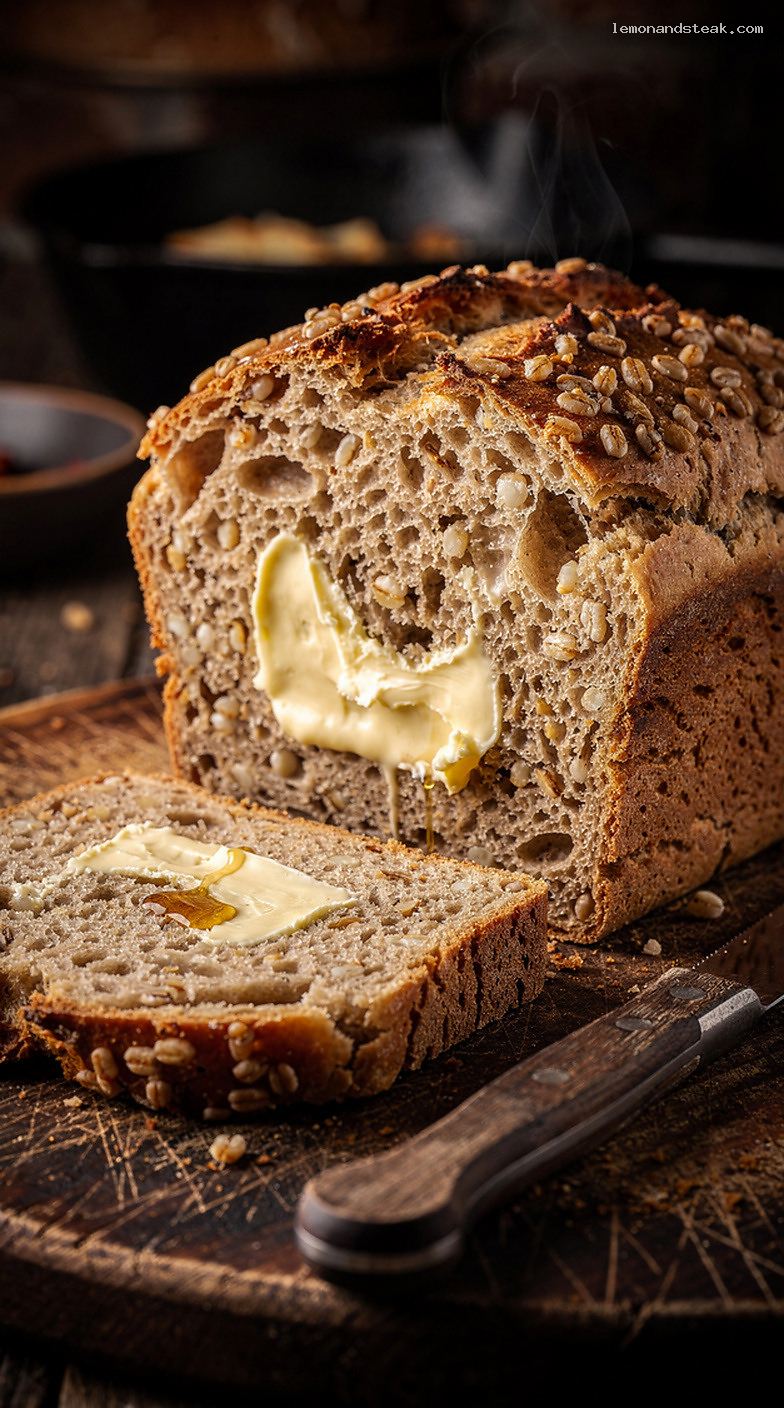
Quick Recipe Version (TL;DR)
Quick Ingredients
- 1 cup (170 g) cooked pearl barley, cooled (see Full Ingredients for how much dry barley to cook)
- 1 cup (240 g) warm water (105–110°F / 40–43°C)
- 2 1/4 tsp (7 g) active dry yeast
- 2 tbsp (42 g) honey
- 2 tbsp (28 g) olive oil
- 3 cups (360 g) bread flour
- 1 cup (120 g) barley flour
- 1 tbsp (9 g) vital wheat gluten (optional but recommended)
- 1 1/2 tsp (10 g) fine sea salt
- 1 tbsp (14 g) melted butter (for pan) or 1 tbsp (15 ml) oil
- 1 tbsp (10 g) barley flakes or rolled oats (optional topping)
Do This
- 1. Stir yeast + warm water + honey; rest 5–10 minutes until foamy.
- 2. Mix in olive oil, cooled cooked barley, bread flour, barley flour, gluten (optional), and salt.
- 3. Knead 8–10 minutes until elastic; dough will be slightly tacky.
- 4. Rise covered in a warm spot 60–90 minutes until doubled.
- 5. Shape into a loaf, place in a greased 9×5-inch pan; proof 45–60 minutes until domed 1 inch over the rim.
- 6. Bake at 375°F (190°C) for 40–45 minutes until deep golden and 200–205°F (93–96°C) inside.
- 7. Cool at least 1 hour before slicing for the best chewy crumb.
Why You’ll Love This Recipe
- Hearty and satisfying: cooked barley adds chew and a rustic, homestyle feel.
- Mild nutty flavor: barley flour brings gentle sweetness and depth without being overpowering.
- Reliable for home bakers: bread flour provides structure so the loaf rises well.
- Great for toast and sandwiches: sturdy slices that don’t crumble.
Grocery List
- Produce: None (optional: fresh rosemary or thyme)
- Dairy: Butter (or use oil to keep it dairy-free)
- Pantry: Pearl barley, barley flour, bread flour, honey, olive oil, active dry yeast, fine sea salt, vital wheat gluten (optional), barley flakes or rolled oats (optional)
Full Ingredients
Cooked Barley (for the dough)
- 1/2 cup (90 g) dry pearl barley
- 2 cups (480 g) water
- 1/4 tsp fine sea salt
- You will use 1 cup (170 g) cooked barley in the dough; save any extra for soup or breakfast bowls.
Dough
- 1 cup (240 g) warm water (105–110°F / 40–43°C)
- 2 1/4 tsp (7 g) active dry yeast
- 2 tbsp (42 g) honey
- 2 tbsp (28 g) olive oil
- 3 cups (360 g) bread flour
- 1 cup (120 g) barley flour
- 1 tbsp (9 g) vital wheat gluten (optional but recommended for a taller loaf)
- 1 1/2 tsp (10 g) fine sea salt
- 1 cup (170 g) cooked pearl barley, cooled to room temperature
For the Pan and Topping (optional)
- 1 tbsp (14 g) melted butter (for greasing the pan) or 1 tbsp (15 ml) oil
- 1 tbsp (10 g) barley flakes or rolled oats, for sprinkling
- 1 tsp (5 ml) water, for brushing the top (helps topping stick)
Step-by-Step Instructions
Step 1: Cook the barley and cool it
In a small saucepan, combine the dry pearl barley (1/2 cup / 90 g), water (2 cups / 480 g), and salt (1/4 tsp). Bring to a boil over high heat, then reduce to a gentle simmer and cover.
Simmer for 30–35 minutes, or until the barley is tender and most of the water is absorbed. Drain if needed. Spread the cooked barley on a plate or sheet pan to cool faster. Measure out 1 cup (170 g) cooked barley for the dough and make sure it’s cool to the touch before mixing (hot barley can weaken yeast).
Step 2: Bloom the yeast
In a large mixing bowl (or the bowl of a stand mixer), combine the warm water (1 cup / 240 g), yeast (2 1/4 tsp / 7 g), and honey (2 tbsp / 42 g). Stir well.
Let stand for 5–10 minutes, until the mixture looks foamy on top. If it doesn’t foam, your yeast may be expired or the water may have been too hot or too cool.
Step 3: Mix the dough
Add the olive oil (2 tbsp / 28 g) and the cooled cooked barley (1 cup / 170 g) to the yeast mixture. Stir to combine; the barley will look chunky and rustic.
Add the bread flour (3 cups / 360 g), barley flour (1 cup / 120 g), vital wheat gluten if using (1 tbsp / 9 g), and salt (1 1/2 tsp / 10 g). Mix until a shaggy dough forms and no dry flour remains. If the dough looks very dry and won’t come together, add water 1 tablespoon (15 g) at a time (up to 2–3 tablespoons total) until it holds together.
Step 4: Knead until elastic
By stand mixer: Knead with a dough hook on medium-low speed for 8 minutes.
By hand: Turn the dough onto a lightly floured counter and knead for 10 minutes. Because of the barley, the dough may feel slightly tacky and textured; aim for a dough that is elastic and stretches without tearing too quickly.
Form into a smooth ball. If it’s sticking excessively to your hands or the bowl, dust with 1–2 tablespoons of bread flour as needed (avoid adding too much or the loaf can turn dense).
Step 5: First rise (bulk fermentation)
Lightly oil the bowl, place the dough inside, and turn it once so the surface is lightly coated. Cover with a lid or damp towel.
Let rise in a warm spot (about 75–80°F / 24–27°C) for 60–90 minutes, or until doubled in size. Barley flour can slow fermentation slightly, so use the “doubled” cue more than the clock.
Step 6: Shape the loaf and proof
Grease a 9×5-inch loaf pan with melted butter (1 tbsp / 14 g) or oil. Turn the dough out onto a lightly floured surface and gently press into a rectangle about the width of your pan.
Roll it up tightly into a log, pinch the seam closed, and place seam-side down in the pan. Cover loosely.
Proof for 45–60 minutes, until the dough crowns about 1 inch above the rim of the pan and springs back slowly when gently pressed.
Step 7: Bake until deep golden
About 20 minutes before baking, preheat the oven to 375°F (190°C) with a rack in the center.
If using a topping, brush the loaf lightly with 1 tsp (5 ml) water and sprinkle with 1 tbsp (10 g) barley flakes or rolled oats.
Bake for 40–45 minutes, rotating the pan once halfway through. The loaf should be a deep golden brown, and the internal temperature in the center should read 200–205°F (93–96°C) on an instant-read thermometer.
If the top is browning too quickly, tent loosely with foil for the last 10–15 minutes.
Step 8: Cool completely before slicing
Remove the bread from the pan right away and cool on a wire rack for at least 1 hour. This sets the crumb so you get clean slices (and maximum chew) instead of a gummy center.
Pro Tips
- Cool the barley thoroughly: warm barley can weaken yeast and make the dough sticky and sluggish.
- Vital wheat gluten helps: barley flour has less gluten than wheat; adding 1 tablespoon improves rise and sliceability.
- Use a thermometer for doneness: aim for 200–205°F in the center for a fully baked, not-doughy loaf.
- Don’t rush the cool: slicing too early compresses the crumb and makes it seem “underbaked” even when it isn’t.
- Want a darker crust? Bake 5 extra minutes, or remove from the pan for the last 5 minutes and place the loaf directly on the rack.
Variations
- Seeded barley bread: Add 2 tbsp (18 g) flaxseed and 2 tbsp (20 g) sunflower seeds with the dry ingredients.
- Herb barley loaf: Mix in 1 tbsp chopped fresh rosemary (or 1 tsp dried) plus 1/2 tsp black pepper for a savory, steakhouse-style bread.
- Dairy-free version: Use oil instead of butter for the pan; the dough itself is already dairy-free.
Storage & Make-Ahead
Let the loaf cool completely, then store at room temperature in a bread bag or tightly wrapped for 2 days. For longer storage, slice and freeze in a sealed freezer bag for up to 3 months. Toast slices straight from frozen.
Make-ahead option: cook the barley up to 2 days in advance and refrigerate it. Bring to room temperature (or at least not cold) before mixing into the dough for the most even rise.
Nutrition (per serving)
Approximate, per slice (1/12 loaf): 185 calories; 4 g protein; 3 g fat; 36 g carbohydrates; 3 g fiber; 7 g sugars; 250 mg sodium.
Leave a Reply