
Quick Recipe Version (TL;DR)
Quick Ingredients
- 240 g bread flour (2 cups)
- 160 g buckwheat flour (1 1/3 cups)
- 7 g active dry yeast (2 1/4 tsp)
- 10 g fine sea salt (1 3/4 tsp)
- 220 ml warm water, 38–43°C / 100–110°F (scant 1 cup)
- 100 ml buttermilk, room temperature (about 7 tbsp)
- 15 ml apple cider vinegar (1 tbsp)
- 15 g honey or molasses (1 tbsp)
- 18 g olive oil (1 1/2 tbsp)
- Optional topping: 1 tbsp buckwheat groats or sesame seeds
Do This
- 1. Mix flours, yeast, and salt; whisk water, buttermilk, vinegar, honey, and oil.
- 2. Stir wet into dry to make a sticky dough; rest 20 minutes.
- 3. Knead 5–7 minutes (or do 3 sets of stretch-and-folds over 30 minutes).
- 4. Cover and rise 60–90 minutes until puffy and about doubled.
- 5. Shape into a tight round; proof 45–60 minutes while you preheat oven and Dutch oven to 232°C / 450°F.
- 6. Score and bake in the hot Dutch oven: 20 minutes covered at 232°C / 450°F, then 20–25 minutes uncovered at 218°C / 425°F.
- 7. Cool at least 2 hours before slicing for the best texture.
Why You’ll Love This Recipe
- Deep, earthy flavor: Buckwheat adds a nutty, rustic taste that feels extra hearty.
- Mild tang without sourdough fuss: Buttermilk and vinegar create a gentle, satisfying tang.
- Crackly crust, tender crumb: Baking in a Dutch oven gives you bakery-style results at home.
- Reliable rise: A blend of buckwheat and bread flour keeps the loaf sturdy, sliceable, and not dense.
Grocery List
- Produce: Fresh rosemary or thyme (optional)
- Dairy: Buttermilk
- Pantry: Bread flour, buckwheat flour, active dry yeast, fine sea salt, honey or molasses, apple cider vinegar, olive oil, optional buckwheat groats or sesame seeds
Full Ingredients
Dough
- Bread flour: 240 g (2 cups), plus 1–2 tbsp for dusting
- Buckwheat flour: 160 g (1 1/3 cups)
- Active dry yeast: 7 g (2 1/4 tsp)
- Fine sea salt: 10 g (1 3/4 tsp)
- Warm water: 220 ml (scant 1 cup), warmed to 38–43°C / 100–110°F
- Buttermilk: 100 ml (about 7 tbsp), room temperature
- Apple cider vinegar: 15 ml (1 tbsp)
- Honey or molasses: 15 g (1 tbsp)
- Olive oil: 18 g (1 1/2 tbsp)
Optional Topping
- Buckwheat groats or sesame seeds: 1 tbsp (for a rustic look and extra crunch)
Step-by-Step Instructions
Step 1: Prep your pan and plan your bake
Line a medium bowl with a clean kitchen towel and dust it generously with bread flour (this helps prevent sticking during the final proof). If you have a banneton, use it instead, still dusted with flour.
Set a 4–6 quart Dutch oven (with lid) aside for now. You’ll preheat it later for the best crust.
Step 2: Mix the dry ingredients
In a large mixing bowl, whisk together 240 g bread flour, 160 g buckwheat flour, 7 g active dry yeast, and 10 g fine sea salt.
Whisking distributes the yeast and salt evenly, which helps the loaf rise consistently and taste balanced.
Step 3: Mix the wet ingredients and form the dough
In a measuring jug or medium bowl, whisk together 220 ml warm water, 100 ml buttermilk, 15 ml apple cider vinegar, 15 g honey (or molasses), and 18 g olive oil.
Pour the wet mixture into the dry ingredients. Stir with a sturdy spoon or dough whisk until no dry flour remains. The dough will be soft and slightly sticky (that’s good; it helps keep buckwheat bread from turning dry).
Step 4: Rest the dough (short autolyse)
Cover the bowl and let the dough rest for 20 minutes at room temperature. This gives the flours time to hydrate and makes the dough easier to handle.
Step 5: Develop structure and do the first rise
Turn the dough onto a lightly floured counter. Knead for 5–7 minutes, adding only a light dusting of bread flour as needed. Aim for a dough that becomes smoother and more elastic, but still a bit tacky.
If you prefer a lower-effort method: keep the dough in the bowl and do 3 sets of stretch-and-folds (grab an edge, stretch up, fold over) every 10 minutes for 30 minutes.
Place the dough in a lightly oiled bowl, cover, and let rise for 60–90 minutes at warm room temperature (about 22–24°C / 72–75°F) until puffy and close to doubled in size.
Step 6: Shape the loaf and proof
Gently turn the dough onto a lightly floured surface. Pat it into a rough circle, then shape into a tight round by folding edges toward the center and turning the dough seam-side down. Cup your hands around it and drag it slightly on the counter to build surface tension (this helps it stand tall).
Place seam-side up into the floured towel-lined bowl. Cover and proof for 45–60 minutes, until the dough looks noticeably lighter and slowly springs back when pressed gently.
Step 7: Preheat the oven and Dutch oven
About 30 minutes before baking, place the Dutch oven (with lid) on the middle rack and preheat the oven to 232°C / 450°F. A thoroughly heated pot is the secret to a bold, rustic crust.
Step 8: Score and bake
Carefully remove the hot Dutch oven. Place a sheet of parchment on the counter (about 30 cm / 12 inches square). Invert the proofed dough onto the parchment so it is seam-side down.
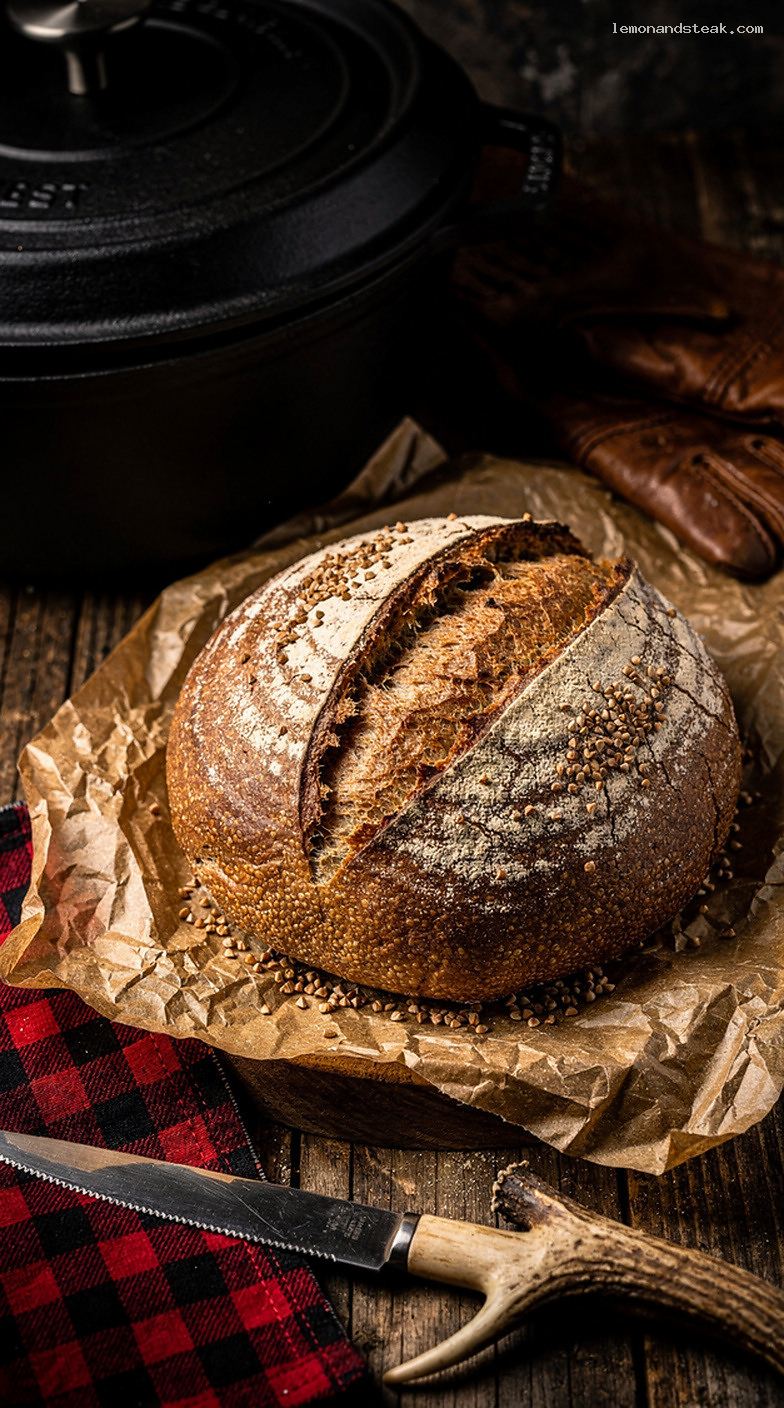
If using a topping, lightly mist or brush the surface with water, then sprinkle with 1 tbsp buckwheat groats or sesame seeds.
Score the top with a sharp knife or lame: one long slash (about 1 cm / 1/2 inch deep) or a simple cross.
Lift the loaf by the parchment and set it into the Dutch oven. Cover with the lid and bake for 20 minutes at 232°C / 450°F.
Remove the lid, reduce the oven temperature to 218°C / 425°F, and bake for 20–25 minutes more, until the crust is deeply browned and the center reads 96°C / 205°F on an instant-read thermometer.
Step 9: Cool completely before slicing
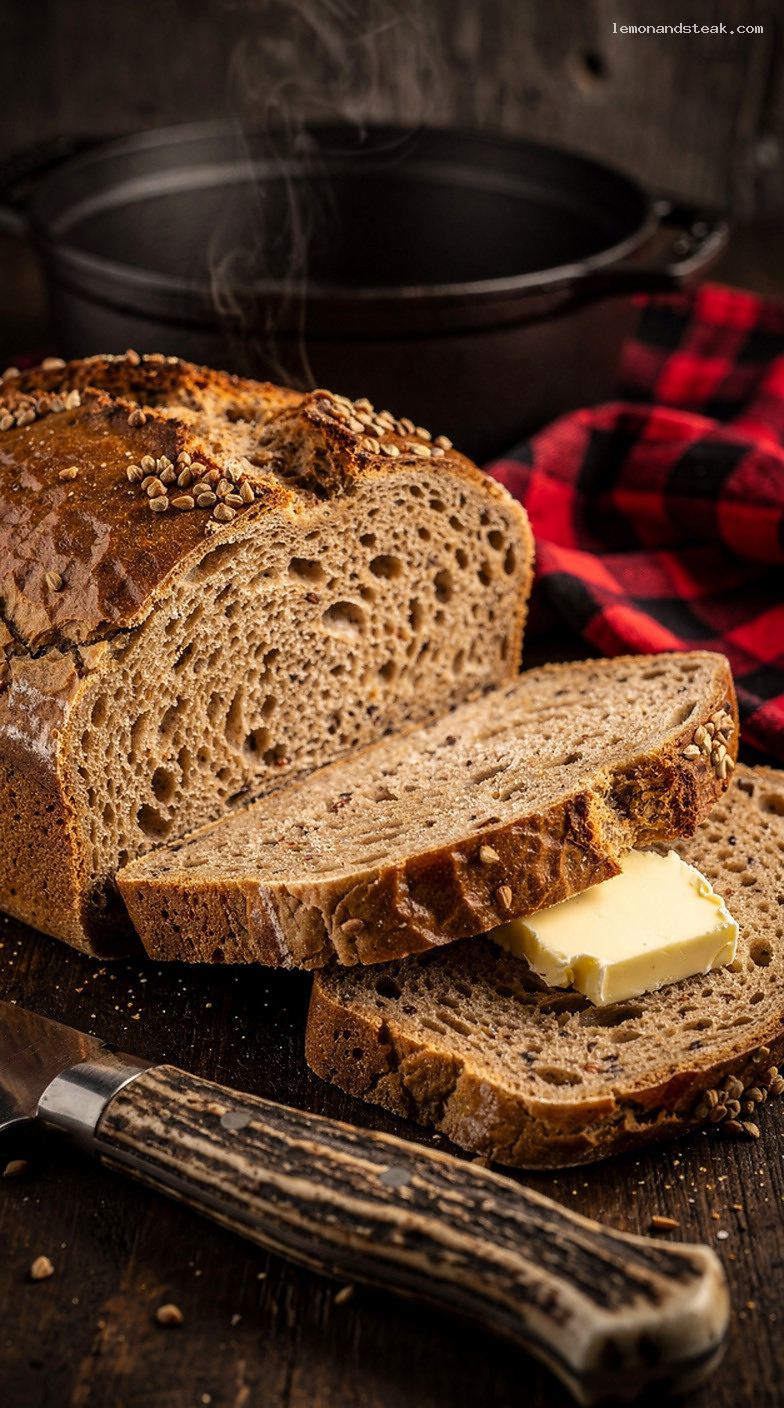
Transfer the loaf to a wire rack and cool for at least 2 hours. Buckwheat breads finish setting as they cool; slicing too early can make the crumb feel gummy even if it’s fully baked.
Pro Tips
- Weigh your flour if you can: Buckwheat flour compacts easily; a kitchen scale helps you get a consistent dough texture.
- Sticky dough is normal: Resist adding lots of extra flour. A slightly tacky dough bakes up tender instead of dry.
- Check doneness by temperature: Aim for 96°C / 205°F in the center for a loaf that’s baked through without over-drying.
- Let the crust get dark: Buckwheat’s earthy flavor shines with a deep bake; pale crust can taste flat.
- No Dutch oven? Bake on a preheated baking stone or sheet at 232°C / 450°F for 40–45 minutes, and place a metal pan with 1 cup boiling water on the lower rack for steam during the first 15 minutes.
Variations
- Seeded buckwheat loaf: Add 60 g (1/2 cup) sunflower seeds or pumpkin seeds to the dough when you first mix it.
- Caraway-rye vibe (without rye): Add 2 tsp caraway seeds and swap honey for 1 tbsp molasses for a deeper, deli-style flavor.
- Herby lodge bread: Add 1 tbsp finely chopped fresh rosemary (or 2 tsp dried rosemary) to the dry ingredients for an aromatic, savory loaf.
Storage & Make-Ahead
Cool the loaf completely, then store at room temperature in a paper bag or loosely wrapped in a clean towel for 2 days. For longer storage, slice once fully cooled and freeze in a zip-top freezer bag for up to 2 months. Toast slices straight from frozen.
Make-ahead option: after shaping, cover and refrigerate the dough for 8–12 hours for extra flavor. Bake directly from the fridge (it may need an extra 5–10 minutes of proofing at room temperature while the oven preheats).
Nutrition (per serving)
Approximate per slice (1/12 loaf): 180 calories, 6 g protein, 33 g carbs, 4 g fiber, 3 g fat, 2 g sugar, 390 mg sodium.
Leave a Reply