
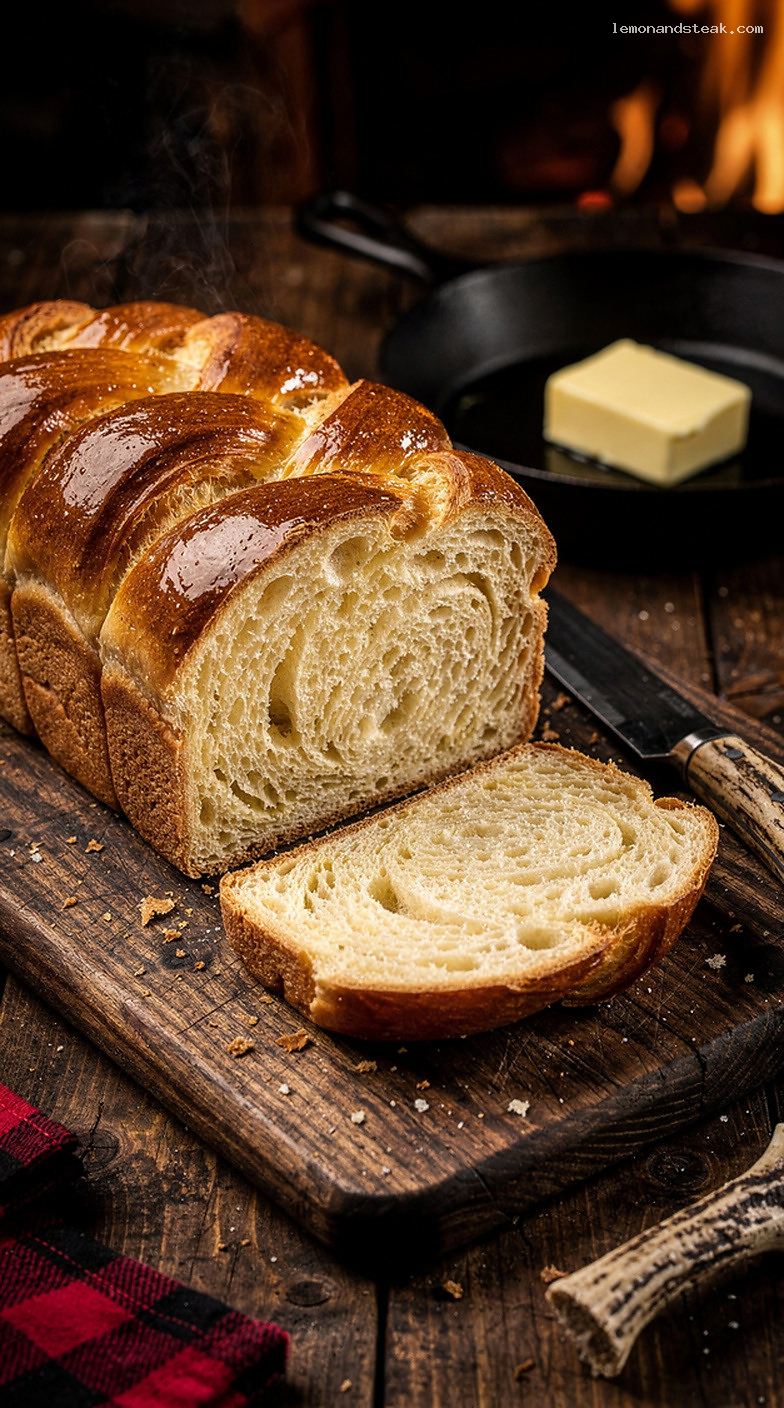
Quick Recipe Version (TL;DR)
Quick Ingredients
- 360 g bread flour (3 cups), plus a little extra for dusting
- 50 g granulated sugar (1/4 cup)
- 7 g instant yeast (2 1/4 tsp)
- 7 g fine salt (1 1/4 tsp)
- 120 g whole milk, warmed to 43°C / 110°F (1/2 cup)
- 3 large eggs (about 150 g without shells), room temperature
- 113 g unsalted butter (1/2 cup), softened and cut into 1 tbsp pieces
- 1 egg (for egg wash)
- 1 tbsp whole milk (for egg wash)
- 1 tbsp softened butter (for greasing the pan)
Do This
- 1) Mix flour, sugar, yeast, and salt; add warm milk and eggs and knead 5 minutes.
- 2) Add softened butter gradually; knead until smooth and stretchy, 10–15 minutes.
- 3) Rise at room temp until puffy (about 1 1/2–2 hours), then refrigerate 8–12 hours.
- 4) Shape into a loaf (or 8 small balls), place in a greased 23 x 13 cm / 9 x 5 in pan.
- 5) Proof until the dough crowns 2–3 cm (1 in) over the rim, 1 1/2–2 hours.
- 6) Brush with egg wash; bake at 177°C / 350°F for 30–35 minutes (88°C / 190°F internal). Cool 1 hour.
Why You’ll Love This Recipe
- Classic brioche texture: soft, tender, and lightly shreddable with a rich, buttery bite.
- Gorgeous golden crust: the egg wash gives that bakery-style shine.
- Reliable for home kitchens: an overnight chill makes the dough easy to handle and boosts flavor.
- Versatile: perfect for toast, French toast, sandwiches, or simply with butter.
Grocery List
- Produce: Optional: 1 lemon (for zest, if you want a subtle aroma)
- Dairy: Whole milk, unsalted butter
- Pantry: Bread flour, granulated sugar, instant yeast, fine salt
Full Ingredients
For the Brioche Dough
- Bread flour: 360 g (3 cups), plus extra for dusting
- Granulated sugar: 50 g (1/4 cup)
- Instant yeast: 7 g (2 1/4 tsp)
- Fine salt: 7 g (1 1/4 tsp)
- Whole milk: 120 g (1/2 cup), warmed to 43°C / 110°F
- Eggs: 3 large, room temperature
- Unsalted butter: 113 g (1/2 cup), softened (about 21°C / 70°F), cut into 1 tbsp pieces
- Optional: 1 tsp finely grated lemon zest (for a subtle French-bakery aroma)
For the Pan and Finish
- Butter for greasing: 1 tbsp softened butter
- Egg wash: 1 large egg + 1 tbsp whole milk (whisked together)
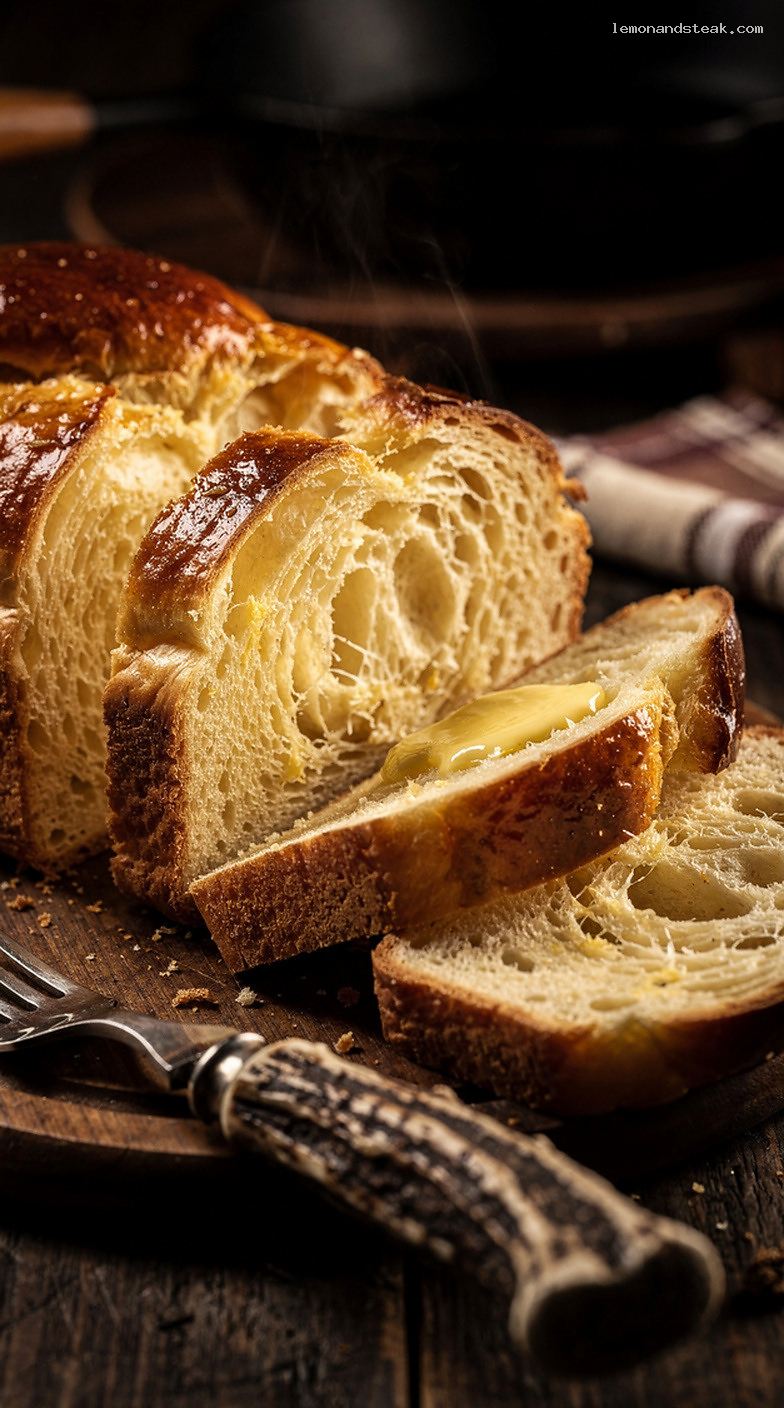
Step-by-Step Instructions
Step 1: Set up your pan and ingredients
Grease a 23 x 13 cm (9 x 5 in) loaf pan thoroughly with 1 tbsp softened butter. If you like extra insurance, line the pan with parchment so it overhangs the long sides (this makes lifting the loaf out easy), then butter the parchment lightly.
Warm the milk to 43°C / 110°F (it should feel warm, not hot). Make sure the eggs are at room temperature so the dough mixes smoothly.
Step 2: Mix the dough
Stand mixer method (recommended): In the bowl of a stand mixer, whisk together the bread flour, sugar, instant yeast, and salt. Add the warm milk and 3 eggs (and optional lemon zest). Fit the mixer with a dough hook and mix on medium-low speed for 3–5 minutes, scraping the bowl once or twice, until a shaggy dough forms.
By hand: Mix the dry ingredients in a large bowl. Add milk and eggs and stir with a sturdy spoon until a rough dough forms, then knead on a clean counter for about 8 minutes before moving on to adding the butter (your dough will be sticky; resist adding lots of extra flour).
Step 3: Knead in the butter gradually
With the mixer running on medium-low, add the softened butter one tablespoon at a time, waiting until each addition is mostly absorbed before adding the next. This gradual method is the key to a smooth, rich brioche dough.
Once all the butter is added, continue kneading on medium for 10–15 minutes, until the dough looks glossy, gathers around the hook, and becomes stretchy. It should pass a windowpane test: pinch off a small piece and gently stretch it; you should be able to stretch it thin enough to let light through without tearing quickly.
If the dough is very slack, stop and scrape down the bowl, then knead 2–3 minutes more. Avoid adding flour unless the dough is truly soupy; brioche dough should be soft and slightly tacky.
Step 4: First rise until puffy
Shape the dough into a rough ball (a bowl scraper helps), place it in a lightly buttered bowl, and cover tightly. Let rise at 24°C / 75°F until visibly puffy and expanded, about 1 1/2–2 hours. It may not perfectly double—look for a noticeable increase and a lighter, aerated feel.
Step 5: Chill the dough overnight for best flavor and easy shaping
Gently press down the dough to release excess gas, cover the bowl tightly, and refrigerate for 8–12 hours. This chill firms the butter, makes shaping much easier, and improves flavor.
If you need to move faster, you can chill for a minimum of 2 hours, but the dough will be softer and a bit trickier to handle.
Step 6: Shape the loaf (two easy options)
Turn the cold dough out onto a lightly floured counter and pat it into a rectangle. Choose one shaping method below.
Option A: Classic rolled loaf
Roll the dough into a rectangle about 20 x 30 cm (8 x 12 in). Starting from the short end, roll up tightly into a log, pinch the seam closed, and place seam-side down in the prepared loaf pan.
Option B: Brioche “pull-apart” loaf
Divide the dough into 8 equal pieces (about 95 g each). Shape each piece into a smooth ball (pinch the seams underneath). Arrange the balls in the loaf pan in two rows. This creates a beautiful pull-apart pattern and very tender slices.
Step 7: Proof until tall and airy
Cover the pan loosely with lightly buttered plastic wrap (or a reusable cover). Proof at warm room temperature, ideally around 24–26°C / 75–79°F, until the dough rises to 2–3 cm (about 1 in) above the rim of the pan, about 1 1/2–2 hours.
The dough should look very puffy and jiggle slightly if you gently shake the pan. If your kitchen is cool, this can take longer; go by the look and feel more than the clock.
Step 8: Egg wash and bake
About 20 minutes before baking, place a rack in the lower-middle of the oven and preheat to 177°C / 350°F.
Whisk together 1 egg and 1 tbsp milk. Brush a thin, even layer over the top of the proofed dough (try not to let wash pool around the edges, which can “glue” the loaf to the pan).
Bake for 30–35 minutes, rotating the pan at the 20-minute mark for even browning. The top should be a deep golden brown, and the internal temperature in the center should read 88°C / 190°F.
If the top is browning too quickly, tent loosely with foil for the final 10 minutes while it finishes baking through.
Step 9: Cool properly for the best texture
Let the loaf cool in the pan for 10 minutes, then turn it out onto a wire rack. Cool for at least 1 hour before slicing. Brioche continues to set as it cools; slicing too early can compress the crumb.
Pro Tips
- Use a scale if you can: brioche is all about ratios, and weighing flour (360 g) makes results much more consistent.
- Butter temperature matters: softened butter (around 21°C / 70°F) blends in smoothly; melted butter can make the dough greasy and slow to rise.
- Don’t rush the knead: a fully developed dough is what gives brioche its tender, slightly shreddable crumb.
- Proof by look, not the clock: underproofed brioche can split; properly proofed dough looks pillowy and slightly wobbly.
- Check doneness with a thermometer: pull the loaf at 88°C / 190°F internal for a fully baked, soft center.
Variations
- Brioche with pearl sugar: after egg wash, sprinkle 2 tbsp pearl sugar over the top for a sweet crunch.
- Cinnamon brioche loaf: roll the dough out, spread with 2 tbsp softened butter, sprinkle with 50 g (1/4 cup) brown sugar plus 2 tsp cinnamon, then roll and bake as directed.
- Mini brioche buns: divide into 10 pieces (about 75 g each), proof on a sheet pan, egg wash, and bake at 190°C / 375°F for 14–16 minutes.
Storage & Make-Ahead
Room temperature: Store tightly wrapped at room temperature for up to 2 days. Brioche dries out faster than lean breads, so keep it well sealed.
Freeze: Slice the fully cooled loaf, wrap slices tightly, and freeze up to 2 months. Toast from frozen (it’s excellent this way).
Make-ahead schedule: Mix and knead the dough in the evening, rise for 1 1/2–2 hours, refrigerate overnight (8–12 hours), shape and proof in the morning, then bake.
Nutrition (per serving)
Approximate per slice (1/12 loaf): 260 calories, 12 g fat (7 g saturated), 31 g carbohydrates (6 g sugars, 1 g fiber), 7 g protein, 220 mg sodium, 95 mg cholesterol.
Leave a Reply