
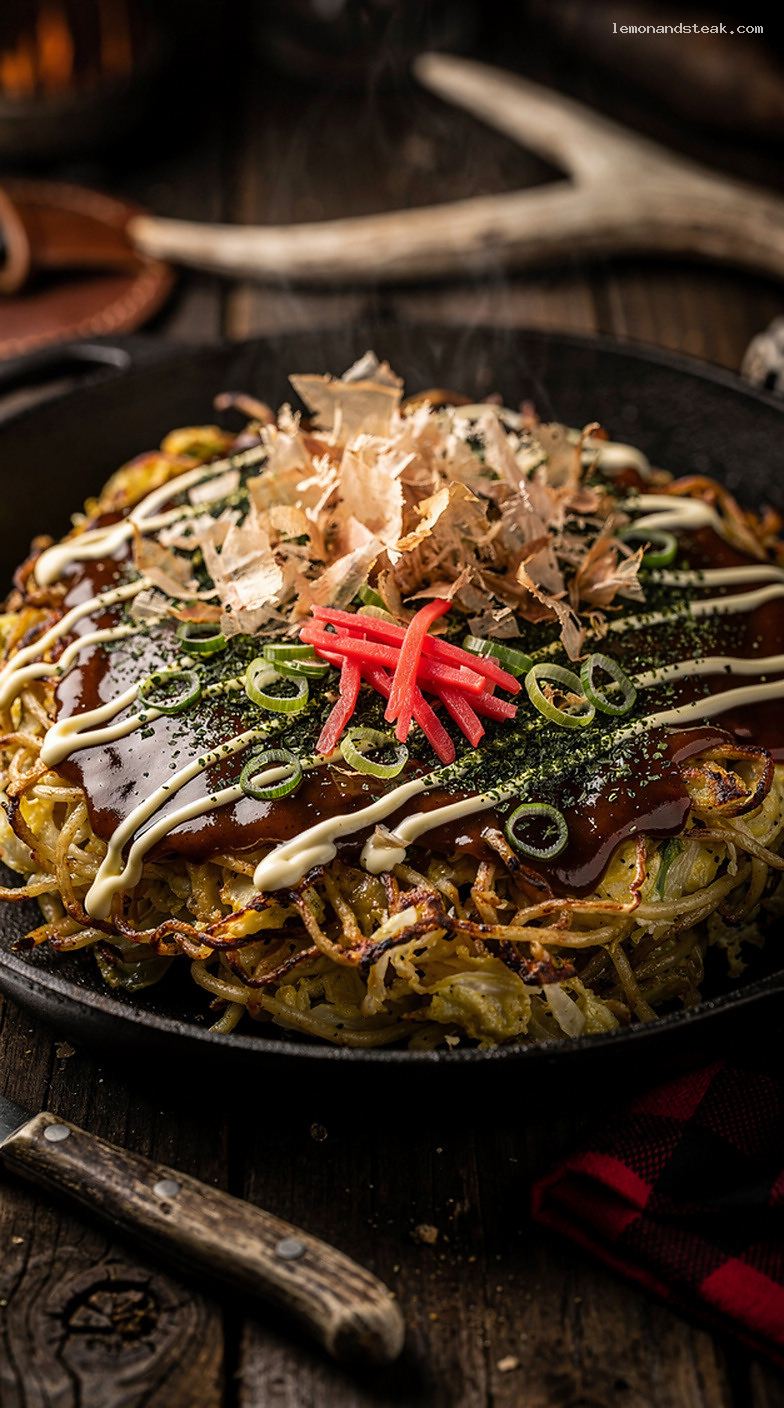
Quick Recipe Version (TL;DR)
Quick Ingredients
- 4 cups (300 g) finely shredded green cabbage
- 1/2 cup (50 g) sliced scallions
- 1 cup (120 g) all-purpose flour
- 1 tsp baking powder
- 1/2 tsp kosher salt
- 3/4 cup (180 ml) dashi (or water)
- 2 large eggs
- 1/4 cup (30 g) tenkasu (tempura bits), optional
- 1/4 cup (30 g) beni shoga (pickled red ginger), optional
- 4 oz (115 g) thin-sliced pork belly (or thick-cut bacon strips)
- 2 tbsp neutral oil (for pan)
- Okonomiyaki sauce + Japanese mayonnaise + aonori + bonito flakes (to finish)
Do This
- 1) Whisk flour, baking powder, salt, dashi, and eggs until just smooth.
- 2) Fold in cabbage, scallions, and (optional) tenkasu and pickled ginger.
- 3) Heat a skillet over medium heat (aim for about 350°F / 175°C surface temp); oil lightly.
- 4) Mound half the batter into a 7–8 inch pancake; top with pork belly.
- 5) Cook covered 4–5 minutes; flip and cook covered 4–5 minutes more.
- 6) Flip once more for 30–60 seconds to re-crisp; repeat for the second pancake.
- 7) Brush with okonomiyaki sauce, drizzle mayo, and top with aonori and bonito flakes.
Why You’ll Love This Recipe
- Big, satisfying comfort food: crisp edges, tender cabbage, and a savory-sweet finish.
- Flexible “use what you have” recipe: swap proteins and add-ins easily.
- Restaurant-style toppings at home with simple sauces and a regular skillet.
- Fast cooking: two hearty pancakes in about 10 minutes on the stove.
Grocery List
- Produce: green cabbage, scallions, (optional) pickled red ginger (beni shoga)
- Dairy: eggs, (optional) Japanese mayonnaise (Kewpie-style)
- Pantry: all-purpose flour, baking powder, kosher salt, neutral oil, dashi (or Hondashi + water), ketchup, Worcestershire sauce, soy sauce, oyster sauce, sugar, tempura bits (tenkasu, optional), aonori (dried green seaweed, optional), katsuobushi (bonito flakes, optional)
- Meat/Seafood: thin-sliced pork belly (or bacon)
Full Ingredients
Okonomiyaki Batter
- 1 cup (120 g) all-purpose flour
- 1 tsp baking powder
- 1/2 tsp kosher salt
- 3/4 cup (180 ml) dashi, at room temperature (or water)
- 2 large eggs
- Optional, for extra fluff: 1/4 cup (60 g) grated nagaimo (Japanese mountain yam) or 2 tbsp mayonnaise mixed into the batter
Vegetables and Mix-Ins
- 4 cups (300 g) finely shredded green cabbage (very thin shreds cook best)
- 1/2 cup (50 g) thinly sliced scallions
- Optional: 1/4 cup (30 g) tenkasu (tempura bits) for crunch
- Optional: 1/4 cup (30 g) beni shoga (pickled red ginger), drained and finely chopped
Protein Topping (Choose One)
- 4 oz (115 g) thin-sliced pork belly (typical Osaka-style)
- OR 4 oz (115 g) bacon (about 4 slices), laid flat on top
For Pan-Frying
- 2 tbsp neutral oil (such as canola or grapeseed), divided
Okonomiyaki Sauce (Homemade) and Finishing Toppings
- Homemade okonomiyaki sauce (makes about 1/2 cup):
- 1/4 cup (60 ml) ketchup
- 2 tbsp (30 ml) Worcestershire sauce
- 1 tbsp (15 ml) soy sauce
- 1 tbsp (15 ml) oyster sauce
- 1 tbsp (12 g) granulated sugar
- 1/4 cup (60 g) Japanese mayonnaise (Kewpie-style), for drizzling
- 1 tbsp (2 g) aonori (dried green seaweed), optional
- 1/2 cup (10–15 g) katsuobushi (bonito flakes), optional
- Optional: extra sliced scallions and extra pickled ginger for serving
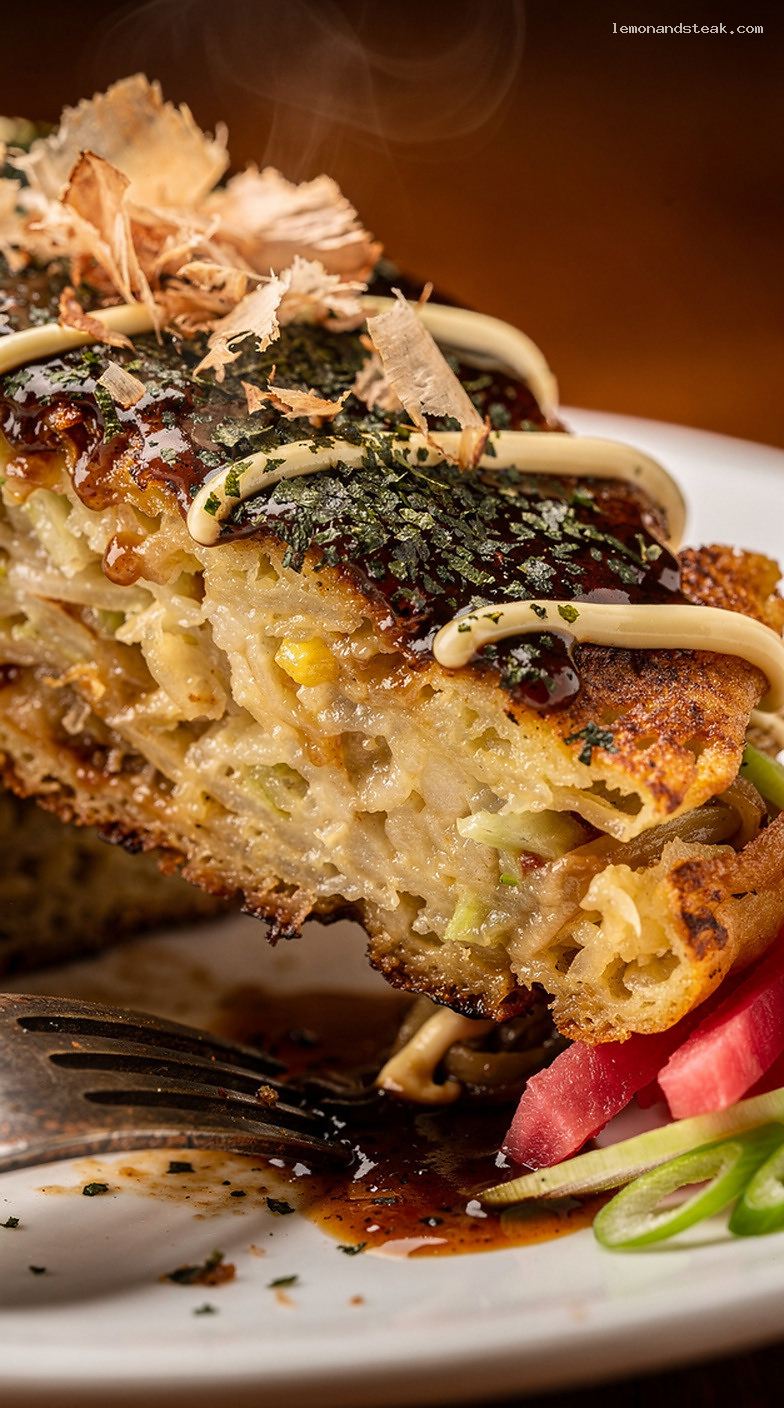
Step-by-Step Instructions
Step 1: Prep the cabbage and toppings
Finely shred the cabbage (thin shreds help the pancake cook through before the outside over-browns). Slice the scallions. If using pickled red ginger (beni shoga), chop it finely and drain off excess liquid. Lay out the pork belly (or bacon) so it’s ready to place on top.
Step 2: Mix the homemade okonomiyaki sauce (optional but recommended)
In a small bowl, whisk together ketchup, Worcestershire sauce, soy sauce, oyster sauce, and sugar until smooth. Set aside. (If you’re using a store-bought okonomiyaki sauce, you can skip this step.)
Step 3: Make the batter
In a large bowl, whisk the flour, baking powder, and kosher salt. Add the dashi and eggs, then whisk just until you don’t see dry flour.
Tip: Stop as soon as the batter comes together. Overmixing can make the pancake tougher instead of tender.
Step 4: Fold in the cabbage mixture
Add the shredded cabbage and scallions to the batter. If using tenkasu and/or pickled ginger, add them now. Use a spatula to fold everything together until the cabbage is evenly coated.
The mixture will look very cabbage-heavy. That’s exactly right: okonomiyaki is more cabbage than batter.
Step 5: Preheat the skillet and shape the first pancake
Heat a 10–12 inch nonstick or well-seasoned cast iron skillet over medium heat until the surface is about 350°F / 175°C (a drop of water should sizzle and evaporate quickly, not instantly smoke).
Add 1 tbsp neutral oil and swirl to coat. Scoop in half the mixture, then press it into a thick, even round about 7–8 inches wide and 3/4 inch thick. Arrange half the pork belly (or bacon) strips on top.
Step 6: Cook covered, then flip
Cover the skillet with a lid and cook for 4–5 minutes, or until the bottom is deeply golden and the pancake feels set when you nudge it.
Slide a wide spatula underneath and flip in one confident motion. (If you’re nervous, you can flip onto a plate, then slide it back into the pan.) Cover again and cook for another 4–5 minutes, until the pork is cooked and the second side is browned.
Flip one more time and cook uncovered for 30–60 seconds to re-crisp the first side.
Step 7: Finish, serve, and cook the second pancake
Transfer to a plate. Brush or drizzle generously with okonomiyaki sauce, then drizzle Japanese mayonnaise in thin lines (a squeeze bottle helps). Sprinkle with aonori and a loose handful of bonito flakes. Serve hot.
Repeat Steps 5–7 with the remaining oil, batter, and pork belly to make the second pancake.
Pro Tips
- Slice cabbage thinly: Thin shreds soften quickly and bind better, giving you a tender center with crisp edges.
- Keep the heat at medium: Too hot browns the outside before the cabbage turns tender. Aim for about 350°F / 175°C skillet surface temperature.
- Use a lid: Covering traps steam, helping the thick pancake cook through without drying out.
- Don’t overmix: Mix batter just until combined, then fold in cabbage gently to avoid a dense pancake.
- Make it neat: Press the mound into an even thickness so it cooks at the same rate across the whole pancake.
Variations
- Seafood okonomiyaki: Replace pork with 6 oz (170 g) chopped cooked shrimp or a mix of shrimp and scallops. Fold seafood into the batter (instead of topping) so it heats through evenly.
- Vegetarian: Skip the pork and add 1 cup (70 g) sliced mushrooms and 1/2 cup (80 g) corn kernels. Finish with extra aonori and scallions.
- Extra hearty: Add 1/2 cup (50 g) shredded mozzarella or thin slices of cheese between the batter and pork topping for a melty center.
Storage & Make-Ahead
Okonomiyaki is best fresh, but leftovers keep well. Cool completely, then refrigerate (tightly wrapped) for up to 3 days. Reheat in a lightly oiled skillet over medium-low heat for 3–5 minutes per side until hot and re-crisped, or in a 350°F / 175°C oven for 10–12 minutes. For longer storage, freeze (wrapped well) up to 2 months; thaw overnight in the fridge before reheating. If you know you’ll have leftovers, store sauce and toppings separately and add them after reheating for the best texture.
Nutrition (per serving)
Approximate, per serving (1/4 of recipe, with pork belly, sauce, and mayonnaise): 420 calories, 16 g protein, 20 g fat, 45 g carbohydrates, 4 g fiber, 980 mg sodium.
Leave a Reply