
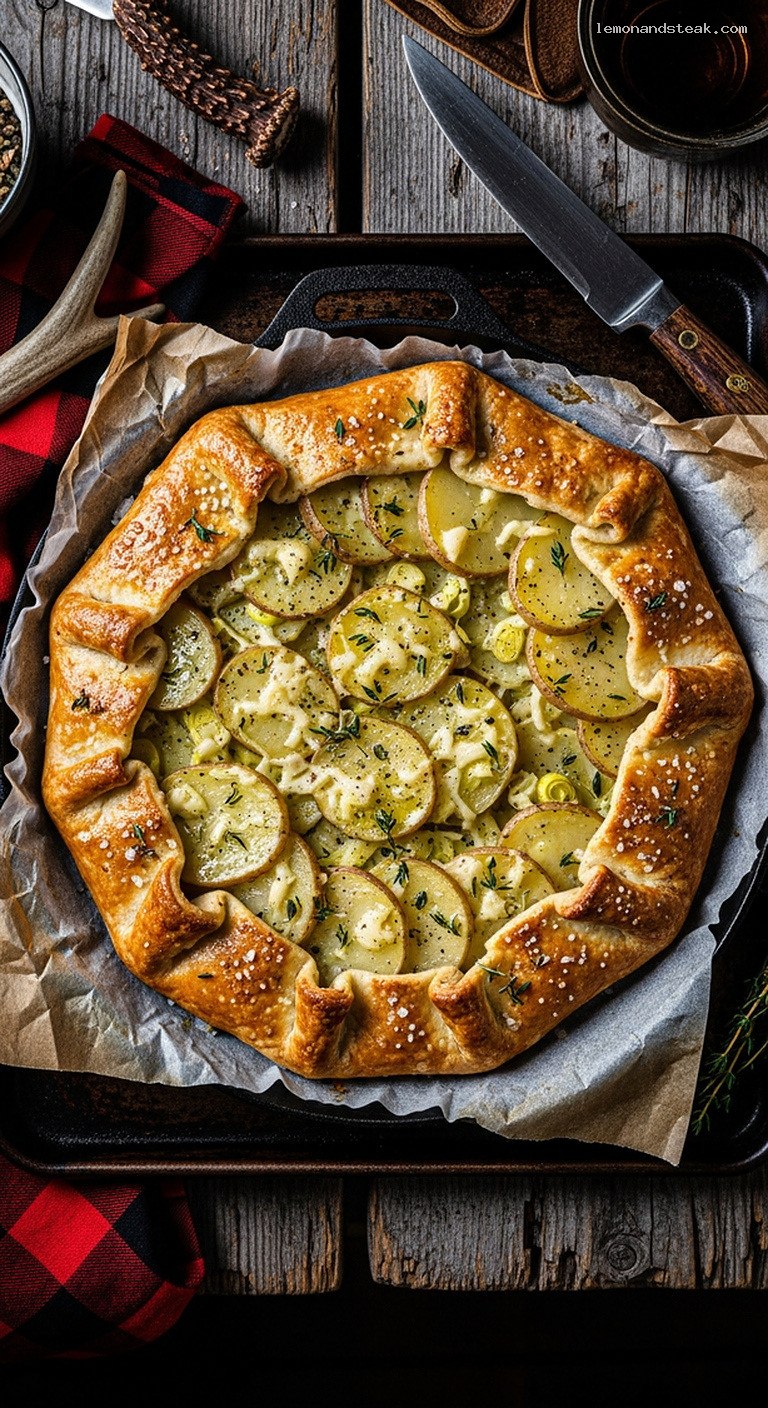
Quick Recipe Version (TL;DR)
Quick Ingredients
- 1 1/4 cups (150 g) all-purpose flour
- 1/2 tsp fine sea salt (plus more to taste)
- 1/2 cup (113 g) cold unsalted butter, cubed
- 3–4 tbsp ice water, 1 tsp apple cider vinegar (optional)
- 2 large leeks, white and light green parts thinly sliced
- 3 tbsp unsalted butter, 2 tbsp olive oil (divided)
- 1 1/4 lb (about 3 medium) Yukon Gold potatoes, thinly sliced
- 2 tsp fresh thyme leaves (or 1 tsp dried)
- 1/4 cup heavy cream
- 1 cup (about 4 oz / 115 g) grated Gruyère or sharp white cheddar
- Freshly ground black pepper
- 1 egg + 1 tbsp milk or cream (egg wash)
Do This
- 1. Make dough: Pulse flour, salt, and cold butter until pea-sized. Add ice water (and vinegar if using) just until dough clumps. Shape into a disk, wrap, and chill 30 minutes.
- 2. Cook leeks: Sauté sliced leeks in butter and 1 tbsp olive oil with salt, pepper, and thyme until very soft, 10–12 minutes. Stir in cream and cool.
- 3. Prep potatoes: Heat oven to 400°F (200°C). Scrub and thinly slice potatoes (about 1/8 inch). Toss with 1 tbsp olive oil, 1/2 tsp salt, and pepper.
- 4. Roll dough: On floured parchment, roll dough to a 12-inch rough circle. Slide parchment onto a baking sheet.
- 5. Assemble: Sprinkle 1/3 of the cheese in the center (leaving a 2-inch border). Spread leeks over cheese. Fan potato slices on top, overlapping. Scatter remaining cheese over potatoes.
- 6. Fold and bake: Fold crust edges up over filling, pleating naturally. Brush crust with egg wash, sprinkle flaky salt and thyme. Bake 40–45 minutes until crust is deeply golden and potatoes are tender.
- 7. Rest and serve: Cool 10–15 minutes, then slice into wedges and serve warm or at room temperature.
Why You’ll Love This Recipe
- All the comfort of potatoes and leeks wrapped in a flaky, buttery free-form crust that feels fancy but is very forgiving.
- No special pan required: this rustic galette is baked right on a sheet pan, so it is ideal for home cooks.
- Perfect make-ahead option for brunch, a cozy dinner, or a holiday side dish.
- Customizable base recipe: easily add bacon, different cheeses, or herbs to make it your own.
Grocery List
- Produce: 2 large leeks, 1 1/4 lb Yukon Gold potatoes, fresh thyme (optional but recommended)
- Dairy: Unsalted butter, heavy cream, 1 egg, milk or extra cream for egg wash, Gruyère or sharp white cheddar cheese
- Pantry: All-purpose flour, olive oil, fine sea salt, black pepper, apple cider vinegar (optional)
Full Ingredients
For the Flaky Galette Crust
- 1 1/4 cups (150 g) all-purpose flour
- 1/2 tsp fine sea salt
- 1/2 cup (1 stick / 113 g) cold unsalted butter, cut into 1/2-inch cubes
- 3–4 tbsp ice water
- 1 tsp apple cider vinegar (optional, helps tenderness and flakiness)
For the Buttery Leek Filling
- 2 large leeks, white and light green parts only, halved lengthwise and thinly sliced (about 4 packed cups)
- 2 tbsp unsalted butter
- 1 tbsp olive oil
- 1/2 tsp fine sea salt
- 1/4 tsp freshly ground black pepper
- 2 tsp fresh thyme leaves, chopped (or 1 tsp dried thyme)
- 1/4 cup (60 ml) heavy cream
For the Potato Topping
- 1 1/4 lb (about 570 g / 3 medium) Yukon Gold potatoes, scrubbed (peel if you prefer), sliced 1/8 inch (3 mm) thick
- 1 tbsp olive oil
- 1/2 tsp kosher or fine sea salt
- 1/4 tsp freshly ground black pepper
Cheese and Finishing Touches
- 1 cup (about 4 oz / 115 g) grated Gruyère or sharp white cheddar cheese, divided
- 1 large egg
- 1 tbsp milk or heavy cream (for egg wash)
- Flaky sea salt, for sprinkling
- Extra fresh thyme leaves, for garnish (optional)
Step-by-Step Instructions
Step 1: Make the flaky galette dough
Add the flour and salt to a medium bowl and whisk to combine. Cut in the cold butter: either use your fingertips to rub the butter into the flour, or use a pastry cutter, until you have a mixture of coarse crumbs with some pea-sized bits of butter still visible. You can also do this in a food processor with a few short pulses.
In a small cup, mix 3 tbsp ice water with the apple cider vinegar (if using). Sprinkle the liquid over the flour-butter mixture and gently toss with a fork until it just starts to clump together. If it looks dry and there are still lots of loose crumbs, add the remaining 1 tbsp ice water, 1 tsp at a time, just until the dough holds when pinched.
Turn the dough out onto a lightly floured surface. Gently press and gather it into a rough ball, then flatten into a disk about 1 inch thick. Avoid kneading; a few cracks are fine. Wrap tightly in plastic wrap or parchment and chill in the refrigerator for at least 30 minutes while you prepare the filling.
Step 2: Prepare and clean the leeks
Leeks often hide grit between their layers, so washing them well is important. Trim off the dark green tops and root ends. Slice the leeks lengthwise, then lay the flat side down and slice into thin half-moons. You should have about 4 packed cups.
Place the sliced leeks in a large bowl of cold water. Use your hands to separate the rings and swish them around; any dirt will sink to the bottom. Lift the leeks out into a colander (do not pour the water through the colander or you will dump the grit back onto them). Drain well and pat dry with a clean kitchen towel or paper towels. Set aside.
Step 3: Cook the buttery leek filling
In a large skillet over medium heat, melt 2 tbsp butter with 1 tbsp olive oil. Add the leeks, salt, and pepper. Cook, stirring often, until the leeks are very soft, silky, and starting to turn pale golden at the edges, about 10–12 minutes. If they start to brown too quickly, lower the heat slightly and add a small splash of water.
Stir in the thyme and cook for 1 minute more to release its aroma. Pour in the heavy cream, stir to coat the leeks, and cook another 1–2 minutes until the cream thickens slightly and clings to the leeks. Taste and adjust seasoning with a pinch more salt or pepper if needed.
Remove from the heat and let the leeks cool to just warm or room temperature. Slightly cooled filling helps keep the butter in the dough from melting too early and ensures a flakier crust.
Step 4: Prep the potatoes and heat the oven
Preheat your oven to 400°F (200°C) with a rack in the middle position. Line a large baking sheet with parchment paper.
Scrub the potatoes well. You can peel them if you prefer a more uniform look, but leaving the skins on gives a rustic appearance and adds flavor and nutrients. Using a sharp knife or mandoline, slice the potatoes into thin rounds, about 1/8 inch (3 mm) thick. Try to keep the slices evenly thin so they cook at the same rate.
Place the potato slices in a large bowl. Add 1 tbsp olive oil, 1/2 tsp salt, and 1/4 tsp black pepper. Toss gently with your hands to coat the slices evenly, separating any pieces that stick together. Set aside while you roll out the dough.
Step 5: Roll out the dough
Remove the chilled dough from the refrigerator. If it feels rock hard, let it sit at room temperature for 5 minutes so it is pliable enough to roll without cracking excessively.
Place a large sheet of parchment paper on your work surface and lightly flour it, as well as your rolling pin. Set the dough disk in the center and roll outward from the middle, rotating the paper occasionally, until you have a rough 12-inch (30 cm) circle about 1/8 inch (3 mm) thick. Do not worry if the edges are uneven; the rustic look is part of the charm.
Slide the parchment with the rolled-out dough onto your lined baking sheet. If the dough has softened considerably, place the whole sheet in the fridge for 5–10 minutes to firm up before assembling.
Step 6: Assemble the galette
Sprinkle about one-third of the grated cheese (roughly 1/3 cup) in the center of the dough, leaving a 2-inch (5 cm) border all the way around. This creates a melty base for the leeks.
Spoon the cooled leek mixture over the cheese and spread it into an even layer within that same 2-inch border.
Arrange the potato slices over the leeks in slightly overlapping concentric circles or loose shingled rows, depending on the shape of your dough. Pack them in fairly snugly; they will shrink slightly as they bake. You may not need every single slice, but try to keep the layer even in thickness.
Scatter the remaining cheese evenly over the potatoes. Gently fold the exposed edge of the dough up over the outer edge of the potatoes, pleating it naturally every couple of inches to form a rustic border and partially cover the filling. The center should remain open.
In a small bowl, whisk together the egg and 1 tbsp milk or cream. Brush the egg wash over the folded crust. Sprinkle the crust and exposed potatoes lightly with flaky sea salt and a few extra thyme leaves, if using.
Step 7: Bake until golden, then rest and serve
Bake the galette at 400°F (200°C) for 40–45 minutes, or until the crust is a deep golden brown, the cheese is bubbling, and the potatoes are tender all the way through when pierced with the tip of a knife. If the edges are browning too quickly before the potatoes are done, loosely tent just the crust with strips of foil and continue baking.
When done, remove the baking sheet from the oven and let the galette rest for 10–15 minutes. This brief cooling time allows the juices to settle slightly, making it easier to slice clean wedges while everything is still warm and luscious.
Transfer the galette to a cutting board by carefully sliding or lifting the parchment, then slice into 6 wedges. Garnish with a few extra thyme leaves if desired, and serve warm or at room temperature.
Pro Tips
- Keep everything cold for flakiness: Cold butter and adequately chilled dough are the keys to a tender, flaky crust. If your kitchen is warm, chill the rolled dough briefly before assembling.
- Slice potatoes evenly: Aim for consistent 1/8-inch slices. Using a mandoline makes this very easy and ensures the potatoes cook through at the same time.
- Do not rush the leeks: Cook the leeks slowly until very soft and sweet. Undercooked leeks can taste harsh; properly cooked leeks melt into the filling.
- Use parchment for easy handling: Rolling and baking on parchment makes transferring the delicate galette much simpler and prevents sticking.
- Let it rest before slicing: A short rest helps the cheese and cream set slightly so the slices hold together and look beautiful on the plate.
Variations
- Bacon and leek galette: Cook 4–6 slices of chopped thick-cut bacon until crisp. Remove with a slotted spoon and stir into the cooled leeks before assembling. Use some of the bacon fat in place of the butter for extra richness.
- Goat cheese twist: Replace half the Gruyère with 3 oz soft goat cheese. Crumble or dollop the goat cheese over the leeks before adding the potatoes for a tangy contrast.
- Herby Dijon version: Whisk 1–2 tsp Dijon mustard into the cream before adding it to the leeks, and add chopped fresh parsley or chives over the finished galette for a brighter, more aromatic flavor.
Storage & Make-Ahead
Make-ahead: The dough can be made up to 3 days in advance and kept refrigerated, or frozen for up to 1 month (thaw overnight in the fridge before using). The leek filling can be cooked up to 2 days ahead; cool completely, store in an airtight container in the refrigerator, and bring to room temperature before assembling. Assemble and bake the galette the day you plan to serve it for best texture.
Leftovers: Store leftover slices tightly covered in the refrigerator for up to 3 days. Reheat on a baking sheet at 350°F (175°C) for 10–15 minutes, until warmed through and the crust re-crisps. The galette is also surprisingly good at room temperature for a next-day lunch.
Nutrition (per serving)
Approximate values per serving (1/6 of the galette): about 520 calories; 34 g fat; 23 g saturated fat; 42 g carbohydrates; 3 g fiber; 5 g sugar; 13 g protein; 650 mg sodium. These numbers are estimates and will vary based on the exact brands and amounts you use.
Leave a Reply