
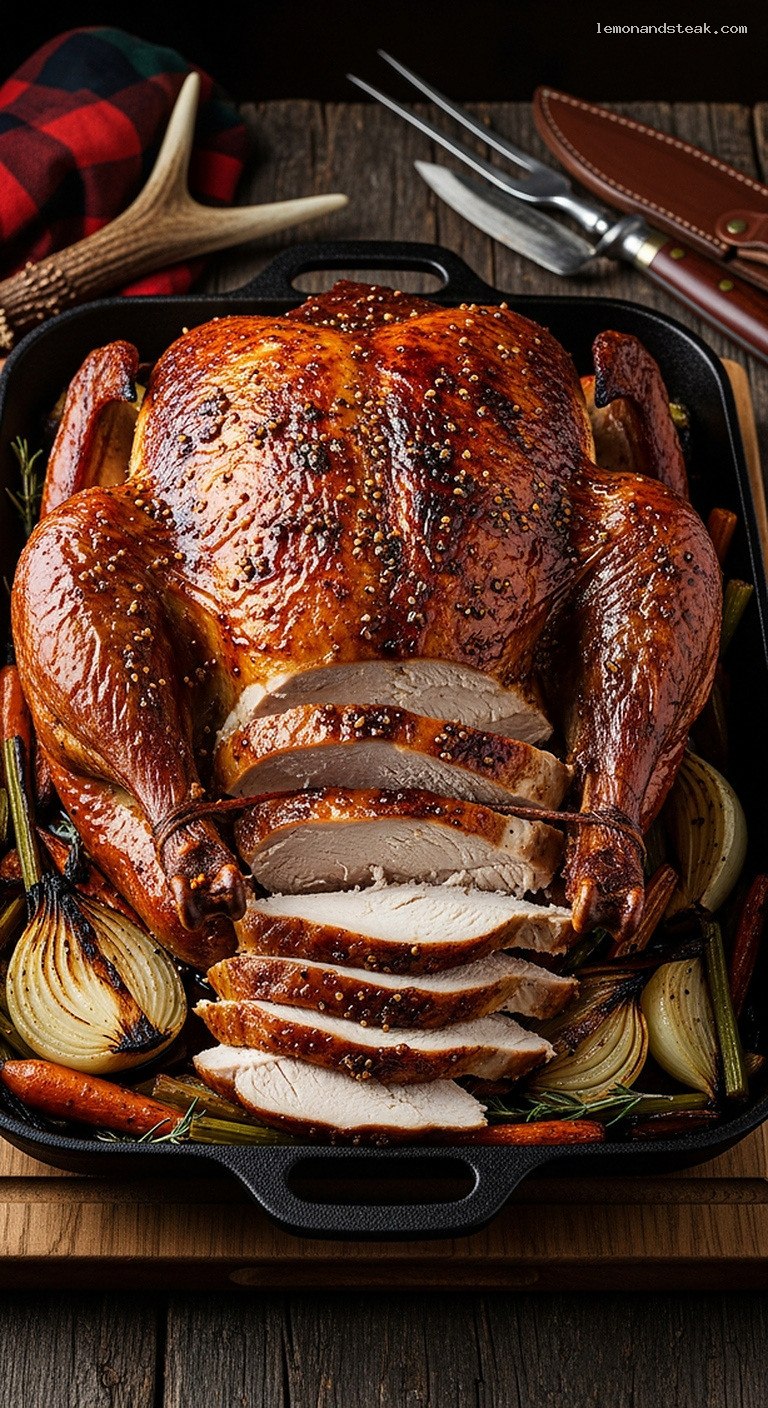
Quick Recipe Version (TL;DR)
Quick Ingredients
- 1 whole turkey, 11 to 13 lb (5 to 6 kg), thawed
- 1 1/2 cups (3 sticks / 340 g) unsalted butter, softened
- 1 cup (about 150 g) finely grated sweet onion (Vidalia or similar)
- 1/2 cup (100 g) packed light brown sugar
- 1 tbsp plus 2 tsp kosher salt, divided
- 2 tsp freshly ground black pepper, divided
- 2 cloves garlic, finely grated or minced
- 1 1/2 tsp smoked paprika
- 1 tsp dried thyme (or 2 tsp fresh, minced)
- 1 tsp dried sage (or 2 tsp fresh, minced)
- 1 tbsp apple cider vinegar
- 2 medium onions, quartered
- 2 carrots and 2 celery stalks, cut into chunks
- 1 head garlic, halved crosswise; 2 bay leaves
- 1 to 1 1/2 cups (240 to 360 ml) low-sodium chicken or turkey broth
Do This
- 1. Thaw turkey completely, remove giblets and neck, and pat the skin very dry with paper towels.
- 2. Mix butter, grated sweet onion, brown sugar, 1 tbsp salt, 1 1/2 tsp pepper, smoked paprika, thyme, sage, garlic, and vinegar into a soft, spreadable butter.
- 3. Season the turkey cavity with 1 tsp salt and 1/2 tsp pepper; stuff some onion pieces and a few garlic cloves inside.
- 4. Gently loosen skin over breast and thighs; rub about two-thirds of the onion-brown sugar butter under the skin and the rest all over the outside.
- 5. Scatter remaining onions, carrots, celery, garlic, and bay leaves in a roasting pan; pour in broth, then set turkey breast-side up on a rack over the aromatics.
- 6. Roast at 275°F (135°C) for about 4 hours, basting every 60 minutes; then increase to 375°F (190°C) and roast 25 to 30 minutes until skin is deep golden and glossy and thickest breast reaches 160°F (71°C).
- 7. Rest turkey loosely tented with foil for at least 30 minutes so juices redistribute and temperature rises to 165°F (74°C), then carve and serve with pan juices.
Why You’ll Love This Recipe
- Low-and-slow roasting keeps the turkey incredibly juicy while the sweet onion-brown sugar butter forms a shiny, almost lacquered skin.
- The flavor is warmly old-fashioned: sweet onions, brown sugar, and classic herbs that taste like a holiday table from decades past.
- The butter mixture goes under and over the skin, so every slice comes out moist, flavorful, and well-seasoned.
- The pan drippings make a naturally rich, slightly sweet gravy with almost no extra work.
Grocery List
- Produce: 1 whole sweet onion (for grating), 2 medium yellow onions, 2 carrots, 2 celery stalks, 1 head garlic, optional fresh thyme and sage, optional lemon (for cavity or garnish)
- Dairy: 1 1/2 cups (3 sticks / 340 g) unsalted butter
- Pantry: 1 whole turkey (11 to 13 lb), light brown sugar, kosher salt, black pepper, smoked paprika, dried thyme, dried sage, apple cider vinegar, bay leaves, low-sodium chicken or turkey broth, optional apple cider or white wine, all-purpose flour (if making gravy)
Full Ingredients
Turkey and Sweet Onion–Brown Sugar Butter
- 1 whole turkey, 11 to 13 lb (5 to 6 kg), fully thawed if previously frozen
- 1 1/2 cups (3 sticks / 340 g) unsalted butter, very soft but not melted
- 1 cup (about 150 g) finely grated sweet onion (such as Vidalia or Walla Walla; about 1 medium-large onion)
- 1/2 cup (100 g) packed light brown sugar
- 1 tbsp kosher salt (for the butter)
- 1 1/2 tsp freshly ground black pepper (for the butter)
- 1 1/2 tsp smoked paprika
- 1 tsp dried thyme (or 2 tsp finely chopped fresh thyme)
- 1 tsp dried sage (or 2 tsp finely chopped fresh sage)
- 2 cloves garlic, finely grated or very finely minced
- 1 tbsp apple cider vinegar
- 1 tsp kosher salt (for seasoning the cavity)
- 1/2 tsp freshly ground black pepper (for seasoning the cavity)
- Optional: 1 small lemon, halved, for stuffing in the cavity
- Kitchen twine for trussing (optional but helpful)
Roasting Pan Aromatics
- 2 medium yellow onions, peeled and quartered
- 2 carrots, cut into 2-inch (5 cm) chunks
- 2 celery stalks, cut into 2-inch (5 cm) chunks
- 1 head garlic, halved crosswise
- 2 bay leaves
- 1 to 1 1/2 cups (240 to 360 ml) low-sodium chicken or turkey broth
- Optional: 1/2 cup (120 ml) apple cider or dry white wine for added flavor in the pan
Simple Old-Fashioned Gravy (Optional but Recommended)
- Pan drippings from the roasted turkey (strained)
- 2 to 4 tbsp turkey fat or butter
- 2 to 4 tbsp all-purpose flour
- 1 to 2 cups (240 to 480 ml) additional low-sodium broth, as needed to thin
- Salt and black pepper, to taste
Step-by-Step Instructions
Step 1: Thaw, Clean, and Dry the Turkey
If your turkey is frozen, thaw it in the refrigerator in advance: allow about 24 hours for every 4 to 5 lb (1.8 to 2.3 kg). For an 11 to 13 lb (5 to 6 kg) turkey, this usually means 3 days in the fridge.
When you are ready to cook, remove the turkey from its packaging in a clean sink. Reach into the cavity and neck area to remove the bag of giblets and the neck (save these for stock or gravy if desired). Pat the turkey very dry, inside and out, with plenty of paper towels. Dry skin is key to a glossy, nicely rendered finish later.
Set the turkey on a wire rack set inside a rimmed baking sheet or directly on the roasting rack you will use later. Let it sit at room temperature while you make the butter, 30 to 45 minutes; this takes the chill off and helps it cook more evenly.
Step 2: Make the Sweet Onion–Brown Sugar Butter
In a large mixing bowl, combine the softened butter, grated sweet onion, brown sugar, 1 tbsp kosher salt, 1 1/2 tsp black pepper, smoked paprika, dried thyme, dried sage, grated garlic, and apple cider vinegar.
Use a spatula or wooden spoon to mash and fold everything together until you have a smooth, cohesive, spreadable butter. The mixture will be quite soft and fragrant, with visible flecks of herbs and paprika and a bit of texture from the onion.
If the butter feels too loose (this can happen if your kitchen is very warm or the onion is very juicy), you can refrigerate it for 10 to 15 minutes to firm it slightly. You want it soft enough to rub under the skin but not so runny that it slides off.
Step 3: Season the Cavity and Work Butter Under the Skin
Preheat your oven to 275°F (135°C) with the rack in the lower third.
Season the inside of the turkey cavity with 1 tsp kosher salt and 1/2 tsp black pepper. If you like, tuck a few onion quarters, a couple of garlic cloves, and the optional lemon halves into the cavity for extra aroma. Do not overpack; air needs to circulate so the turkey roasts evenly.
Gently loosen the skin over the breast meat: slide your fingers under the skin at the neck or cavity opening and carefully work them forward, separating the skin from the meat without tearing it. Do the same over the top of the legs and thighs as far as you comfortably can.
Take about two-thirds of the sweet onion–brown sugar butter and smear it under the loosened skin, pressing it directly onto the breast, legs, and thighs. Spread the remaining third all over the outside of the turkey, including the drumsticks and wings. This is messy work, but it is what gives that deeply flavored, old-fashioned crust.
If you like, tuck the wing tips behind the back of the bird to keep them from burning, and loosely tie the legs together with kitchen twine for a neater shape.
Step 4: Prepare the Roasting Pan and Nest the Turkey
In a large roasting pan, scatter the onion quarters, carrot chunks, celery chunks, and halved garlic head. Add the bay leaves. Pour in 1 cup (240 ml) of broth and, if using, the apple cider or wine. This bed of vegetables adds moisture and flavor to both the turkey and the drippings.
Set a roasting rack over the vegetables and liquid. Place the butter-coated turkey breast-side up on the rack. Adjust the turkey so it sits evenly and is not leaning too far to one side.
If any butter has slipped to the bottom of the pan, scoop it up and smear it back onto the turkey. Season the top lightly with a pinch more salt and pepper if desired.
Step 5: Roast Low and Slow Until Mostly Cooked
Place the roasting pan in the oven. Roast at 275°F (135°C) for about 3 hours 30 minutes for an 11 to 13 lb (5 to 6 kg) turkey, basting every 60 minutes.
To baste, carefully pull the rack out just enough to access the pan, tilt the pan slightly if needed, and use a bulb baster or spoon to ladle the buttery juices over the breast and legs. Work quickly to avoid losing too much oven heat.
After about 3 hours, begin checking the internal temperature. Insert an instant-read thermometer into the thickest part of the breast (do not touch bone) and the deepest part of the thigh. You are aiming for the breast to be around 140 to 145°F (60 to 63°C) at the end of the low-and-slow phase; it will finish cooking when you increase the heat.
Step 6: Finish at Higher Heat for Glossy, Deeply Golden Skin
When the breast reaches roughly 140 to 145°F (60 to 63°C), increase the oven temperature to 375°F (190°C). If the pan is looking very dry, add another 1/2 cup (120 ml) broth.
Roast for another 25 to 30 minutes, continuing to baste once, until the skin is a rich, deep golden brown and looks glossy from the rendered butter and sugar. The internal temperature in the thickest part of the breast should register about 160°F (71°C), and the thigh should be around 175°F (79°C).
Keep an eye on the skin during this final stage. If any area starts to darken too much before the turkey is done (usually the tips of the wings or top of the breast), lay a small piece of foil loosely over that spot while the rest of the bird finishes roasting.
Step 7: Rest, Carve, and Serve with Pan Juices or Gravy
Carefully transfer the turkey to a carving board or platter, leaving the vegetables and drippings in the pan. Loosely tent the turkey with foil and let it rest for at least 30 minutes and up to 60 minutes. During this time, the juices redistribute and the internal temperature will rise to the safe 165°F (74°C) in the breast.
Meanwhile, pour the pan contents through a fine-mesh strainer into a fat separator or heatproof bowl. Skim off excess fat (or reserve a few tablespoons for making gravy), taste, and adjust seasoning with salt and pepper. You can use these strained drippings as a rustic jus or turn them into a classic gravy:
For gravy, in a saucepan, heat 2 to 4 tbsp reserved turkey fat or butter over medium heat. Whisk in an equal amount of flour to form a roux and cook 2 to 3 minutes. Gradually whisk in the strained drippings and enough additional broth to reach your desired consistency. Simmer until thickened, then season to taste.
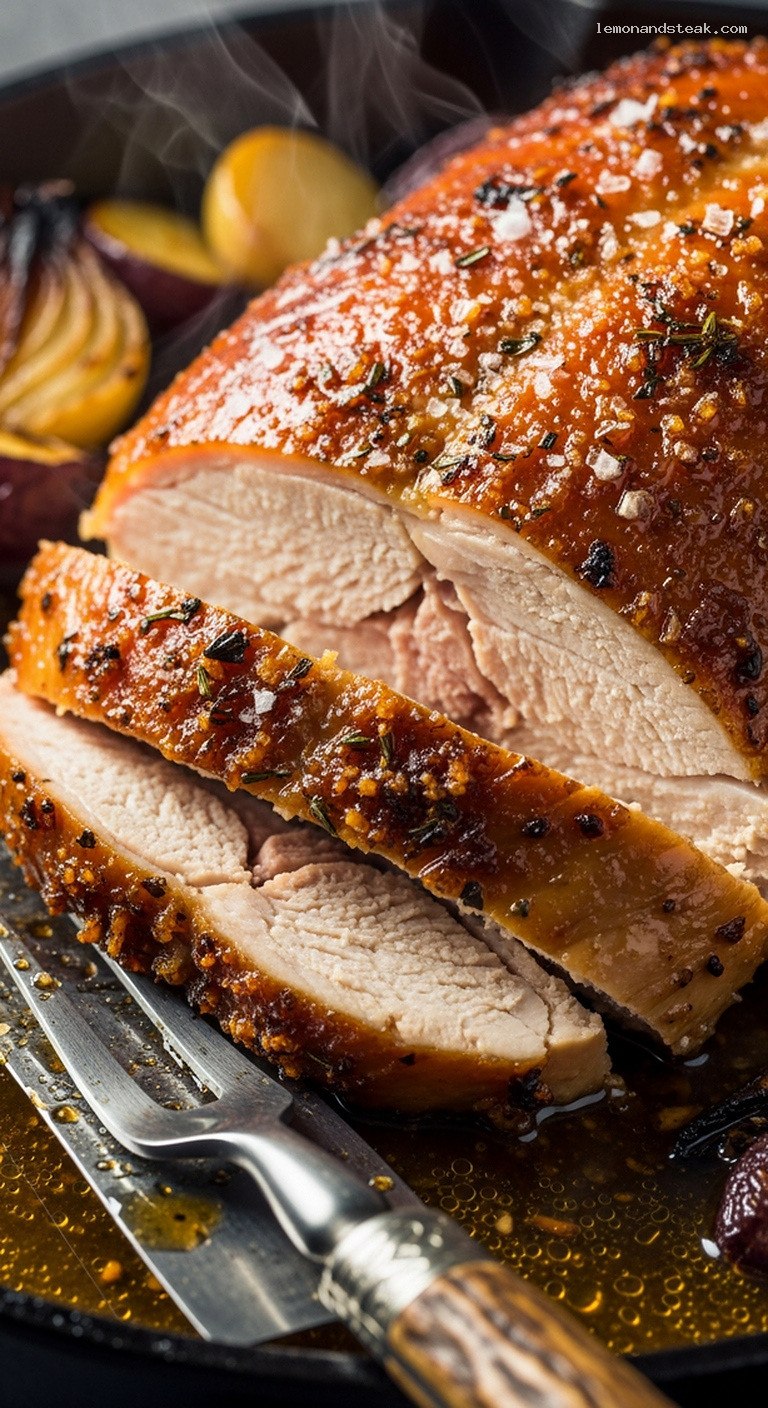
Carve the turkey: remove the legs and thighs, then the breasts, slicing them crosswise into thick, moist slices. Arrange on a warm platter, spoon some glossy pan juices or gravy over the top, and serve the rest on the side.
Pro Tips
- Dry is key for glossy skin: The drier the turkey skin before you apply the butter, the better it will brown and shine. Pat thoroughly with paper towels; for bonus points, refrigerate the uncovered turkey for a few hours or overnight to air-dry before adding the butter.
- Grate the onion finely: Use the small holes of a box grater or a microplane-style grater. Fine shreds melt into the butter and baste the turkey as they cook, rather than sliding off in big chunks.
- Use a thermometer, not the clock: Oven temperatures and turkey sizes vary. The times here are a solid guide, but rely on an instant-read thermometer to confirm doneness.
- Do not overstuff the cavity: A lightly filled cavity helps flavor the meat without blocking heat flow. Too much stuffing or too many aromatics will slow cooking and can lead to uneven results.
- Let it rest generously: A 30- to 60-minute rest makes a big difference in juiciness. The turkey will stay warm under foil, and the meat will slice much more cleanly.
Variations
- Maple-Bourbon Twist: Replace 2 tbsp of the brown sugar with 2 tbsp pure maple syrup and add 1 tbsp bourbon to the butter mixture. The flavor leans even more nostalgic and dessert-like, with a subtle smoky note.
- Herb-Forward, Less Sweet: Halve the brown sugar to 1/4 cup and double the thyme and sage. Add 1 tbsp chopped fresh rosemary. This version is still cozy and old-fashioned but more savory and herbaceous.
- Smoky Backyard Style: Use your smoker or grill set up for indirect heat at 275°F (135°C). Roast the butter-rubbed turkey with a mild wood (apple or maple). Finish over slightly higher heat or in a hot oven to crisp and gloss the skin.
Storage & Make-Ahead
Make-ahead: The sweet onion–brown sugar butter can be made up to 3 days in advance and stored in the refrigerator. Bring it back to room temperature until spreadable before using. You can also season the turkey with the butter and refrigerate it, uncovered, for up to 24 hours before roasting; this deepens flavor and dries the skin for extra-crisp gloss.
Leftovers: Store carved turkey in an airtight container in the refrigerator for 3 to 4 days. For best results, drizzle leftover slices with a little broth or gravy before reheating gently (covered) in a 300°F (150°C) oven or in the microwave on low power.
Freezing: Turkey meat freezes well for 2 to 3 months. Wrap tightly in foil or plastic, then place in a freezer bag, pressing out excess air. Thaw overnight in the fridge and reheat with a splash of broth.
Nutrition (per serving)
Approximate values for 1 serving (about 6 oz / 170 g cooked turkey with some skin and a spoonful of pan juices): about 520 calories; 40 g protein; 34 g fat (16 g saturated); 12 g carbohydrates; 0 g fiber; 8 g sugar; 850 mg sodium. Actual values will vary depending on the exact size of your turkey, how much skin is eaten, and how much butter and drippings you consume.
Leave a Reply