
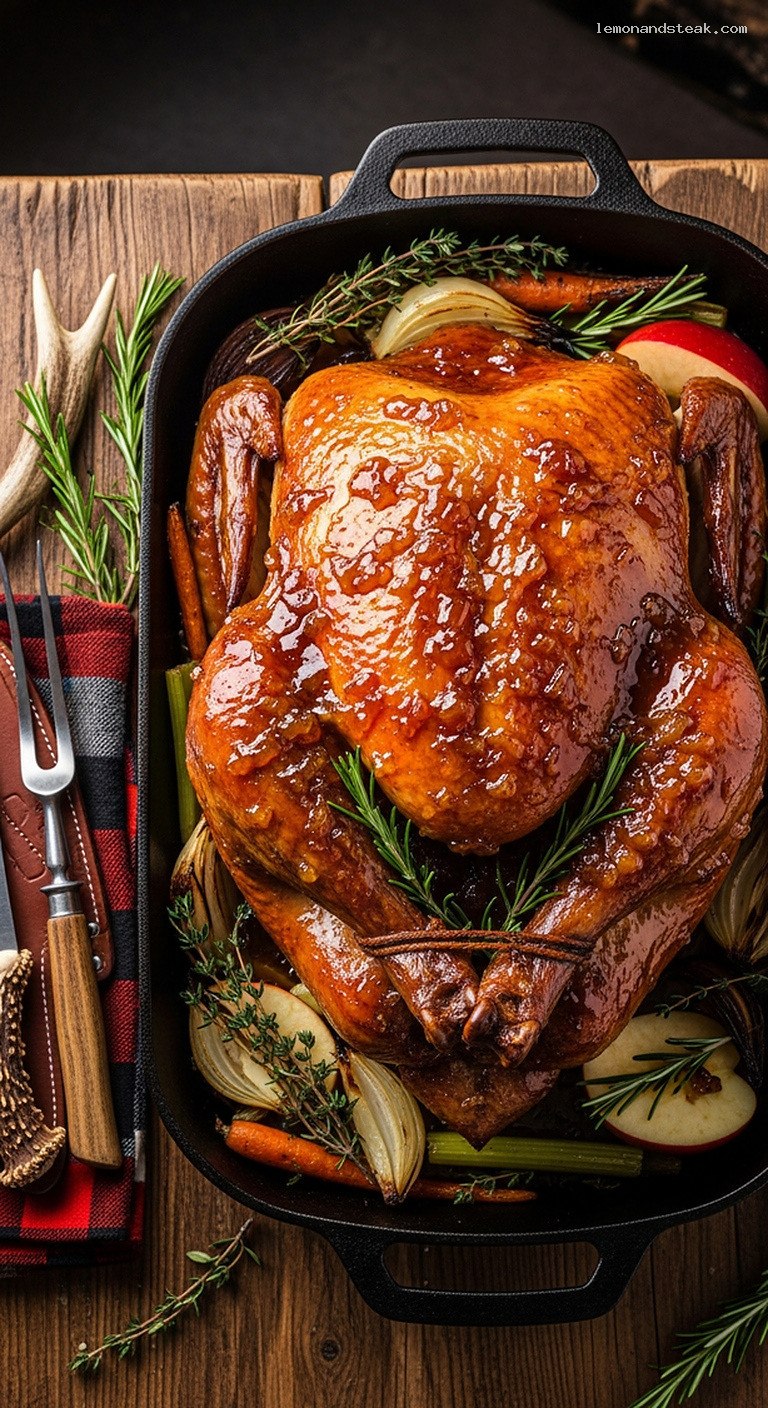
Quick Recipe Version (TL;DR)
Quick Ingredients
- 1 whole turkey (12–14 lb), thawed
- 3 tbsp kosher salt, 1 tsp black pepper
- 1 tsp each: garlic powder, onion powder, dried thyme; 1 tsp dried sage (optional)
- 8 tbsp (1 stick) unsalted butter: 4 tbsp softened, 4 tbsp melted
- 1 1/4 cups apple jelly
- 2 tbsp apple cider vinegar, 1 tbsp Dijon or yellow mustard
- 2 onions, 2 carrots, 4 celery stalks
- Fresh thyme/rosemary, 1 apple, 1 bay leaf (optional but nice)
- 1–4 cups low-sodium chicken or turkey broth
- 3 tbsp flour (for optional gravy)
Do This
- 1. Pat turkey dry. Season inside and out with salt, pepper, garlic/onion powder, thyme, and sage. Chill uncovered 12–24 hours if you have time.
- 2. Mix 4 tbsp softened butter with herbs and rub under the turkey skin over breasts and legs.
- 3. Fill cavity with onion, apple, carrot, celery, herbs, and bay. Place turkey on vegetables in roasting pan with 1 cup broth.
- 4. Roast at 325°F (165°C), uncovered, for 45 minutes, then tent loosely with foil and continue roasting.
- 5. Simmer apple jelly, 4 tbsp melted butter, vinegar, mustard, salt, and pepper to make glaze.
- 6. When turkey is about 45–60 minutes from done, brush with glaze every 15–20 minutes until skin is deep golden and glossy and breast reaches 160–165°F (71–74°C).
- 7. Rest 30 minutes. Carve. Simmer pan drippings with flour and broth for gravy, if desired. Serve turkey with extra warm glaze and gravy.
Why You’ll Love This Recipe
- Retro charm: The apple jelly–butter glaze gives the turkey a nostalgic, glossy finish straight out of a classic home-cooking cookbook.
- Balanced flavor: Sweet apple, buttery richness, gentle tang, and savory herbs come together in a cozy, crowd-pleasing way.
- Simple technique: No complicated brines or spatchcocking required—just straightforward roasting with a trusty glaze.
- Showstopper centerpiece: The burnished, amber-brown skin is shiny and beautiful, ideal for holidays or Sunday dinner.
Grocery List
- Produce: 2 large onions, 2–3 carrots, 4 celery stalks, 1 apple, fresh thyme, fresh rosemary (optional), 1 bay leaf (optional).
- Dairy: Unsalted butter (1 stick / 8 tbsp minimum).
- Pantry: Whole turkey (12–14 lb), apple jelly, low-sodium chicken or turkey broth, apple cider vinegar, Dijon or yellow mustard, all-purpose flour, kosher salt, black pepper, garlic powder, onion powder, dried thyme, dried sage (optional), neutral oil or extra butter for pan.
Full Ingredients
For the Turkey
- 1 whole turkey (12–14 lb / 5.4–6.4 kg), fully thawed if frozen
- 3 tbsp kosher salt (use 2 tbsp if using Morton’s; 3 tbsp if using Diamond Crystal)
- 1 tsp freshly ground black pepper
- 1 tsp garlic powder
- 1 tsp onion powder
- 1 tsp dried thyme
- 1 tsp dried sage (optional, but very retro and delicious)
- 1 large onion, quartered (for the cavity)
- 1 medium apple, cored and quartered (any crisp, sweet-tart variety)
- 1 large carrot, cut into 3–4 chunks
- 2 celery stalks, cut into 3–4 chunks
- 4 sprigs fresh thyme (or 1 tsp dried thyme)
- 2 sprigs fresh rosemary (optional)
- 1 bay leaf (optional)
For the Herb Butter (Under the Skin)
- 4 tbsp (57 g) unsalted butter, softened to room temperature
- 1 tsp fresh thyme leaves, finely chopped (or 1/2 tsp dried thyme)
- 1 tsp chopped fresh sage (or 1/2 tsp dried sage)
- 1/2 tsp kosher salt
- 1/4 tsp freshly ground black pepper
For the Apple Jelly–Butter Glaze
- 1 1/4 cups (about 380 g) apple jelly
- 4 tbsp (57 g) unsalted butter, melted
- 2 tbsp apple cider vinegar
- 1 tbsp Dijon mustard or classic yellow mustard
- 1/4 tsp kosher salt
- 1/4 tsp freshly ground black pepper
- Optional: 1/4 tsp ground cinnamon for a subtle warm note
For the Roasting Pan
- 1 large onion, sliced into 1/2-inch (1.25 cm) rounds
- 2 carrots, cut into 2-inch (5 cm) pieces
- 2 celery stalks, cut into 2-inch (5 cm) pieces
- 2 tbsp neutral oil or melted butter (for greasing the pan and vegetables)
- 1 cup (240 ml) low-sodium chicken or turkey broth, plus up to 3 cups (720 ml) more as needed for basting and gravy
For Simple Pan Gravy (Optional but Recommended)
- 3 tbsp fat from the roasting pan (or unsalted butter)
- 3 tbsp all-purpose flour
- 2–3 cups (480–720 ml) low-sodium chicken or turkey broth, warmed
- Kosher salt and freshly ground black pepper, to taste
Step-by-Step Instructions
Step 1: Thaw and Dry the Turkey
If your turkey is frozen, thaw it safely in the refrigerator: plan about 24 hours of thawing time for every 4–5 lb (1.8–2.3 kg) of turkey. For a 12–14 lb bird, this is typically 3–4 days. Once thawed, remove the turkey from its packaging in a clean sink. Pull out the neck and giblet packet from the cavities (usually one at the main cavity and one at the neck end). Pat the turkey very dry, inside and out, with plenty of paper towels.
Place the turkey on a wire rack set over a rimmed baking sheet or directly in your roasting pan. This helps air circulate and encourages crisp skin later.
Step 2: Season the Turkey (Optional Dry Brine)
In a small bowl, mix the kosher salt, black pepper, garlic powder, onion powder, dried thyme, and dried sage (if using). Sprinkle this mixture evenly over the entire surface of the turkey, including the back and legs. Gently season inside the cavity as well, using about 1–2 teaspoons of the mixture.
For the best flavor and juiciness, refrigerate the turkey uncovered for 12–24 hours after seasoning. This acts like a dry brine and deeply seasons the meat while also drying the skin. If you are short on time, you can skip the long rest and proceed directly, but the flavor improves noticeably with the overnight chill.
Step 3: Make the Herb Butter and Prep Aromatics
In a small bowl, stir together the softened 4 tbsp butter, chopped fresh thyme, chopped sage, salt, and pepper until well combined. Set aside at cool room temperature; you want it spreadable, not melted.
Prepare your aromatics: quarter 1 onion and the apple, and cut 1 carrot and 2 celery stalks into chunks for the cavity. Toss these cavity aromatics together in a bowl. For the roasting pan, slice the second onion into thick rounds and chop the remaining carrots and celery into large pieces.
Rub the roasting pan lightly with the 2 tbsp neutral oil or melted butter, then scatter the sliced onion, carrot pieces, and celery in an even layer. Pour 1 cup (240 ml) broth into the bottom of the pan. This vegetable “rack” will add flavor to the drippings and help prevent burning.
Step 4: Butter Under the Skin and Assemble the Bird
Preheat your oven to 325°F (165°C), positioning a rack in the lower third. Place the turkey breast-side up on a rack set in the prepared roasting pan (or directly on the bed of vegetables if you do not have a rack).
To apply the herb butter, gently slide your fingers under the skin over the breasts, starting at the cavity end. Work slowly to separate the skin from the meat without tearing it, creating a pocket over each breast and as far down the thighs as you comfortably can. Spread the herb butter evenly under the skin, concentrating most over the breast meat; smooth the skin on top to distribute it.
Stuff the main cavity loosely with the onion, apple, carrot, celery chunks, fresh thyme, rosemary sprigs, and bay leaf (if using). Do not pack tightly; air circulation helps even cooking. Tuck the wing tips under the bird. If you like, tie the legs loosely with kitchen twine for a neater shape.
Step 5: Start Roasting the Turkey
Place the roasting pan in the preheated 325°F (165°C) oven. Roast the turkey uncovered for 45 minutes to allow the skin to begin browning.
After 45 minutes, check the pan. If the bottom looks dry or the vegetables are starting to scorch, add 1/2–1 cup (120–240 ml) additional broth or water. Loosely tent the turkey with foil by laying a large sheet over the top, crimping lightly at the edges so it stays in place but still allows air to circulate.
Continue roasting, tented, for another 1 hour. At this point (about 1 hour 45 minutes into cooking), start checking the internal temperature every 20–30 minutes. Insert an instant-read thermometer into the thickest part of the breast and the inner thigh, avoiding bone. You are aiming for 160–165°F (71–74°C) in the breast and 175°F (79°C) in the thigh by the end of cooking, but do not expect to be there yet.
Step 6: Make the Apple Jelly–Butter Glaze
While the turkey roasts, prepare the glaze. In a small saucepan over medium-low heat, combine the apple jelly, melted 4 tbsp butter, apple cider vinegar, mustard, salt, pepper, and cinnamon (if using). Cook, stirring often, until the jelly fully melts and the mixture is smooth and slightly thickened, about 5–7 minutes.
Reduce the heat to low to keep the glaze warm, or remove it from the heat and rewarm gently before using. The glaze should be pourable but not watery, with a glossy, syrupy consistency. If it becomes too thick, thin with 1–2 teaspoons of water or broth. If it seems too thin, simmer for a few extra minutes to concentrate.
Step 7: Glaze and Finish Roasting
When the turkey is about 45–60 minutes away from being done (for a 12–14 lb bird, this is typically around 2–2 1/4 hours into roasting), remove the foil tent and brush the turkey generously with the warm apple jelly–butter glaze. Focus on the breasts, drumsticks, and exposed thighs. Return the turkey to the oven uncovered.
Continue roasting, brushing with more glaze every 15–20 minutes. Rotate the pan front-to-back once or twice during this final stage for even browning. Keep an eye on the color: you want a deep golden brown with a shiny, lacquered look. If any area begins to darken too quickly, lightly cover just that area with a small piece of foil.
As soon as the breast meat reaches 160–165°F (71–74°C) and the thigh reaches about 175°F (79°C), remove the turkey from the oven. For most 12–14 lb birds, total cooking time will land around 3 hours to 3 hours 30 minutes.
Step 8: Rest, Make Optional Gravy, and Serve
Transfer the turkey carefully to a cutting board or platter, leaving the vegetables and drippings in the pan. Tent loosely with foil and let rest for at least 30 minutes (up to 45 minutes is fine). This rest is crucial for juicy meat.
For simple pan gravy, skim 3 tbsp of fat from the surface of the drippings into a saucepan (or use 3 tbsp butter). Set the roasting pan over medium heat on the stovetop if safe to do so, or scrape the drippings and vegetables into the saucepan. Sprinkle in the 3 tbsp flour and cook, stirring constantly, for 2–3 minutes to form a light brown roux. Gradually whisk in 2 cups (480 ml) warm broth, scraping up browned bits. Simmer, whisking, until thickened to your liking, 5–10 minutes. Add up to 1 more cup (240 ml) broth if you prefer thinner gravy. Season with salt and pepper to taste.
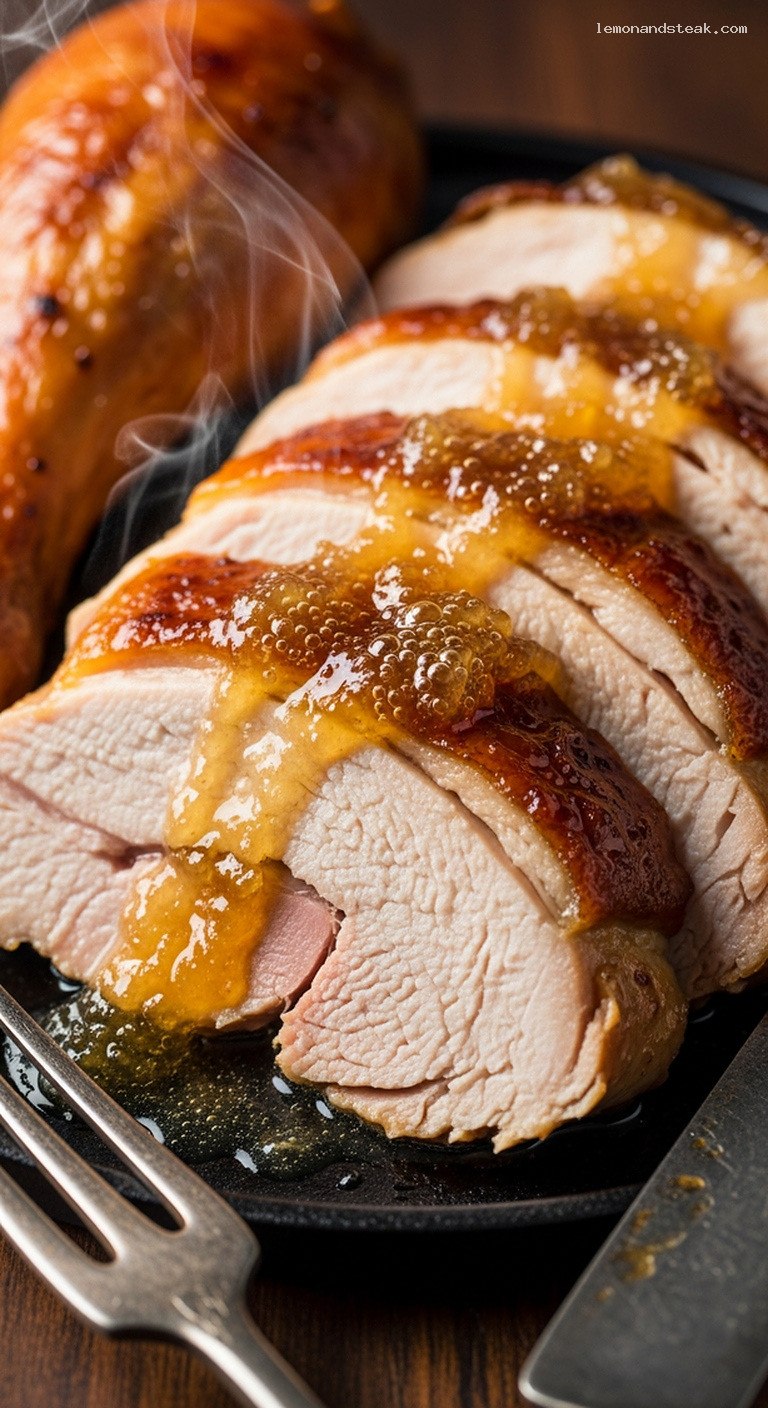
Carve the turkey: remove the legs and thighs, then breasts, slicing meat across the grain. Arrange slices on a warm platter. Brush with any remaining warm apple jelly glaze for extra shine, and serve with the pan gravy alongside.
Pro Tips
- Use a thermometer, not the clock: Oven temperatures and turkey sizes vary. An instant-read thermometer is the best way to guarantee juicy meat and avoid overcooking.
- Dry the skin well: Patting the turkey thoroughly dry before seasoning and roasting is key to crisp, glossy skin that holds the apple jelly glaze beautifully.
- Glaze in the last hour: Sugar-rich glazes can burn if applied too early. Start glazing only once the turkey is mostly cooked and the skin is already lightly browned.
- Rotate and shield: If your oven has hot spots, rotate the pan a couple of times. Use small pieces of foil to shield any areas that darken too fast while the rest catches up.
- Let it rest: That 30-minute rest lets juices redistribute and makes carving much easier, so do not rush it.
Variations
- Spiced Apple Jelly Glaze: Add 1/4 tsp ground cloves and 1/4 tsp smoked paprika to the glaze for a slightly smoky, warmly spiced twist that still feels nostalgic.
- Orange–Apple Glaze: Replace 2 tbsp of the apple jelly with 2 tbsp orange marmalade and add 1 tsp finely grated orange zest for a citrusy, holiday-style glaze.
- Turkey Breast Only: Use a 6–7 lb bone-in turkey breast, halve the herb butter and glaze amounts, and roast at 325°F (165°C) for about 2–2 1/2 hours, glazing during the last 35–40 minutes.
Storage & Make-Ahead
Leftover turkey keeps well in the refrigerator for up to 3–4 days. Carve all remaining meat from the bones, drizzle with a little extra broth or leftover gravy to keep it moist, and store in airtight containers. Reheat gently, covered, in a 300°F (150°C) oven or in a skillet with a splash of broth until just warmed through.
The apple jelly–butter glaze can be made 2–3 days ahead. Store in a covered jar in the refrigerator, then rewarm gently on the stovetop before brushing onto the turkey. You can also roast the turkey earlier in the day, let it rest, carve it, and reheat slices, tightly covered with foil and a bit of broth, at 300°F (150°C) for 20–25 minutes before serving.
Turkey carcass and bones can be frozen for up to 3 months for stock. Leftover gravy will keep in the refrigerator for 3 days or in the freezer for up to 2 months.
Nutrition (per serving)
Approximate values for 1 serving (about 6 oz / 170 g cooked turkey with skin, plus some glaze and a small amount of gravy): about 430 calories; 53 g protein; 21 g fat; 7 g carbohydrates; 1 g fiber; 6 g sugars; 980 mg sodium. Actual values will vary based on the size of the turkey, how much skin and glaze are eaten, and how heavily you salt and sauce your portion.
Leave a Reply