
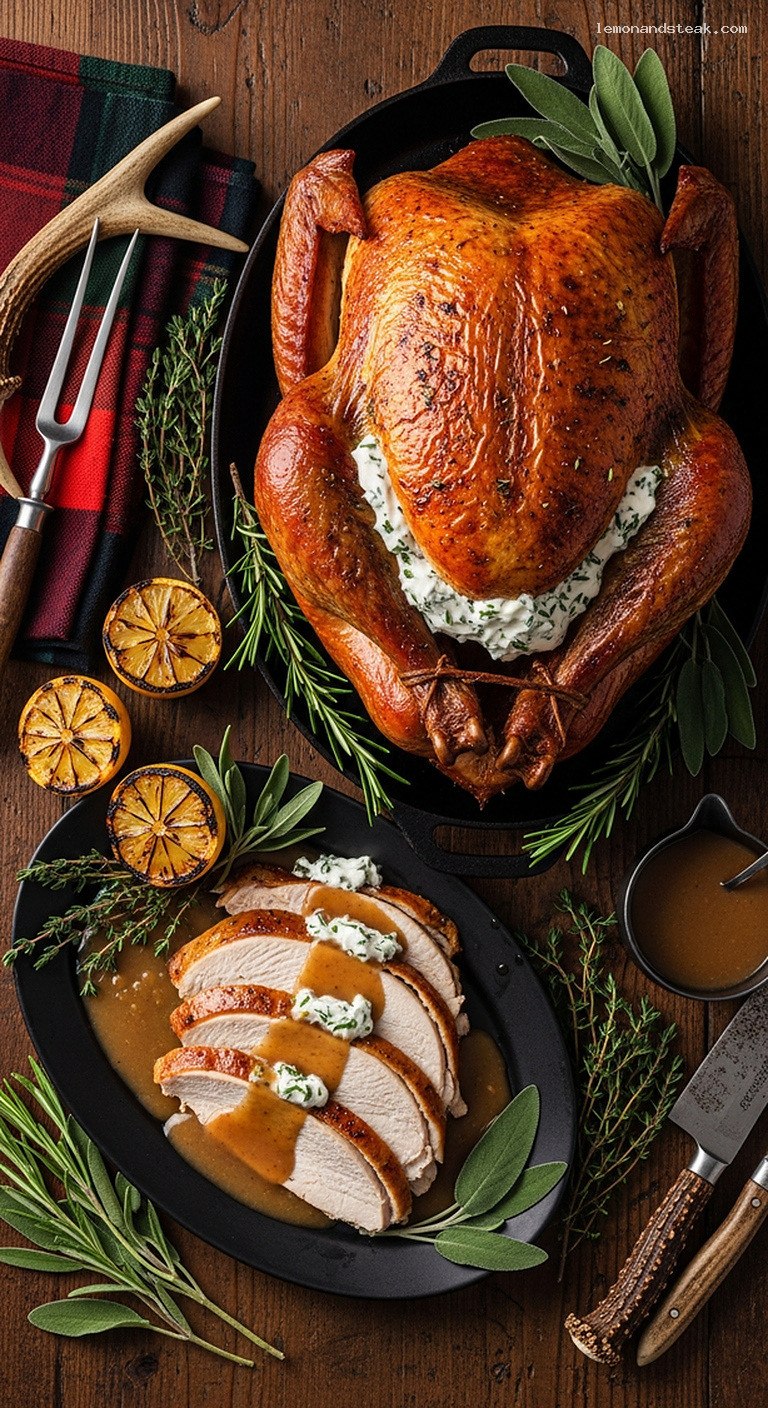
Quick Recipe Version (TL;DR)
Quick Ingredients
- 1 (12 lb) whole turkey, thawed, giblets removed
- 2 tbsp kosher salt (for dry brine)
- 1 1/2 cups full-fat sour cream
- 6 tbsp unsalted butter, very soft
- 6 cloves garlic, finely minced
- 1/4 cup finely chopped fresh herbs (thyme, rosemary, sage, parsley)
- 1 lemon (zest and 2 tbsp juice, plus wedges for serving)
- 1 large yellow onion and 1 firm apple, quartered; extra herb sprigs (for cavity)
- 2–3 cups low-sodium chicken or turkey stock, 3 tbsp all-purpose flour (for gravy)
- Freshly ground black pepper, smoked or sweet paprika, and a little oil
Do This
- 1. Pat turkey dry, remove giblets, and rub all over with 2 tbsp kosher salt. Chill uncovered 8–24 hours if time allows.
- 2. Mix sour cream, soft butter, garlic, chopped herbs, lemon zest and juice, 2 tsp salt, 1 tsp pepper, and 1/2 tsp paprika into a thick paste.
- 3. Loosen skin over breast and thighs with your fingers. Spread most of the sour cream mixture evenly under the skin; rub the rest over the outside.
- 4. Stuff the cavity loosely with onion, apple, and herb sprigs. Tie legs with kitchen twine. Let turkey sit at room temp 45–60 minutes.
- 5. Roast breast-side up at 325°F (163°C) on a rack in a roasting pan for about 3 hours, until breast is 160°F (71°C) and thigh is 170°F (77°C).
- 6. Transfer turkey to a board, tent loosely with foil, and rest 30–45 minutes.
- 7. Meanwhile, skim fat from drippings, make a pan gravy with flour and stock, carve turkey, and serve with the creamy, herby juices and gravy.
Why You’ll Love This Recipe
- The sour cream rub melts under the skin, keeping the meat incredibly juicy and tender.
- Fresh herbs and lemon give the turkey an old-fashioned, creamy tang that tastes like holiday comfort.
- Most of the work is simple mixing and rubbing; the oven does the rest.
- Built-in pan gravy makes this a complete, show-stopping centerpiece.
Grocery List
- Produce: 1 large yellow onion, 1 firm apple, 1 lemon, 6 cloves garlic, fresh thyme, fresh rosemary, fresh sage, fresh parsley
- Dairy: 1 1/2 cups full-fat sour cream, 6 tbsp unsalted butter
- Pantry: 1 (12 lb) whole turkey, kosher salt, black pepper, smoked or sweet paprika, all-purpose flour, low-sodium chicken or turkey stock, neutral oil (such as canola or vegetable)
Full Ingredients
For the Turkey
- 1 whole turkey, about 12 lb, completely thawed if previously frozen, giblets and neck removed
- 2 tbsp kosher salt (for dry brining the turkey)
- 1 tsp freshly ground black pepper
- 1 tsp smoked or sweet paprika
- 1 tbsp neutral oil (for the roasting pan and skin, if needed)
Herbed Sour Cream Rub
- 1 1/2 cups full-fat sour cream
- 6 tbsp unsalted butter, very soft but not melted
- 6 cloves garlic, very finely minced or grated
- 1 tbsp Dijon mustard (optional but adds depth)
- 1 tbsp finely chopped fresh thyme leaves
- 1 tbsp finely chopped fresh rosemary leaves
- 1 tbsp finely chopped fresh sage leaves
- 1 tbsp finely chopped fresh flat-leaf parsley
- 1 tsp finely grated lemon zest (from about half a lemon)
- 2 tbsp fresh lemon juice
- 2 tsp kosher salt
- 1 tsp freshly ground black pepper
- 1/2 tsp smoked or sweet paprika
- Optional: 1/2 tsp onion powder for extra savory flavor
Aromatics for the Cavity
- 1 large yellow onion, peeled and quartered
- 1 firm apple (such as Granny Smith or Honeycrisp), cored and quartered
- 1/2 lemon, cut into 2 wedges
- 4–6 sprigs mixed fresh herbs (thyme, rosemary, sage, parsley)
For the Pan Gravy (Optional but Recommended)
- Pan drippings and browned bits from the roasting pan
- 3 tbsp all-purpose flour
- 2–3 cups low-sodium chicken or turkey stock (start with 2 cups, add more as needed for consistency)
- 1 tsp Dijon mustard (optional)
- Salt and freshly ground black pepper, to taste

Step-by-Step Instructions
Step 1: Thaw, dry-brine, and prep the turkey
If your turkey is frozen, thaw it in the refrigerator several days in advance (allow about 24 hours per 4–5 lb). On the day before roasting, remove the turkey from its packaging. Take out the neck and giblets from the cavity and save them for stock or gravy if you like.
Pat the turkey very dry with paper towels, inside and out. Sprinkle 2 tbsp kosher salt evenly all over the surface of the bird, including the back and legs. You can also sprinkle a pinch inside the cavity. Place the turkey on a rack set over a rimmed baking sheet or in your roasting pan. Refrigerate uncovered for at least 8 hours and up to 24 hours. This dry-brine step seasons the meat deeply and helps the skin brown and crisp.
Step 2: Make the herbed sour cream rub
About 1–2 hours before you plan to roast, prepare the rub. In a medium bowl, combine the sour cream and very soft butter. Mash together with a spatula or spoon until smooth and homogenous.
Add the minced garlic, Dijon mustard (if using), chopped thyme, rosemary, sage, parsley, lemon zest, lemon juice, 2 tsp kosher salt, 1 tsp black pepper, 1/2 tsp paprika, and onion powder (if using). Stir until everything is well combined into a thick, spreadable paste. Taste a tiny bit and adjust salt or lemon to your liking; it should taste well-seasoned and tangy.
Step 3: Loosen the skin and spread the rub underneath
Take the turkey out of the refrigerator and let it sit at room temperature for about 45–60 minutes to take the chill off. This helps it cook more evenly. If there is any moisture on the surface, pat it dry again thoroughly with paper towels.
Starting at the cavity end of the bird, gently slide your fingers under the skin of the breast, being careful not to tear it. Work slowly to loosen the skin from the meat, moving up toward the top of the breasts. Do the same over the thighs and drumsticks as much as you comfortably can.
Using your hand or a small spatula, scoop generous amounts of the herbed sour cream mixture and push it under the loosened skin, then smooth it over the meat. Aim to use about two-thirds of the mixture under the skin, spreading it as evenly as possible over the breasts and thighs. Rub the remaining mixture all over the outside of the turkey, including the legs and wings. If the skin is very slick, you can leave a tiny bit of bare skin on top of the breasts to help them brown, but try to keep an even coating overall.
Step 4: Add aromatics, season the exterior, and set up the pan
Season the outside of the turkey lightly with the 1 tsp black pepper and 1 tsp paprika. The turkey is already salted from the dry brine and the rub, so you likely will not need more salt on the outside.
Stuff the cavity loosely with the onion wedges, apple wedges, lemon pieces, and herb sprigs. Do not pack them tightly; air should still be able to circulate. Tuck the wing tips underneath the bird to prevent burning. Tie the legs together at the ankles with kitchen twine for a neat shape.
Lightly oil the roasting rack and pan with about 1 tbsp neutral oil to help with cleanup and prevent sticking. Place the turkey breast-side up on a rack set in a large roasting pan. Position it so the breast is centered and as level as possible for even cooking.
Step 5: Roast the turkey low and slow
Preheat your oven to 325°F (163°C) with a rack in the lower third position. Once the oven is hot, place the turkey in the oven. If you like, you can tent the breast loosely with a piece of foil for the first hour to protect it from over-browning.
Roast at 325°F (163°C) for about 3 hours total for a 12 lb turkey, or roughly 15 minutes per pound. About every 45 minutes, rotate the pan for even browning. You can baste lightly with the pan juices if you like, but it is not strictly necessary because the sour cream rub is already keeping the meat moist.
Begin checking the internal temperature after about 2 1/2 hours. Insert an instant-read thermometer into the thickest part of the breast (without touching bone) and the thickest part of the thigh. The turkey is done when the breast registers 160°F (71°C) and the thigh registers about 170°F (77°C). If the skin is browning too quickly before it is done, tent the bird loosely with foil.
Step 6: Rest the turkey and make the pan gravy
When the turkey reaches temperature, carefully transfer it to a large cutting board or serving platter. Tent it loosely with foil and let it rest for 30–45 minutes. This rest is essential for juicy meat; the internal temperature will continue to rise a few degrees while the juices redistribute.
While the turkey rests, make the gravy. Pour the drippings from the roasting pan into a heatproof measuring cup and let them sit a minute. Skim off and reserve 3–4 tbsp of the clear fat from the top. Pour off any additional fat, leaving the browned bits (fond) in the pan, and add enough stock to the remaining juices to total about 2–3 cups liquid.
Set the roasting pan over medium heat across two burners. Add the reserved fat back to the pan (if you do not have quite enough, top up with butter or oil) and sprinkle in the 3 tbsp flour. Whisk and cook for 1–2 minutes, scraping up the browned bits, until the flour smells toasty. Slowly whisk in the stock-and-drippings mixture, stirring constantly to avoid lumps. Simmer 5–10 minutes, until thickened to your liking. Stir in the Dijon mustard if using, and season to taste with salt and pepper.
Step 7: Carve and serve
Once the turkey has rested, remove the twine and discard the aromatics from the cavity. Use a sharp carving knife to remove the legs and thighs, then the wings, and finally carve the breasts off the bone and slice them crosswise. You will see a pale, creamy, herbed layer under the golden skin where the sour cream rub has melted into the meat—that is flavor and moisture.
Arrange the sliced turkey on a warm platter, spoon some of the pan juices or a little gravy over the top to keep it glistening, and serve the remaining gravy on the side. Garnish with extra herb sprigs and lemon wedges if desired. Enjoy the tender, juicy turkey with its subtle creamy tang and old-fashioned herb flavor.
Pro Tips
- Plan thawing ahead. A 12 lb turkey may take 3 full days to thaw in the refrigerator. Build this into your schedule so you can still dry-brine overnight.
- Do not skip drying the skin. Patting the turkey dry before salting and again before roasting is key to crisp, browned skin instead of steaming.
- Use an instant-read thermometer. Oven temperatures and bird sizes vary. Rely on internal temperature, not just time, to avoid dry or undercooked meat.
- Protect the breast if needed. If the breast browns too quickly, tent it loosely with foil; remove the foil for the last 20–30 minutes so the skin crisps.
- Let it rest fully. The 30–45 minute rest may feel long, but it is one of the biggest differences between dry turkey and juicy turkey.
Variations
- Herb and citrus twist: Add extra lemon zest and a little orange zest to the sour cream rub, and tuck orange wedges into the cavity along with the lemon for a brighter, more citrus-forward flavor.
- Garlic-lover’s version: Increase the garlic to 8–10 cloves and add 1/2 tsp garlic powder to the rub for a more pronounced garlic profile.
- Turkey breast only: Use a 5–7 lb bone-in turkey breast instead of a whole bird. Rub as directed and roast at 325°F (163°C) for about 1 3/4–2 1/2 hours, until the thickest part registers 160°F (71°C).
Storage & Make-Ahead
Make-ahead: You can dry-brine the turkey up to 24 hours before roasting and apply the herbed sour cream rub up to 12 hours ahead. After rubbing, keep the turkey uncovered or loosely tented in the refrigerator; this develops flavor and still allows the skin to dry slightly for better browning.
Leftovers: Cool leftover turkey completely, then store in airtight containers in the refrigerator for up to 3–4 days. For longer storage, freeze sliced meat and gravy separately for up to 2–3 months. Reheat gently in a covered dish at 300°F (149°C) with a splash of stock or gravy to keep the meat moist.
Nutrition (per serving)
Approximate values for 1/10 of the turkey plus a modest amount of gravy (this will vary with portion size and how much skin and gravy you eat): about 420 calories; 45 g protein; 22 g fat; 6 g saturated fat; 4 g carbohydrates; 0 g fiber; 2 g sugars; 860 mg sodium.
Leave a Reply