
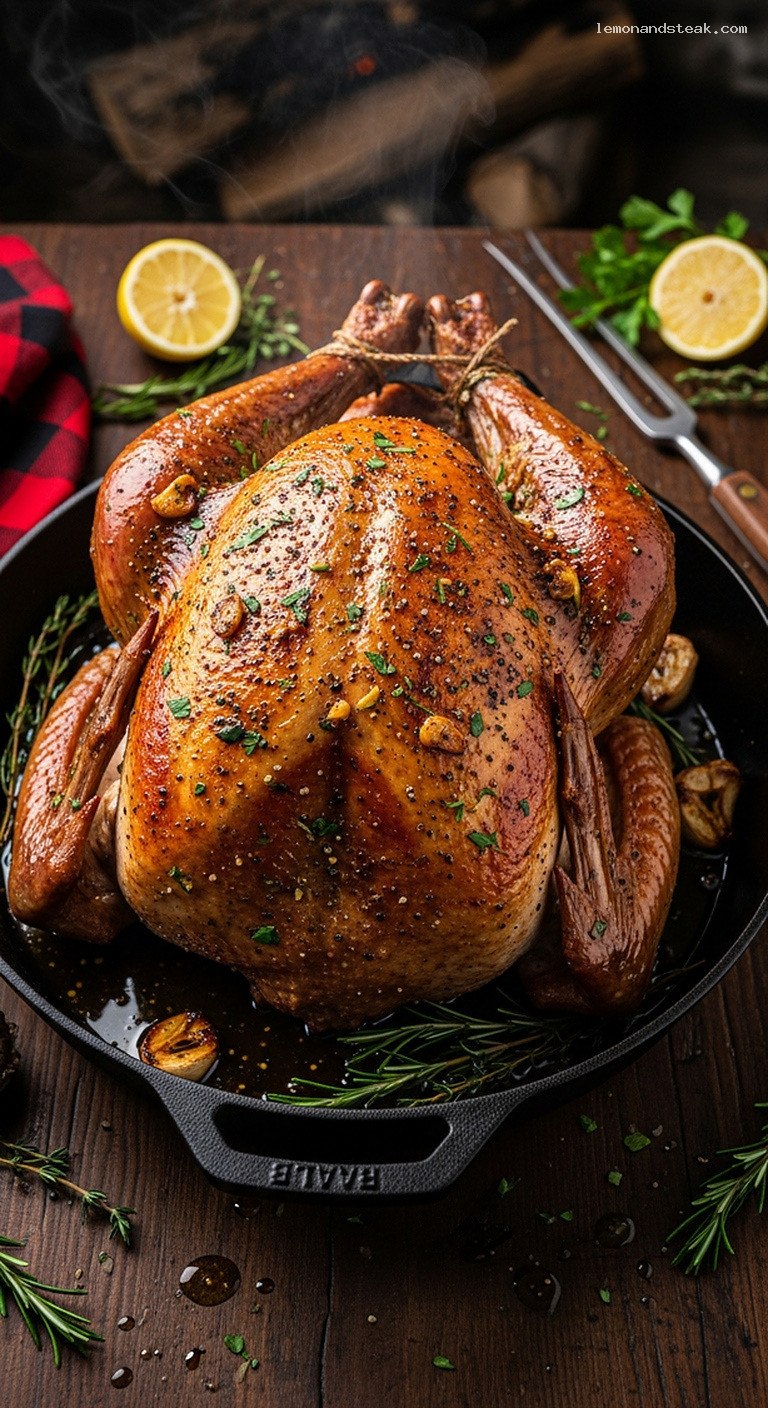
Quick Recipe Version (TL;DR)
Quick Ingredients
- 1 whole turkey (12–14 lb), thawed
- 2 1/2 tbsp kosher salt, divided
- 3 1/2 tsp freshly ground black pepper, divided
- 12 tbsp (1 1/2 sticks) unsalted butter, softened
- Zest and juice of 2 lemons
- 6 garlic cloves, minced
- 1/4 cup chopped fresh parsley
- 1 tbsp chopped fresh thyme
- 1 tbsp chopped fresh rosemary
- 1 medium onion, quartered; 1 lemon, halved
- 8–12 sprigs fresh herbs (thyme, rosemary, parsley)
- 1–2 cups low-sodium chicken or turkey broth
- 3 tbsp flour + 3 tbsp pan fat or butter for optional gravy
Do This
- 1. Pat turkey very dry, remove giblets, and season all over (including cavity) with 2 tbsp kosher salt and 2 tsp black pepper. Chill uncovered in the fridge overnight if possible for extra-crisp skin.
- 2. Mix softened butter with lemon zest, lemon juice, garlic, parsley, thyme, rosemary, 1 tsp salt, and 1 1/2 tsp pepper.
- 3. Preheat oven to 425°F (220°C). Loosen skin over breasts and thighs; rub about half the lemon herb butter under the skin and the rest all over the outside. Stuff cavity with onion, lemon halves, and herb sprigs. Tie legs and tuck wing tips.
- 4. Place turkey breast-side up on a rack in a roasting pan. Pour 1 cup broth into the pan. Roast 30 minutes at 425°F (220°C).
- 5. Reduce oven to 325°F (165°C). Roast 2–2 1/2 hours more, adding broth if pan dries and tenting loosely with foil if browning too quickly. Aim for 160–165°F (71–74°C) in the thickest part of thigh.
- 6. Transfer turkey to a board, tent loosely with foil, and rest 30 minutes.
- 7. For gravy, skim 3 tbsp fat from drippings, whisk with 3 tbsp flour, then whisk in 2–3 cups warm broth. Simmer until thickened, season with salt, pepper, and a squeeze of lemon. Carve turkey and serve with pan gravy.
Why You’ll Love This Recipe
- Bright lemon and fresh herbs give the turkey a lively, aromatic flavor that still tastes totally classic and homestyle.
- A generous lemon herb butter under and over the skin keeps the meat juicy while producing beautifully crisp, golden-brown skin.
- The method is straightforward and forgiving, with clear doneness cues so you do not have to guess.
- Pan drippings turn into an easy, deeply flavorful lemon-herb gravy that ties the whole meal together.
Grocery List
- Produce: 3 lemons, 1 medium yellow onion, 1 bulb garlic, fresh flat-leaf parsley, fresh thyme, fresh rosemary
- Dairy: Unsalted butter (at least 1 1/2 sticks / 12 tbsp)
- Pantry: 1 whole turkey (12–14 lb), kosher salt, freshly ground black pepper, low-sodium chicken or turkey broth, all-purpose flour
Full Ingredients
For the Turkey
- 1 whole turkey (12–14 lb), thawed if frozen (allow several days in the fridge)
- 2 1/2 tbsp kosher salt, divided
- 2 tsp freshly ground black pepper, divided
- 1 medium yellow onion, peeled and quartered
- 1 lemon, halved
- 4 sprigs fresh thyme
- 4 sprigs fresh rosemary
- 4 sprigs fresh flat-leaf parsley
- 1–2 cups low-sodium chicken or turkey broth (for the roasting pan)
For the Lemon Herb Butter
- 12 tbsp (1 1/2 sticks / 170 g) unsalted butter, softened to room temperature
- Zest of 2 lemons (about 2 tbsp loosely packed)
- 2 tbsp freshly squeezed lemon juice
- 6 garlic cloves, finely minced or pressed
- 1/4 cup finely chopped fresh flat-leaf parsley
- 1 tbsp finely chopped fresh thyme leaves
- 1 tbsp finely chopped fresh rosemary leaves
- 1 tsp kosher salt
- 1 1/2 tsp freshly ground black pepper
For the Pan Gravy (Optional but Recommended)
- 3 tbsp fat from the roasting pan drippings (or unsalted butter)
- 3 tbsp all-purpose flour
- 2–3 cups low-sodium chicken or turkey broth, warmed
- Salt and freshly ground black pepper, to taste
- 1–2 tsp fresh lemon juice, to taste (for brightness)
- 1 tbsp chopped fresh herbs (parsley, thyme, or rosemary), optional
Step-by-Step Instructions
Step 1: Prep and Dry the Turkey
Make sure your turkey is fully thawed. For a 12–14 lb bird, this usually means 3–4 days in the refrigerator. Remove the turkey from its packaging in the sink, and remove the neck and giblet packet from the cavity (check both the main cavity and the neck cavity). Pat the turkey completely dry with paper towels, inside and out. Dry skin is key for crisp, golden roast turkey.
Place the turkey breast-side up on a rack set inside a large roasting pan. If you have time, season the turkey all over with 2 tbsp of the kosher salt (reserve 1/2 tbsp for later) and 1 1/2 tsp black pepper, including a light sprinkle inside the cavity. Return the uncovered turkey to the refrigerator for up to 24 hours. This optional step lightly dry-brines the turkey and helps the skin crisp more in the oven.
Step 2: Make the Lemon Herb Butter
In a medium bowl, combine the softened butter, lemon zest, lemon juice, minced garlic, chopped parsley, thyme, rosemary, 1 tsp kosher salt, and 1 1/2 tsp black pepper. Mash everything together with a fork or spatula until the butter is evenly flecked with herbs and zest and the mixture is smooth and spreadable.
Taste a tiny bit (it will be salty and strongly flavored, which is exactly what you want for seasoning the turkey) and adjust with a pinch more salt or lemon if needed. Set aside at cool room temperature so it stays soft and easy to spread.
Step 3: Season the Turkey with Lemon Herb Butter
Let the turkey sit at room temperature for 30–45 minutes before roasting so it is not ice-cold going into the oven. Preheat the oven to 425°F (220°C) with a rack positioned in the lower third to leave room for the tall bird.
Using your fingers, gently loosen the skin over the turkey breasts: slide a hand in at the cavity opening and carefully separate the skin from the meat without tearing it, working your way up toward the neck. Do the same over the tops of the thighs if you can reach. Be patient; slow, gentle movement keeps the skin intact.
Take about half of the lemon herb butter and, using your fingers or a small spatula, smear it directly onto the meat under the loosened skin over the breasts and thighs. Press and smooth the skin from the outside to distribute the butter evenly underneath.
Rub the remaining butter all over the outside of the turkey, covering breasts, legs, thighs, and as much of the back as you can reach. Sprinkle the remaining 1/2 tbsp kosher salt and 1/2 tsp pepper evenly over the skin.
Stuff the main cavity loosely with the onion quarters, lemon halves, and the fresh herb sprigs. Do not pack tightly; air should still circulate for even cooking. Tie the legs together with kitchen twine, and tuck the wing tips under the body so they do not burn.
Step 4: Set Up the Roasting Pan and Start Hot
Make sure the turkey is settled breast-side up on the rack in your roasting pan. The rack keeps the turkey lifted so hot air can circulate and the bottom does not stew in its juices. Pour 1 cup of broth into the bottom of the pan to prevent burning and to start building flavorful drippings for gravy.
Place the pan in the preheated 425°F (220°C) oven. Roast for 30 minutes. This initial blast of high heat helps the skin start to brown and render the fat, giving you a great head start on crispness and color.
Step 5: Lower the Heat and Roast Until Done
After 30 minutes, reduce the oven temperature to 325°F (165°C). If any spots on the turkey are browning much faster than the rest, tent them loosely with a bit of foil. Continue roasting, checking every 30 minutes. If the pan looks dry or the drippings are starting to darken too much, add another 1/2 cup of broth or water to the pan.
About halfway through the remaining cooking time, you can baste lightly with the pan juices if you like, though the butter does most of the work in keeping the meat moist. Roast until an instant-read thermometer inserted into the thickest part of the thigh (not touching bone) registers 160–165°F (71–74°C). For a 12–14 lb unstuffed turkey, total roasting time (including the initial 30 minutes at high heat) is typically about 3 to 3 1/4 hours, but always trust the thermometer over the clock.
Step 6: Rest the Turkey and Make the Pan Gravy
Carefully transfer the turkey to a large cutting board or serving platter. Tent loosely with foil (do not wrap tightly or it will steam and soften the skin). Let it rest for at least 30 minutes. Resting is crucial: it allows the juices to redistribute so the slices are moist instead of dry.
While the turkey rests, make the gravy. Pour the pan drippings through a fine-mesh strainer into a heatproof measuring cup. Let them sit a minute so the fat rises to the top. Skim off 3 tbsp of the fat and add to a medium saucepan (if you do not have enough fat, supplement with butter to reach 3 tbsp). Discard any burned bits left in the pan, but keep the browned, flavorful bits stuck to the bottom as much as possible when you first deglaze.
Place the saucepan over medium heat. Whisk the flour into the hot fat and cook, whisking constantly, for 2–3 minutes until the roux is smooth and just starting to turn golden and smell nutty. Slowly whisk in 2 cups of warm broth, then add any remaining (defatted) juices from the roasting pan. Bring to a gentle simmer, whisking, until thickened to your liking, 5–8 minutes. If it is too thick, whisk in more broth. Season with salt, pepper, and a teaspoon or two of lemon juice for brightness. Stir in chopped fresh herbs if using.
Step 7: Carve and Serve
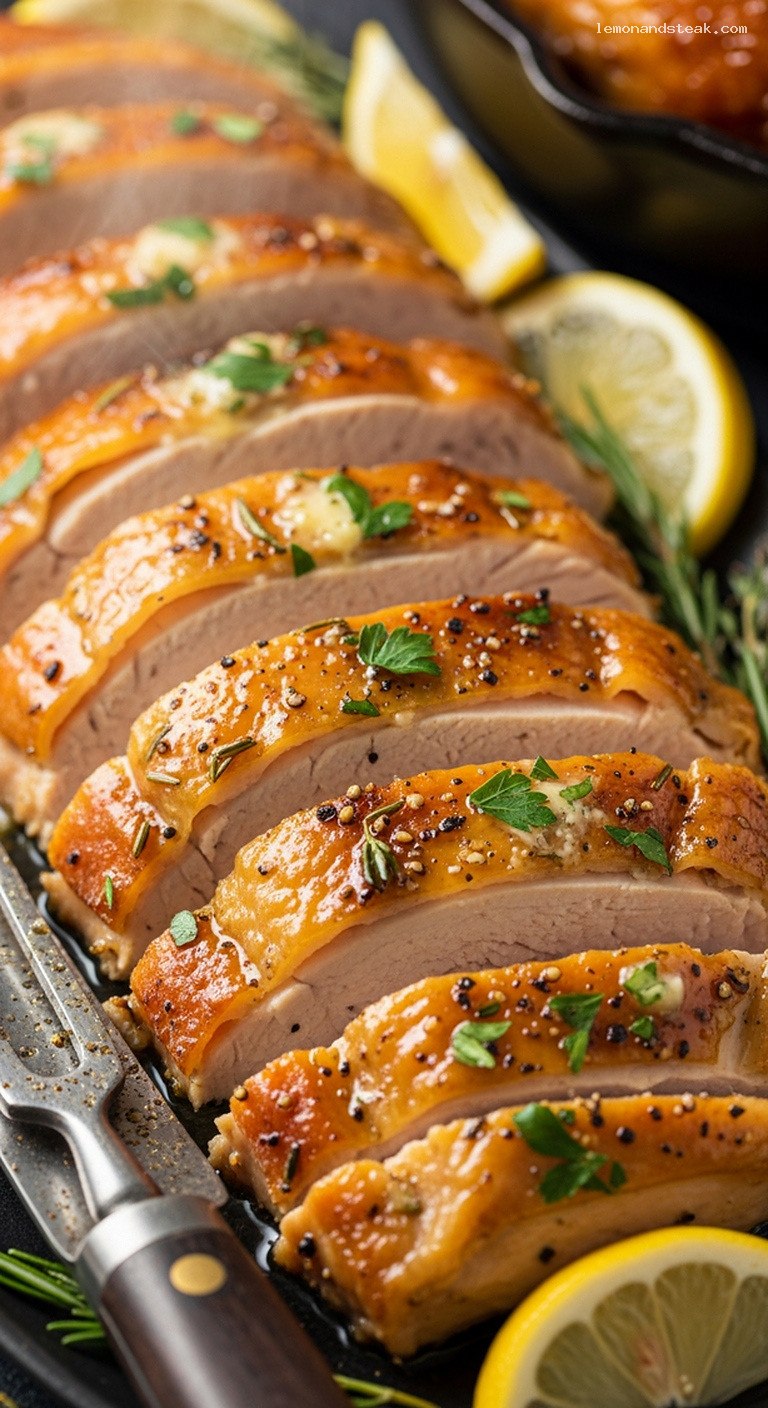
Once the turkey has rested, remove the kitchen twine and discard the aromatics from the cavity. Use a sharp carving knife to remove the legs and thighs, then the wings, then slice the breasts off the bone in large lobes and cut them crosswise into even slices. Arrange the meat on a warm platter with some lemon wedges and herb sprigs for a simple, homestyle presentation.
Spoon some of the lemon-herb pan gravy over the sliced turkey, leaving extra in a gravy boat at the table. The result should be juicy meat with a bright, citrusy, herbal aroma and deeply savory, buttery flavor that still feels like a classic roast turkey.
Pro Tips
- Dry the skin thoroughly. Any surface moisture will steam instead of crisp. Blot the turkey well with paper towels before seasoning and again before it goes into the oven if needed.
- Do the optional overnight chill. Salting and leaving the turkey uncovered in the fridge for up to 24 hours lightly dry-brines the meat and makes the skin noticeably crisper and more evenly browned.
- Use a thermometer, not just time. Oven calibration and turkey size vary, so check for 160–165°F (71–74°C) in the thigh and 155–160°F (68–71°C) in the breast for perfect doneness.
- Do not skip the rest. That 30-minute rest makes the difference between juicy slices and a plate full of lost juices. The turkey will stay hot under a loose foil tent.
- Adjust the lemon to your taste. For a brighter flavor, finish the carved meat or the gravy with a little extra squeeze of lemon; for a more classic profile, keep the lemon confined mostly to the butter and cavity.
Variations
- Extra-peppery lemon turkey: Increase the black pepper in both the butter and on the skin for a bolder, steakhouse-style cracked pepper crust against the lemon and herbs.
- Garlic-forward version: Use up to 8–10 cloves of garlic in the lemon herb butter for a robust garlicky aroma, and add a few lightly smashed cloves to the roasting pan.
- Herb-only (milder citrus) version: Reduce the lemon juice in the butter to 1 tbsp and skip the lemon in the cavity, focusing mainly on parsley, thyme, and rosemary for a more traditional herb roast flavor with just a hint of lemon.
Storage & Make-Ahead
Leftover turkey keeps well and is excellent for sandwiches, soups, and casseroles. Refrigerate carved meat in shallow, airtight containers within 2 hours of cooking. It will keep for 3–4 days in the fridge. For longer storage, freeze in well-wrapped portions (ideally with a bit of gravy or broth to prevent dryness) for up to 2–3 months; thaw overnight in the fridge before reheating.
Reheat gently, covered, in a 300°F (150°C) oven with a splash of broth or gravy until warmed through, or warm individual portions in a covered skillet over low heat. You can make the lemon herb butter up to 3 days ahead and keep it in the fridge; bring to room temperature before using so it spreads easily. The turkey can also be seasoned with salt and left uncovered in the fridge overnight to dry the skin and deepen the flavor. Save the carcass and bones to make a rich turkey stock the next day.
Nutrition (per serving)
Approximate values for 1/12 of the turkey (white and dark meat, without gravy): about 450 calories; 55 g protein; 24 g fat; 8 g saturated fat; 0–2 g carbohydrates; 0 g fiber; 0–1 g sugar; approximately 850–950 mg sodium (this will vary with the exact amount of salt, drippings used, and portion sizes). Gravy will add additional calories, fat, and sodium depending on how much you use.
Leave a Reply