
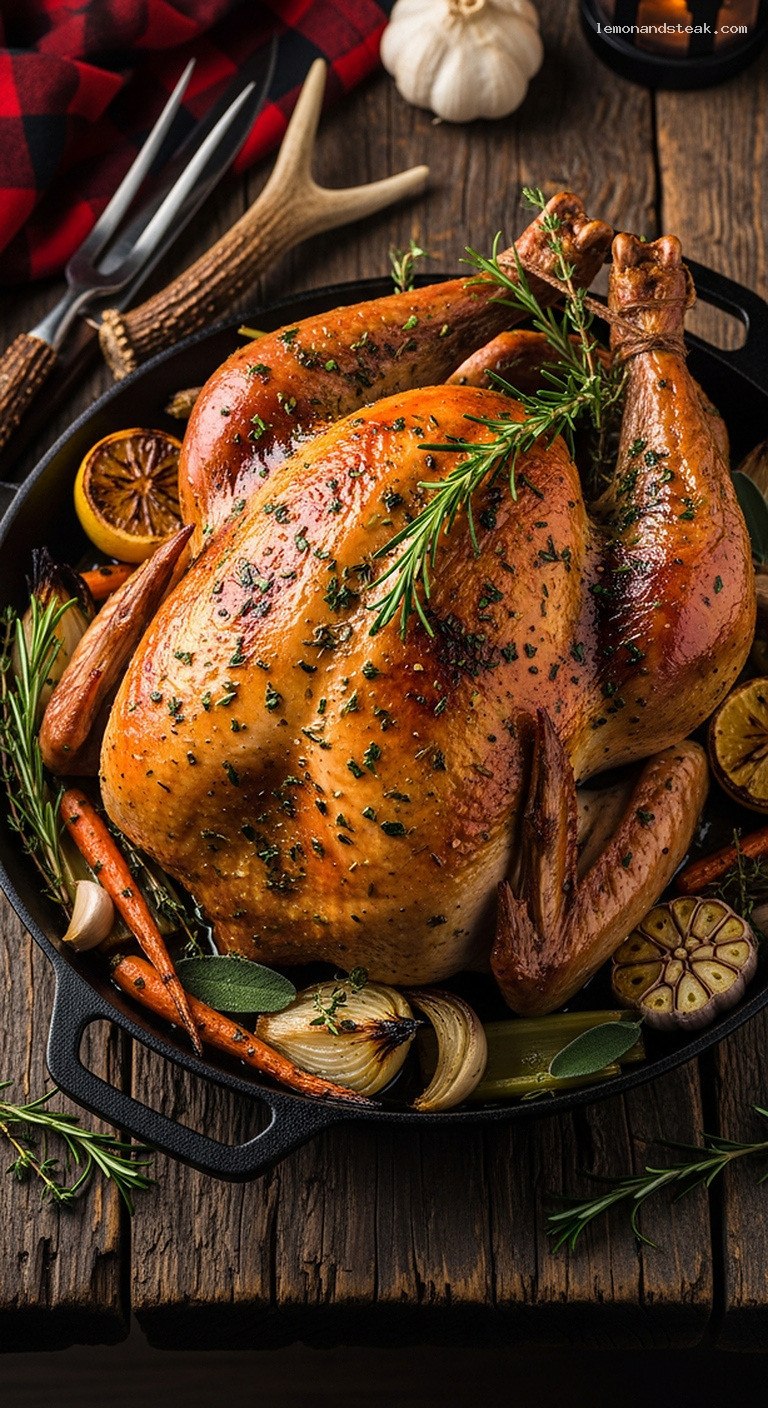
Quick Recipe Version (TL;DR)
Quick Ingredients
- 1 whole turkey (12–14 lb), thawed
- 4 cups low-sodium chicken or turkey broth, divided
- 10–12 garlic cloves (for broth + cavity)
- 1 cup (2 sticks) unsalted butter, softened
- Fresh rosemary, thyme, sage, and parsley (about 2–3 tbsp each, chopped)
- 1 lemon, plus zest and juice
- 1 large onion, 2 carrots, 2 celery ribs
- Kosher salt, black pepper, sugar, paprika or smoked paprika
- 2 tbsp all-purpose flour (for gravy), neutral oil for vegetables
- Optional: Worcestershire sauce, extra fresh herb sprigs
Do This
- 1. Pat the thawed turkey dry and chill uncovered 4–24 hours if you have time, to help the skin dry out for better browning.
- 2. Simmer garlic, broth, salt, pepper, sugar, and a splash of Worcestershire 10 minutes; strain and cool slightly to make a smooth garlic broth for injecting.
- 3. Inject the warm (not hot) garlic broth all over the breasts, thighs, and drumsticks, spacing injections 1–1 1/2 inches apart.
- 4. Mix softened butter with chopped herbs, lemon zest, lemon juice, salt, pepper, and paprika. Rub most under the skin over breasts and thighs, the rest all over the outside.
- 5. Fill the cavity with onion, garlic, lemon, and herbs. Set turkey on a rack over carrots and celery in a roasting pan with broth in the bottom.
- 6. Roast at 425°F for 20 minutes, then at 325°F for about 2 1/2–3 hours more, until the breast is 160–165°F and thighs are 170–175°F, tenting with foil if browning too fast.
- 7. Rest 30–45 minutes before carving. Make a quick gravy by thickening the pan drippings and extra broth with a flour roux.
Why You’ll Love This Recipe
- The garlic broth injection keeps the turkey incredibly juicy from the inside out.
- Herb butter under and over the skin gives classic, cozy, holiday flavors in every bite.
- The roasting pan vegetables and drippings turn into a rich, deeply savory gravy.
- It looks impressive, but the steps are very manageable for home cooks.
Grocery List
- Produce: 1 whole garlic head, extra garlic cloves (10–12 total), 1 large yellow onion, 2 medium carrots, 2 ribs celery, 1 lemon, fresh rosemary, fresh thyme, fresh sage, fresh parsley
- Dairy: 1 cup (2 sticks) unsalted butter
- Pantry: 1 whole turkey (12–14 lb), low-sodium chicken or turkey broth (about 6 cups total), kosher salt, black pepper, sugar, smoked or sweet paprika, neutral oil (canola or vegetable), all-purpose flour, Worcestershire sauce (optional)
Full Ingredients
For the Garlic Broth Injection
- 2 cups (480 ml) low-sodium chicken or turkey broth
- 6 large garlic cloves, smashed
- 1 1/2 tsp kosher salt (reduce to 1 tsp if your broth is not low-sodium)
- 1 tsp granulated sugar (helps browning and rounds out flavor)
- 1 tsp Worcestershire sauce (optional, for extra savoriness)
- 1/2 tsp freshly ground black pepper
For the Herb Butter and Turkey
- 1 whole turkey, 12 to 14 lb (5.4 to 6.4 kg), fully thawed, giblets and neck removed
- 1 cup (2 sticks / 226 g) unsalted butter, very soft
- 2 tbsp olive oil (helps the butter spread and brown nicely)
- 1 tbsp kosher salt (use 2–2 1/2 tsp if using salted butter)
- 1 1/2 tsp freshly ground black pepper
- 2 tbsp finely chopped fresh rosemary leaves
- 2 tbsp finely chopped fresh thyme leaves
- 2 tbsp finely chopped fresh sage leaves
- 2 tbsp chopped fresh parsley
- Zest of 1 lemon (about 1 tbsp)
- 1 tbsp freshly squeezed lemon juice
- 1 tsp smoked paprika or sweet paprika
- 1 large yellow onion, quartered
- 1 whole head garlic, halved crosswise
- 1 lemon, quartered
- 2 ribs celery, cut into 2-inch pieces
- 2 medium carrots, cut into 2-inch pieces
- 2–3 tbsp neutral oil (for tossing vegetables)
- 2 cups (480 ml) low-sodium chicken or turkey broth (for the roasting pan)
- Optional: extra fresh herb sprigs (rosemary, thyme, sage) for the cavity and pan
For the Pan Gravy (Optional but Recommended)
- 2 tbsp fat from the pan drippings (or unsalted butter)
- 2 tbsp all-purpose flour
- 1 1/2 to 2 cups (360–480 ml) combined defatted pan drippings and extra chicken or turkey broth
- Salt and freshly ground black pepper, to taste
- Optional: 1–2 tsp Worcestershire sauce or a splash of cream, to finish
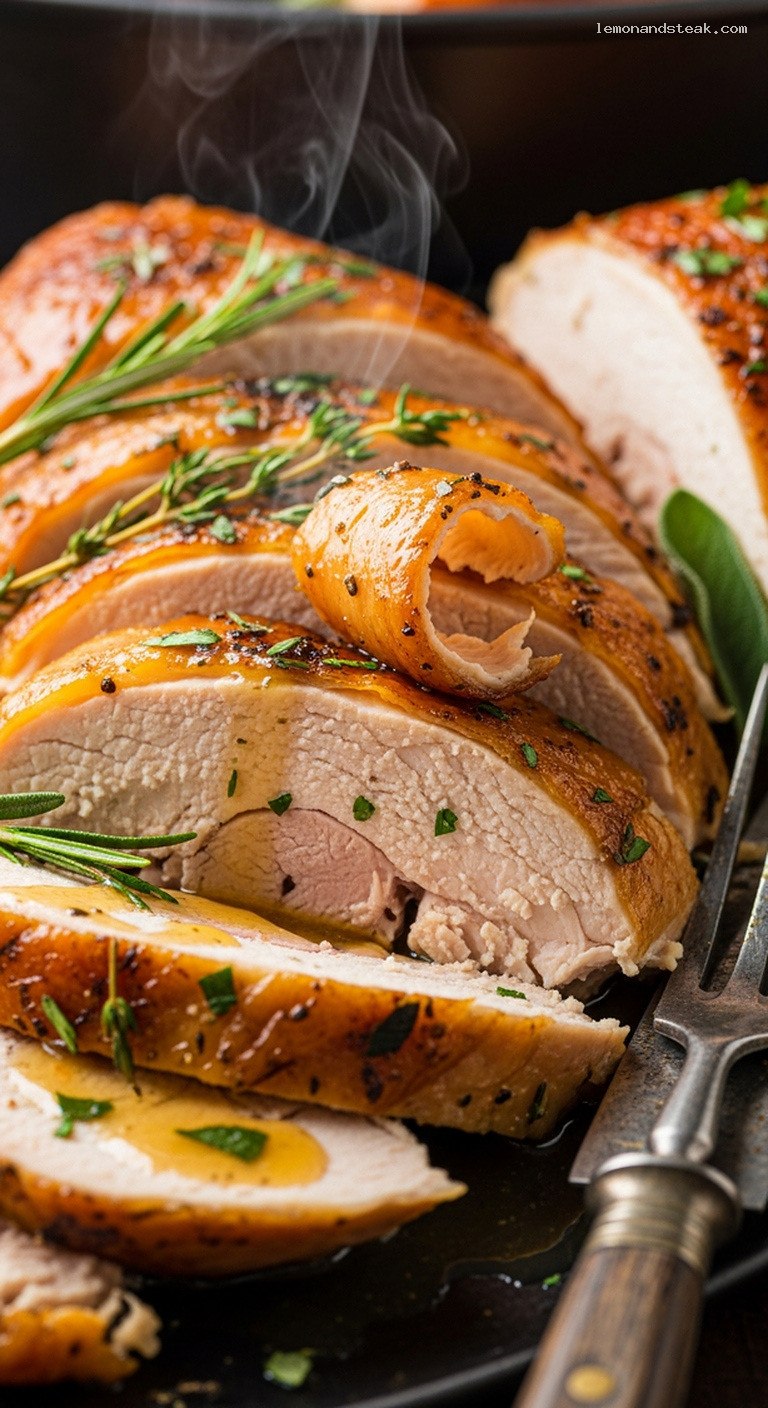
Step-by-Step Instructions
Step 1: Thaw, Dry, and Prep the Turkey
If your turkey is frozen, thaw it completely in the refrigerator (allow about 24 hours for every 4–5 lb / 1.8–2.2 kg of turkey). Once thawed, remove the turkey from its packaging in a clean sink. Reach into the cavity and remove the neck and giblet packet; reserve these for stock or gravy if you like.
Pat the turkey very dry with paper towels, inside and out. For the best, crispiest skin, place the turkey on a rack set over a rimmed baking sheet and refrigerate it, uncovered, for 4–24 hours. If you are short on time, even 1–2 hours of uncovered chilling helps dry the skin.
Step 2: Make the Garlic Broth Injection
In a small saucepan, combine the 2 cups broth, smashed garlic cloves, kosher salt, sugar, Worcestershire (if using), and black pepper. Bring to a gentle simmer over medium heat. Simmer for 10 minutes to soften the garlic and infuse the broth with flavor.
Remove from the heat and strain the mixture through a fine-mesh strainer into a heatproof measuring cup, pressing on the garlic to extract as much liquid and flavor as possible. Discard the garlic solids. Let the broth cool until warm but not hot to the touch (about body temperature); this makes it comfortable to handle and safer for your injector.
Step 3: Inject the Turkey with Garlic Broth
Load a meat injector with the warm garlic broth. Working on a rimmed tray or in your roasting pan, insert the injector needle deep into the thickest parts of the turkey breast, thighs, and drumsticks. Depress the plunger slowly as you withdraw the needle, so the liquid is distributed along the injection path rather than pooling in one spot.
Space the injections about 1–1 1/2 inches (2.5–4 cm) apart, using roughly 1 1/4 cups of the broth in the breasts and dividing the remaining broth between thighs and drumsticks. You will see the meat plump slightly. Some broth may leak out; that is normal. Gently pat the surface dry with paper towels again, but do not squeeze the turkey or you will force out the injected liquid.
Step 4: Make the Herb Butter and Season Under the Skin
In a medium bowl, combine the softened butter, olive oil, kosher salt, black pepper, chopped rosemary, thyme, sage, parsley, lemon zest, lemon juice, and smoked or sweet paprika. Mash with a fork until everything is evenly blended into a fragrant herb butter.
Place the turkey breast-side up on a rack. Starting at the cavity end, gently slide your fingers under the skin of each breast to loosen it from the meat, being careful not to tear the skin. Work your way up toward the top of the breast. Do the same over the upper thighs if you can reach them.
Spread about two-thirds of the herb butter under the loosened skin, pushing it as far up as you can and smoothing from the outside to distribute it evenly over the meat. Rub the remaining butter all over the outside of the turkey, including legs and wings. Tuck the wing tips under the body so they do not burn, and tie the legs loosely together with kitchen twine.
Stuff the cavity with the quartered onion, halved garlic head, lemon quarters, and a few herb sprigs if you have them. This will gently perfume the meat and drip flavor into the pan juices.
Step 5: Prepare the Roasting Pan and Roast the Turkey
Preheat your oven to 425°F (220°C) with a rack in the lower third. Toss the carrots and celery with the neutral oil and a pinch of salt and pepper, then spread them in an even layer in a large roasting pan. Add any remaining herb sprigs. Pour 1 1/2 cups of broth into the bottom of the pan. Set a roasting rack over the vegetables and place the turkey breast-side up on the rack.
Roast at 425°F (220°C) for 20 minutes to start browning and crisping the skin. Without opening the oven, reduce the temperature to 325°F (165°C) and continue roasting for about 2 1/2 to 3 hours, basting the turkey with the pan juices every 45 minutes. If the pan looks dry, add the remaining 1/2 cup broth (or a bit of water) to keep a thin layer of liquid for drippings.
After about 1 1/2 hours at 325°F, check the skin. If it is already a deep golden brown, loosely tent the breast with foil to prevent over-browning while the meat finishes cooking. Begin checking the internal temperature about 30 minutes before the estimated finish time. The turkey is done when the thickest part of the breast registers 160–165°F (71–74°C) and the thickest part of the thigh registers 170–175°F (77–79°C). Remove the turkey from the oven and transfer it carefully to a cutting board or platter.
Step 6: Rest the Turkey and Carve
Tent the turkey loosely with foil and let it rest for 30–45 minutes. Resting is crucial: it allows the juices, including that garlic broth you injected, to redistribute throughout the meat, keeping each slice moist rather than letting the juices run out onto the cutting board.
To carve, start by removing the leg quarters (thigh and drumstick) by cutting through the joints, then separate thighs from drumsticks. Remove the wings. Slice each breast half off the bone in one large lobe, then slice crosswise into 1/4–1/2 inch thick slices. Arrange the meat on a warm serving platter, spooning a bit of the pan juices over the top to keep it glossy and moist.
Step 7: Make the Pan Gravy
While the turkey rests, place the roasting pan over two stovetop burners set to medium heat. Carefully tilt the pan and spoon off most of the fat into a heatproof cup, reserving about 2 tbsp of fat for the gravy. Pour the remaining juices and browned bits through a fine-mesh strainer into a measuring cup. If needed, add extra broth to reach 1 1/2–2 cups total liquid.
In a medium saucepan, heat the 2 tbsp reserved fat (or butter) over medium heat. Sprinkle in the flour and whisk constantly for 2–3 minutes until the roux is smooth and light golden. Gradually whisk in the strained pan juices and broth, starting with a small amount to avoid lumps. Bring to a gentle simmer, whisking, until thickened, 5–7 minutes. Season to taste with salt, pepper, and a little Worcestershire or a splash of cream if you like. Serve warm alongside the carved turkey.
Pro Tips
- Inject while the broth is warm, not hot or cold. Warm liquid spreads more easily through the meat and is easier to work with.
- Do not over-salt early. The injection and herb butter both contain salt, so you usually will not need extra salt on the skin beyond what is in the butter.
- Use a good instant-read thermometer. Turkey can go from perfect to dry quickly. Rely on internal temperatures instead of time alone.
- Protect the breast. Foil-tenting the breast partway through keeps the white meat tender while the dark meat finishes cooking.
- Let it rest. The 30–45 minute rest may be the most important step for a juicy bird; do not rush it.
Variations
- Citrus-Herb Turkey: Add the zest of an extra orange to the herb butter and replace 1/2 cup of the injection broth with orange juice. Tuck orange slices into the cavity along with the lemon.
- Smoky-Spicy Turkey: Increase smoked paprika to 2 tsp in the herb butter and add 1/2 tsp cayenne. Stir 1 tsp chipotle in adobo (finely minced) into the garlic broth injection for a gentle smoky heat.
- Turkey Breast Only: Use a 6–8 lb bone-in turkey breast. Halve the injection and butter quantities, and roast at 350°F (175°C) for about 1 3/4 to 2 1/4 hours, until the thickest part is 160–165°F.
Storage & Make-Ahead
Refrigerate leftover turkey in shallow, airtight containers within 2 hours of serving. Properly stored, it will keep in the refrigerator for 3–4 days. For longer storage, freeze sliced turkey tightly wrapped or in freezer bags for up to 2–3 months; thaw overnight in the refrigerator before reheating.
Gravy will keep in the refrigerator for up to 3 days or in the freezer for up to 3 months. Reheat gently over low heat, whisking in a splash of broth or water if it has thickened too much.
To reheat turkey without drying it out, place slices in a baking dish with a few tablespoons of broth or gravy, cover tightly with foil, and warm at 300°F (150°C) until heated through.
Nutrition (per serving)
Approximate values per serving (about 8 oz cooked turkey with some skin and 2–3 tbsp gravy): 450–500 calories, 35–40 g protein, 25–30 g fat, 6–8 g carbohydrates, 0–1 g fiber, 1–2 g sugar, 900–1100 mg sodium. Actual values will vary based on the exact size of the turkey, how much skin is eaten, and how much gravy and butter are consumed.
Leave a Reply