
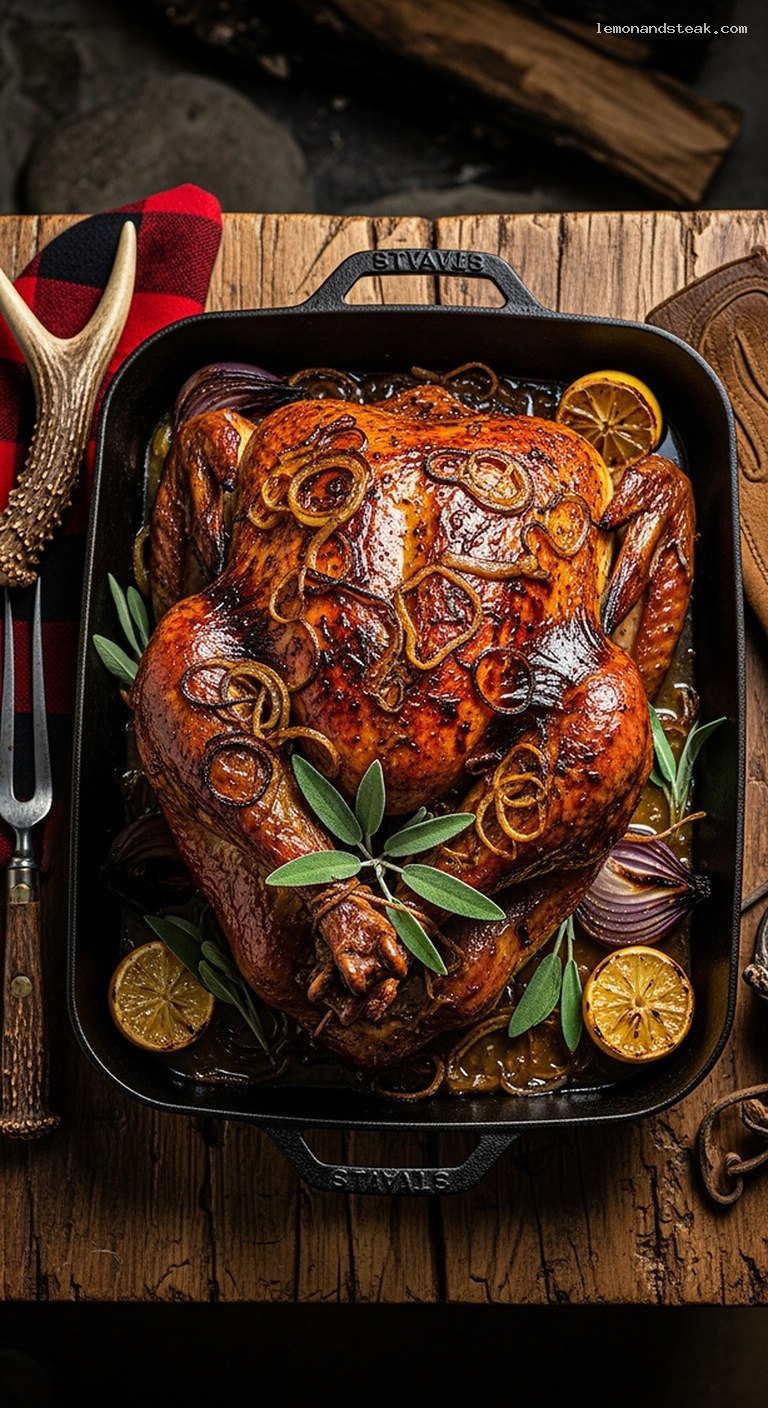
Quick Recipe Version (TL;DR)
Quick Ingredients
- 1 whole turkey (12–14 lb), thawed
- 1/4 cup kosher salt + 2 tsp sugar, 1 1/2 tsp black pepper
- 3 large yellow onions, thinly sliced
- 1 1/2 cups (3 sticks) unsalted butter, very soft, plus 3 tbsp for onions
- 1/4 cup fresh sage, finely chopped (plus extra sprigs)
- 2–3 tbsp fresh thyme, chopped (optional)
- 6 cloves garlic, minced, plus 1 head garlic, halved
- 1 tbsp Dijon mustard, 1 tsp lemon zest
- 2–3 tbsp olive oil
- 2 cups low-sodium chicken or turkey broth
- 1 lemon, halved
- Flour and extra broth for optional gravy
Do This
- 1. Dry brine turkey: pat dry, rub with salt, sugar, pepper, and seasonings. Chill uncovered 24–48 hours.
- 2. Caramelize onions in butter and olive oil until deep golden and jammy, 35–45 minutes. Cool.
- 3. Mix cooled onions with soft butter, sage, thyme, garlic, Dijon, lemon zest, salt, and pepper. Reserve 1/2 cup in a clean bowl for basting.
- 4. Loosen turkey skin; rub onion–sage butter under and over skin. Stuff cavity with lemon, garlic, and herbs. Place on rack in roasting pan with broth.
- 5. Roast at 425°F (220°C) for 30 minutes, then reduce to 325°F (165°C). Baste every 30 minutes with pan juices and melted reserved butter.
- 6. Roast until 160°F in breast and 170–175°F in thigh, 2–2 1/2 hours more. Rest 30–45 minutes, then carve. Make optional pan gravy from drippings.
Why You’ll Love This Recipe
- Rich, deep savory sweetness from a generous layer of slow-caramelized onions blended into a luxurious sage butter.
- Juicy, well-seasoned turkey thanks to an easy dry brine that you can do a day or two ahead.
- Classic holiday herb aroma (sage, thyme, garlic) with a twist that still feels comforting and traditional.
- Built-in pan gravy option that captures every drop of buttery, oniony roasting goodness.
Grocery List
- Produce: 1 whole turkey (12–14 lb), 3 large yellow onions, 1 lemon, 1 head garlic, fresh sage, fresh thyme (optional)
- Dairy: Unsalted butter (about 2 sticks + 3 tbsp for onions + 2 tbsp for gravy, or 1 lb total to be safe)
- Pantry: Kosher salt, black pepper, granulated sugar, olive oil, Dijon mustard, all-purpose flour, low-sodium chicken or turkey broth, garlic powder, dried sage or poultry seasoning (optional)
Full Ingredients
Turkey & Dry Brine
- 1 whole turkey, 12–14 lb, completely thawed (remove giblets and neck)
- 1/4 cup (60 ml) kosher salt (Diamond Crystal; if using Morton, use 3 tbsp)
- 2 tsp granulated sugar
- 1 1/2 tsp freshly ground black pepper
- 1 tsp garlic powder
- 1 tsp dried sage or poultry seasoning (optional, for a little extra herb warmth)
Caramelized Onion & Sage Butter
- 3 tbsp unsalted butter
- 1 tbsp olive oil
- 3 large yellow onions (about 2 1/2–3 lb total), thinly sliced pole-to-pole
- 1/2 tsp kosher salt (for onions)
- 1/2 tsp granulated sugar (optional, helps caramelization)
- 1 1/2 cups (3 sticks / 340 g) unsalted butter, very soft (room temperature)
- 1/4 cup finely chopped fresh sage leaves (about 12–15 leaves)
- 2 tbsp finely chopped fresh thyme leaves (optional but recommended)
- 6 cloves garlic, minced or pressed
- 1 tbsp Dijon mustard
- 1 tsp finely grated lemon zest (from about 1 lemon)
- 1 tsp kosher salt (for the butter)
- 1/2 tsp freshly ground black pepper
For Roasting & Basting
- 1 lemon, halved
- 1 head garlic, halved crosswise
- 6–8 fresh sage sprigs
- 4 fresh thyme sprigs (optional)
- 2 cups (480 ml) low-sodium chicken or turkey broth, plus more as needed
- 1–2 tbsp olive oil (for greasing pan, if needed)
Optional Simple Pan Gravy
- All pan drippings and caramelized onion bits from the roasting pan
- 2 tbsp unsalted butter (only if the pan drippings are very lean)
- 2–3 tbsp all-purpose flour
- 2–3 cups (480–720 ml) low-sodium chicken or turkey broth, warmed
- Salt and freshly ground black pepper, to taste
Step-by-Step Instructions
Step 1: Dry-brine the turkey
At least 24 hours (and up to 48 hours) before roasting, pat the thawed turkey very dry inside and out with paper towels. In a small bowl, mix the kosher salt, sugar, black pepper, garlic powder, and dried sage or poultry seasoning (if using).
Place the turkey on a rack set inside a roasting pan or a rimmed baking sheet. Sprinkle the seasoning mixture evenly all over the turkey, including a light sprinkle inside the cavity. If you like, you can gently loosen the skin over the breast and rub a little of the mixture directly onto the meat.
Refrigerate the turkey uncovered for 24–48 hours. This dry brine will deeply season the meat and help the skin roast up beautifully crisp. Do not rinse the turkey after brining; any excess on the surface will season the drippings.
Step 2: Caramelize the onions
About 1 1/2 to 2 hours before you plan to start roasting, make the caramelized onions. In a large, wide skillet, melt 3 tbsp butter with 1 tbsp olive oil over medium heat. Add the sliced onions and 1/2 tsp kosher salt. Cook, stirring often, until the onions begin to soften and turn translucent, about 10 minutes.
Reduce the heat to medium-low. Sprinkle in the 1/2 tsp sugar if using, and continue cooking, stirring every few minutes, until the onions are very soft, deep golden brown, and jammy, 30–35 minutes more. If the pan starts to look dry or the onions threaten to scorch, add a splash of water and stir, scraping up any browned bits.
Once the onions are richly caramelized, spread them out on a plate or tray to cool more quickly. They should be just warm or at room temperature before you mix them into the butter, so they do not melt it.
Step 3: Make the caramelized onion & sage butter
When the onions are cool, roughly chop them on a cutting board so they mix evenly into the butter. Place the chopped onions in a large bowl with the 1 1/2 cups softened unsalted butter, chopped sage, chopped thyme (if using), minced garlic, Dijon mustard, lemon zest, 1 tsp kosher salt, and 1/2 tsp black pepper.
Stir until everything is thoroughly combined and you have a cohesive, spreadable onion–sage butter. Taste a tiny bit (it will be salty but should taste delicious and well-balanced); adjust salt or pepper if needed.
Measure out about 1/2 cup of this butter into a small bowl and refrigerate it. This portion will stay “clean” and food-safe for later basting. The remaining butter will be used directly on the raw turkey.
Step 4: Prep the turkey for roasting
About 1 hour before roasting, remove the turkey from the refrigerator so it can take some of the chill off. Preheat your oven to 425°F (220°C), with the rack in the lower third of the oven. If your roasting pan does not have a rack, lightly oil the bottom of the pan.
Pat the turkey dry again with paper towels if any surface moisture has formed. Gently slide your fingers under the skin over the breast and upper thighs to loosen it, being careful not to tear it. Using clean hands or a spoon, smear a generous amount of the onion–sage butter under the loosened skin, pressing it over the breast and as far down the legs as you can reach.
Rub the remaining “raw” onion–sage butter all over the outside of the turkey, including the legs and wings. It will look like a lot; that is what gives the bird its deep, savory, caramelized flavor and helps with browning.
Stuff the cavity with the lemon halves, halved head of garlic, and the sage and thyme sprigs. Tuck the wing tips under the body to prevent burning, and loosely tie the legs together with kitchen twine. Place the turkey breast-side up on the rack in the roasting pan. Pour 2 cups broth into the bottom of the pan.
Step 5: Start with high heat for color
Place the turkey in the preheated 425°F (220°C) oven and roast for 30 minutes. This initial blast of higher heat helps set the skin and kick-starts beautiful browning with the onion–sage butter.
While the turkey roasts, melt the reserved 1/2 cup onion–sage butter in a small saucepan over low heat or in short bursts in the microwave until just liquid. Keep it warm but not sizzling hot; this will be your basting mixture along with the pan juices.
After 30 minutes, carefully slide the rack out and check the skin color. If any part is already getting very dark, you can tent that area loosely with a small piece of foil later during roasting. Reduce the oven temperature to 325°F (165°C) for the remainder of the cook time.
Step 6: Roast low and slow, basting with onion–sage butter
Continue roasting the turkey at 325°F (165°C) until done, basting every 30 minutes. To baste, quickly open the oven, pull the rack out just enough to access the turkey, and spoon or brush some of the warm melted onion–sage butter and pan juices over the breast and legs. Try to keep the oven door open as briefly as possible to maintain heat.
Roasting time will vary depending on your oven and turkey size, but for a 12–14 lb unstuffed bird, total roasting time is typically about 2 3/4 to 3 1/4 hours, including the initial high-heat phase. Begin checking the internal temperature after about 2 1/2 hours total.
Insert an instant-read thermometer into the thickest part of the breast (not touching bone); you are aiming for 160°F (71°C). Check the thickest part of the thigh as well; it should read 170–175°F (77–80°C). If the breast reaches 160°F before the legs are done, tent the breast loosely with foil and continue roasting until the thighs catch up.
If the pan starts to look dry during roasting, add another 1/2–1 cup of broth or water to keep the drippings from burning.
Step 7: Rest, carve, and make optional pan gravy
When the turkey reaches temperature, carefully transfer it to a large cutting board or platter, leaving the onions and drippings in the pan. Tent loosely with foil and let rest for at least 30 minutes (up to 45 minutes). This rest is crucial for juicy meat.
While the turkey rests, make the gravy if you like. Tilt the roasting pan and spoon off excess fat, leaving about 1/4 cup fat plus all the caramelized onion bits and browned drippings. If the drippings are very lean, add up to 2 tbsp butter. Place the pan over medium heat on the stovetop (use two burners if the pan is large).
Sprinkle 2–3 tbsp flour over the fat and onions. Whisk and cook for 1–2 minutes to form a roux. Slowly pour in 2 cups warm broth while whisking, scraping up any browned bits. Simmer until thickened to your liking, 5–10 minutes, adding more broth if you prefer a thinner gravy. Taste and season with salt and pepper as needed. Strain for a silky texture, or leave the onions in for a rustic, deeply flavored gravy.
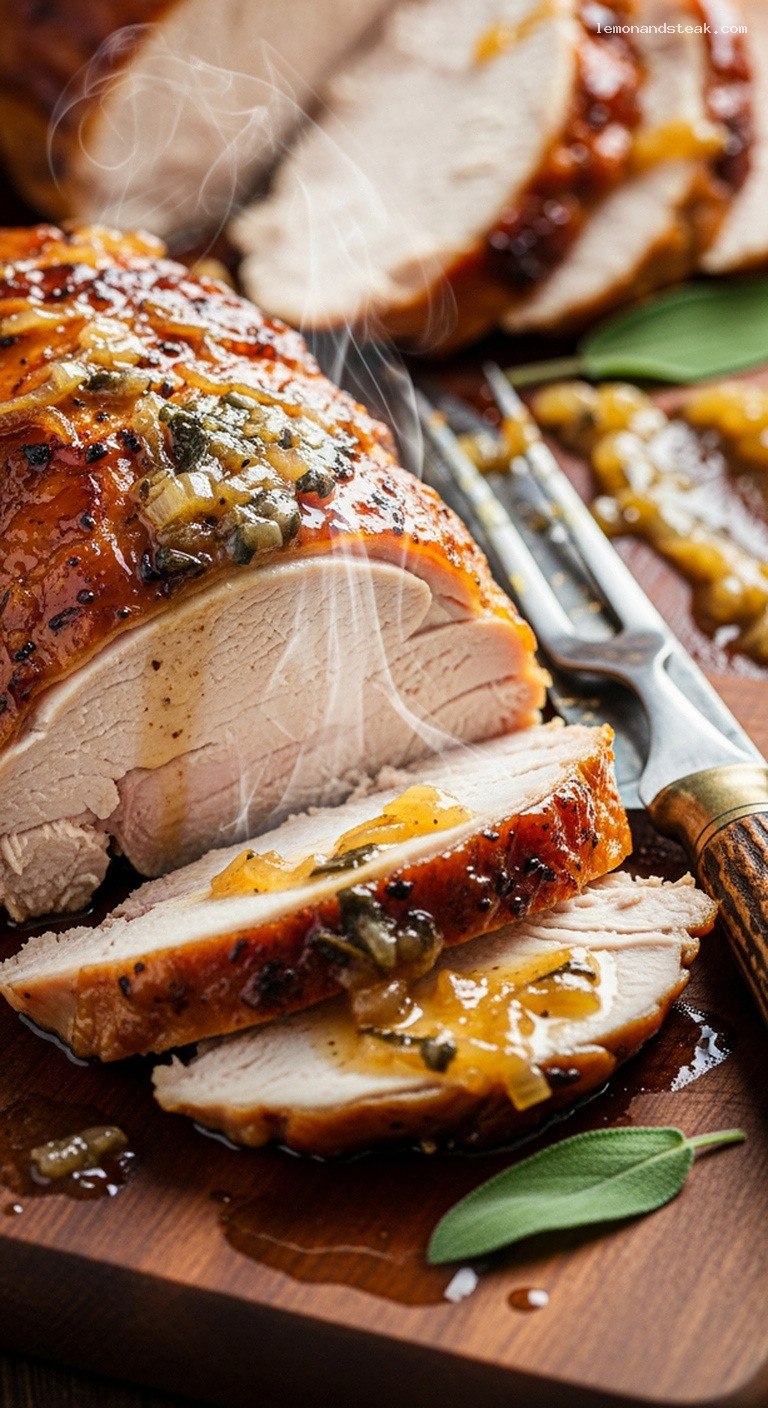
Carve the turkey: remove the legs and thighs, then the breasts, slicing across the grain. Arrange slices on a warm platter, spoon some of the pan onions over the top, and serve with the onion-rich sage gravy on the side.
Pro Tips
- Plan ahead for thawing and brining. A 12–14 lb turkey needs about 3 days to thaw in the fridge (roughly 24 hours per 4–5 lb), plus 24–48 hours for the dry brine. Mark your calendar so you are not rushed.
- Go dark with the onions. Stop only when the onions are a deep, even golden-brown color and taste sweet and mellow. Pale onions will not deliver the same impact in the butter.
- Use a thermometer, not time alone. Oven temperatures and turkey sizes vary. The best insurance for juicy meat is an instant-read thermometer and pulling the turkey once the breast hits 160°F.
- Protect the breast if needed. If the breast browns faster than the legs, tent it loosely with foil partway through roasting to avoid over-browning while the dark meat finishes.
- Do not skip the rest. Resting 30–45 minutes lets the juices redistribute, so the turkey stays moist instead of running dry when carved.
Variations
- Spatchcocked turkey: Have your butcher remove the backbone so the turkey lies flat, or do it yourself. Roast at 425°F (220°C) the whole time, 1 1/2–2 hours total, basting with the onion–sage butter. This gives especially even cooking and lots of crisp skin.
- Herb medley version: Add chopped fresh rosemary and parsley to the onion–sage butter and tuck extra herb sprigs under the turkey for a stronger, garden-herb aroma. Deglaze the roasting pan with a splash of white wine when making gravy.
- Turkey breast only: Use a 5–7 lb bone-in turkey breast. Dry brine as written, then roast at 375°F (190°C), basting with onion–sage butter, until the thickest part reaches 160°F, usually 1 3/4–2 1/4 hours.
Storage & Make-Ahead
The dry brine can be started 2 days in advance, and the caramelized onions can be cooked up to 3 days ahead and refrigerated. You can also make the full onion–sage butter 1–2 days in advance; store it in an airtight container in the refrigerator, then let it soften slightly before rubbing under the skin.
Leftover turkey keeps well in an airtight container in the refrigerator for 3–4 days. For best texture, slice the meat off the bone before chilling. Reheat gently, covered, with a splash of broth in a low oven (300°F / 150°C) or in a covered skillet so it stays moist. The gravy will keep 3–4 days in the fridge and can be frozen for up to 3 months. Leftover turkey meat also freezes well for 2–3 months; thaw overnight in the fridge and reheat gently as above.
Nutrition (per serving)
Approximate values for 1 serving (about 6 oz cooked turkey with skin plus some onion–sage butter and a small amount of gravy): about 650 calories, 46 g protein, 48 g fat, 6 g saturated fat, 3–5 g carbohydrates, 0–1 g fiber, 2 g sugars, and about 750–900 mg sodium. Actual values will vary based on the exact size of the turkey, how much skin and butter each person eats, and how much salt you use in the gravy.
Leave a Reply