
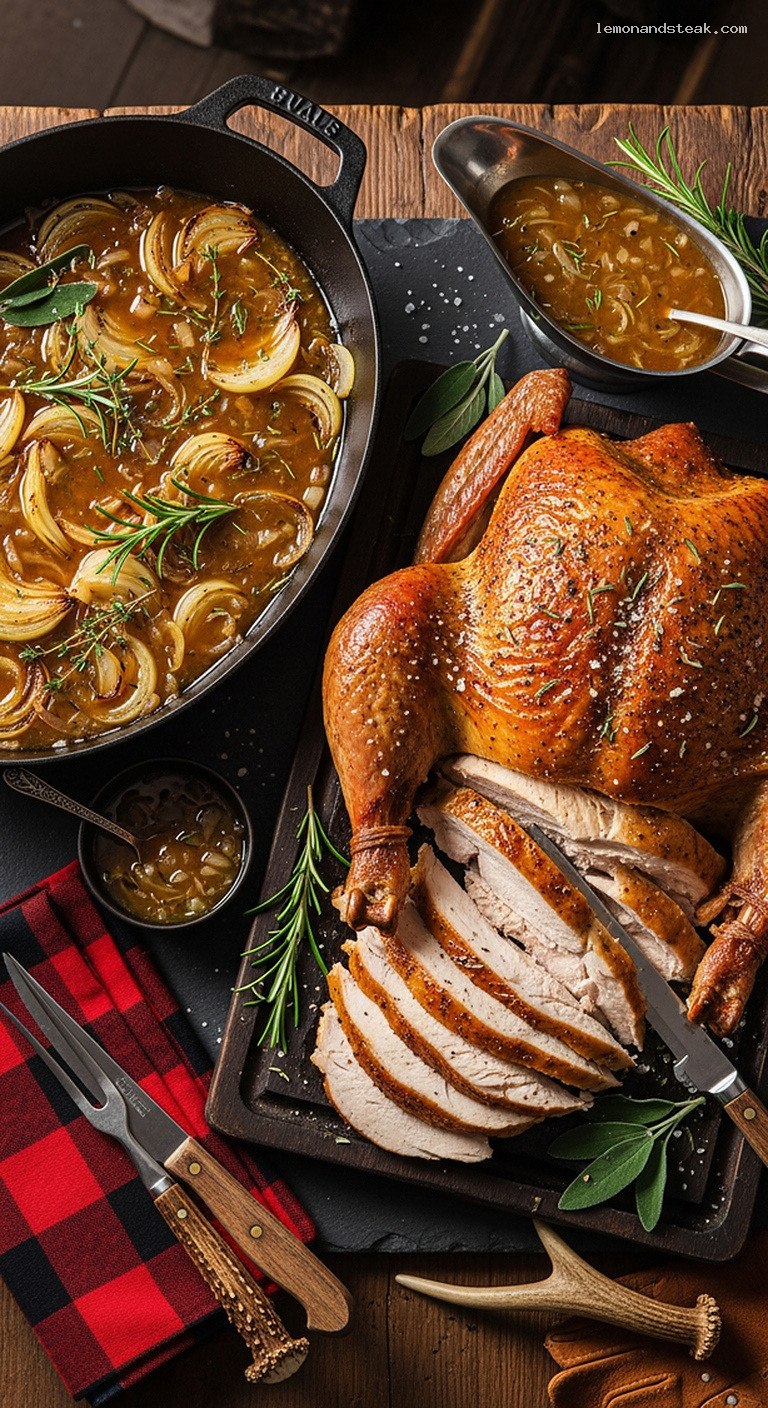
Quick Recipe Version (TL;DR)
Quick Ingredients
- 1 whole turkey (12–14 lb), thawed if frozen
- 3 tbsp kosher salt, 2 tsp black pepper
- 8 tbsp (1 stick) unsalted butter, softened, plus 2 tbsp for pan
- 2 tbsp olive oil
- 3 large yellow onions, sliced
- 6 cloves garlic, smashed
- 3 tbsp all-purpose flour
- 4 cups low-sodium chicken or turkey stock, plus more as needed
- 6 sprigs fresh thyme, 4 sprigs rosemary, 8 large sage leaves
- 1 bay leaf
- 1 lemon, halved (optional, for cavity)
Do This
- 1. Pat turkey dry, season all over (and inside) with salt and pepper, and dry-brine uncovered in the fridge 12–24 hours.
- 2. Heat oven to 425°F (220°C). In a large roasting pan on the stove, sauté sliced onions in butter and oil until soft; stir in flour to coat.
- 3. Add garlic, herbs, bay leaf, and 4 cups stock to the pan; simmer 5 minutes to thicken slightly, then place a roasting rack over the pan.
- 4. Rub turkey with softened butter (including under the skin if possible), tuck wings, and tie legs. Place on the rack over the onion-herb stock base.
- 5. Roast 30 minutes at 425°F, then reduce to 325°F (165°C) and roast 2½–3½ hours more, until breast is 160–165°F and thighs are 170–175°F, adding stock if pan looks dry.
- 6. Transfer turkey to a board to rest 30 minutes. Pour pan liquids into a saucepan, skim fat, adjust thickness with stock, and simmer 10–15 minutes; season to taste.
- 7. Carve turkey and serve with the rich onion-herb pan gravy.
Why You’ll Love This Recipe
- Built-in gravy: The turkey roasts over an onion-herb gravy starter, so the drippings drop right into a flavorful base.
- Moist, well-seasoned meat: A simple dry brine and herb butter keep the turkey juicy with crisp, golden skin.
- Fewer last-minute dishes: The roasting pan does double duty as the starter for your gravy, reducing stress (and cleanup) at serving time.
- Rich, restaurant-style flavor: Caramelized onions, fresh herbs, and stock create a deeply savory gravy with almost no fuss.
Grocery List
- Produce: 3 large yellow onions, 6 cloves garlic, 1 lemon (optional), fresh thyme, fresh rosemary, fresh sage
- Dairy: 1 cup (2 sticks) unsalted butter
- Pantry: 1 whole turkey (12–14 lb), kosher salt, black pepper, olive oil, all-purpose flour, low-sodium chicken or turkey stock, 1 bay leaf
Full Ingredients
For the Turkey
- 1 whole turkey (12–14 lb), thawed if frozen
- 3 tbsp kosher salt (use less if turkey is pre-brined or enhanced)
- 2 tsp freshly ground black pepper
- 6 tbsp unsalted butter, softened
- 2 tbsp olive oil
For the Pan-Infused Herb Gravy Starter
- 2 tbsp unsalted butter
- 3 large yellow onions, halved and thinly sliced
- 1 tbsp olive oil (optional, if onions need more fat)
- 3 tbsp all-purpose flour
- 4 cups low-sodium chicken or turkey stock, plus up to 2 cups more as needed during roasting
- 6 cloves garlic, smashed
- 6 fresh thyme sprigs
- 4 fresh rosemary sprigs
- 8 large fresh sage leaves
- 1 bay leaf
- 1 tsp kosher salt (to season the starter; adjust to taste later)
- ½ tsp freshly ground black pepper
Optional Aromatics for the Turkey Cavity
- 1 lemon, halved
- 1 small onion, quartered
- 2–3 extra sprigs thyme or rosemary
To Finish the Gravy
- All pan juices and onions from roasting pan
- Up to 1 cup additional stock or water, as needed to adjust thickness
- Salt and pepper, to taste
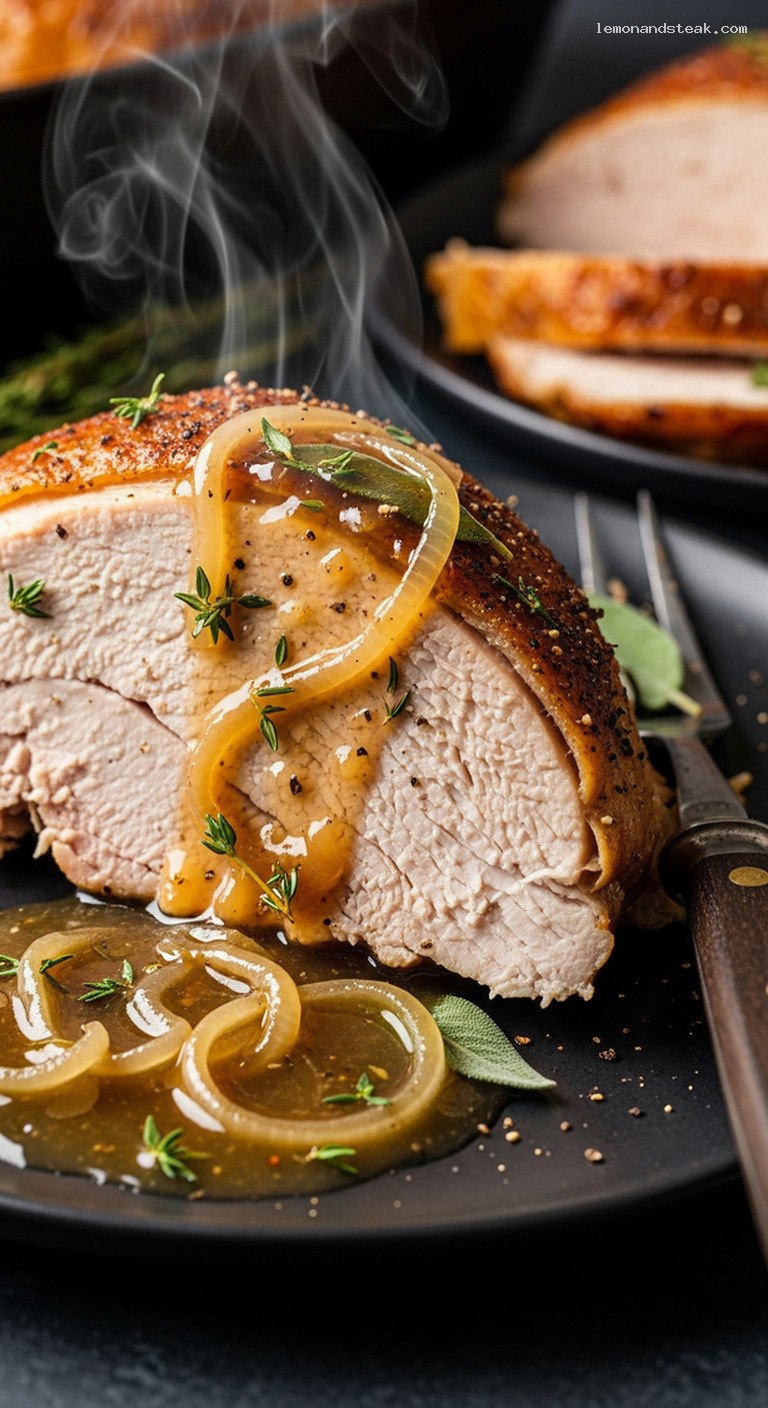
Step-by-Step Instructions
Step 1: Dry-brine the turkey for flavor and juiciness
If your turkey is frozen, make sure it is fully thawed in the refrigerator (this can take 3–4 days for a 12–14 lb bird). Remove any giblets or neck from the cavity and pat the turkey very dry with paper towels, inside and out.
Stir together the 3 tbsp kosher salt and 2 tsp black pepper. Sprinkle this mixture evenly all over the turkey, including a light seasoning inside the cavity. For even better seasoning, gently loosen the skin over the breast with your fingers and rub a little of the salt mixture directly onto the meat under the skin.
Place the turkey breast-side up on a rack set over a rimmed baking sheet or in your roasting pan. Leave it uncovered in the refrigerator for at least 4 hours, ideally 12–24 hours. This dry brine seasons the meat deeply and helps the skin roast up extra crisp and golden.
Step 2: Make the herb butter and preheat the oven
About 1 hour before roasting, take the turkey out of the refrigerator so it can lose some of its chill. In a small bowl, mash together 6 tbsp softened unsalted butter and 2 tbsp olive oil until smooth. You can add a pinch of freshly chopped herbs from your bunch (thyme, rosemary, sage) if you like, but it is optional.
Adjust your oven rack so the turkey will sit roughly in the center of the oven. Preheat the oven to 425°F (220°C). This initial high heat helps to set and brown the skin before we lower the temperature for gentle roasting.
Step 3: Build the onion-herb gravy starter in the roasting pan
Place a large, sturdy roasting pan over medium heat on your stovetop. Add 2 tbsp unsalted butter. Once melted and foamy, add the sliced onions and a pinch of salt. Cook, stirring often, for 10–15 minutes until the onions are softened, lightly golden, and starting to caramelize. If the pan looks dry, add the extra 1 tbsp olive oil.
Sprinkle the 3 tbsp flour evenly over the onions. Stir and cook for 1–2 minutes to coat the onions and cook off the raw flour taste. The mixture will look pasty and thick. Gradually pour in 4 cups of stock while whisking and stirring, scraping up any browned bits from the bottom of the pan. The liquid should be about ½–¾ inch deep across the bottom; add more stock if the pan is very large.
Add the smashed garlic cloves, thyme sprigs, rosemary sprigs, sage leaves, bay leaf, 1 tsp kosher salt, and ½ tsp black pepper. Bring the mixture to a gentle simmer and cook for about 5 minutes, stirring occasionally. You are aiming for a loose, brothy gravy base that will catch the turkey drippings as it roasts. Remove the pan from the heat and position a roasting rack over the onions and liquid.
Step 4: Butter and arrange the turkey for roasting
Pat the turkey dry one more time if any moisture has accumulated. Gently loosen the skin over the breasts with your fingers, being careful not to tear it. Spread some of the herb butter directly onto the breast meat under the skin (about 2 tbsp total), then smooth the skin back into place.
Rub the remaining butter all over the outside of the turkey, including the legs and wings. If using, stuff the cavity loosely with the halved lemon, quartered onion, and extra herb sprigs. Tuck the wing tips under the body to prevent them from burning, and tie the legs together with kitchen twine if desired for a neater shape.
Place the prepared turkey breast-side up on the roasting rack over the onion-herb gravy starter. Make sure the onions and liquid are evenly distributed below, without any large dry spots in the pan.
Step 5: Roast the turkey over the gravy starter
Transfer the roasting pan to the preheated 425°F (220°C) oven. Roast for 30 minutes to begin browning the skin. During this time, the turkey drippings will start falling into the onion-herb mixture, building flavor for your gravy.
After 30 minutes, reduce the oven temperature to 325°F (165°C) without opening the oven for too long. Continue roasting for another 2½–3½ hours, depending on the size of your turkey. As a guideline, a 12–14 lb unstuffed turkey typically takes about 3–3½ hours total, but always rely on temperature rather than time.
Every 45–60 minutes, carefully pull out the pan and check the liquid level in the bottom. It should never cook dry. If it looks low or very thick, stir the onions and add ½–1 cup stock or water as needed to maintain a shallow pool of liquid. There is no need to baste the turkey itself; the butter and dry brine will keep it moist.
Start checking the internal temperature during the last hour. Insert an instant-read thermometer into the thickest part of the breast (without touching bone) and the inner thigh. The turkey is done when the breast reads 160–165°F (71–74°C) and the thigh reads 170–175°F (77–80°C). If parts of the skin are browning too quickly, tent them loosely with foil.
Step 6: Rest the turkey and finish the gravy
When the turkey reaches the proper internal temperatures, carefully transfer it to a large cutting board or platter. Tent it loosely with foil and let it rest for at least 30 minutes. This resting time allows the juices to redistribute, making the meat much more moist when carved.
Meanwhile, finish the gravy. Carefully pour the contents of the roasting pan (onions, herbs, and liquid) through a fine-mesh strainer set over a large bowl or measuring jug, pressing on the solids to extract as much liquid as possible. Discard the herb stems and bay leaf; you can either discard the onions or reserve some for a more rustic gravy.
Let the liquid stand for a few minutes so the fat rises to the top. Skim off most of the fat with a spoon, leaving behind mostly the rich, flavorful juices. Transfer the defatted liquid to a saucepan. If you like a rustic texture, you can add back some of the strained onions at this point.
Bring the gravy to a simmer over medium heat. If it is too thick, whisk in additional stock or water, a little at a time, until it reaches your desired consistency. If it is too thin, simmer it gently for 5–10 minutes to reduce and thicken. Taste and adjust seasoning with salt and pepper. Keep the gravy warm over low heat, stirring occasionally.
Step 7: Carve and serve
After the turkey has rested, remove the twine from the legs and discard any aromatics from the cavity. Using a sharp carving knife, first remove the legs and thighs, then the wings, and finally carve the breast meat into thick slices across the grain.
Arrange the sliced turkey on a warm serving platter. Give the gravy a final stir and pour some into a gravy boat or small pitcher, with extra kept warm on the stove for refills. Serve the turkey with generous spoonfuls of the savory onion-herb gravy, making sure everyone gets some of the rich pan flavor that developed as the turkey roasted.
Pro Tips
- Plan for thawing: A frozen turkey can take several days to thaw safely in the fridge. Allow about 24 hours per 4–5 lb of turkey.
- Use a thermometer: An instant-read meat thermometer is the single best tool to ensure juicy turkey. Time estimates are helpful, but temperature is what matters.
- Keep the pan moist: Do not let the onion-flour mixture dry out or burn. Add stock or water whenever the liquid drops too low or gets very thick.
- Adjust salt at the end: Because the turkey drippings are naturally salty, always taste the finished gravy before adding more salt.
- Make it ahead-friendly: You can prepare the onion-herb gravy starter a day in advance and chill it. Rewarm in the pan before setting the turkey on top to roast.
Variations
- Wine-kissed gravy: Replace 1 cup of the stock in the pan starter with dry white wine. Let it simmer for a few minutes to reduce before adding the remaining stock.
- Garlic and herb heavy: Double the garlic and add a handful of chopped fresh parsley into the finished gravy for a brighter, more herbal flavor.
- Smoky twist: Add 1–2 tsp smoked paprika and a splash of Worcestershire sauce to the finished gravy for a subtle smoky, steakhouse-style note.
Storage & Make-Ahead
Leftover turkey and gravy should be cooled to room temperature within 2 hours, then refrigerated. Store sliced turkey in an airtight container for up to 4 days. Keep gravy in a separate container for up to 3–4 days. Reheat turkey gently in a covered dish with a splash of stock or gravy to prevent it from drying out; cover and warm in a 300°F (150°C) oven or microwave in short bursts. Reheat gravy in a small saucepan over low to medium heat, whisking frequently; add a little water or stock if it has thickened too much.
For longer storage, turkey and gravy both freeze well. Freeze sliced turkey tightly wrapped or in containers for up to 2–3 months. Freeze gravy in small containers or freezer bags for up to 3 months. Thaw overnight in the refrigerator, then reheat gently before serving.
Nutrition (per serving)
Approximate values for 1 serving (about 6 oz roasted turkey with skin plus ¼ cup gravy): 480 calories; 55 g protein; 20 g fat; 18 g carbohydrates; 2 g fiber; 1,150 mg sodium. Actual nutrition will vary based on the specific turkey, amount of skin consumed, and how much gravy you enjoy.
Leave a Reply