
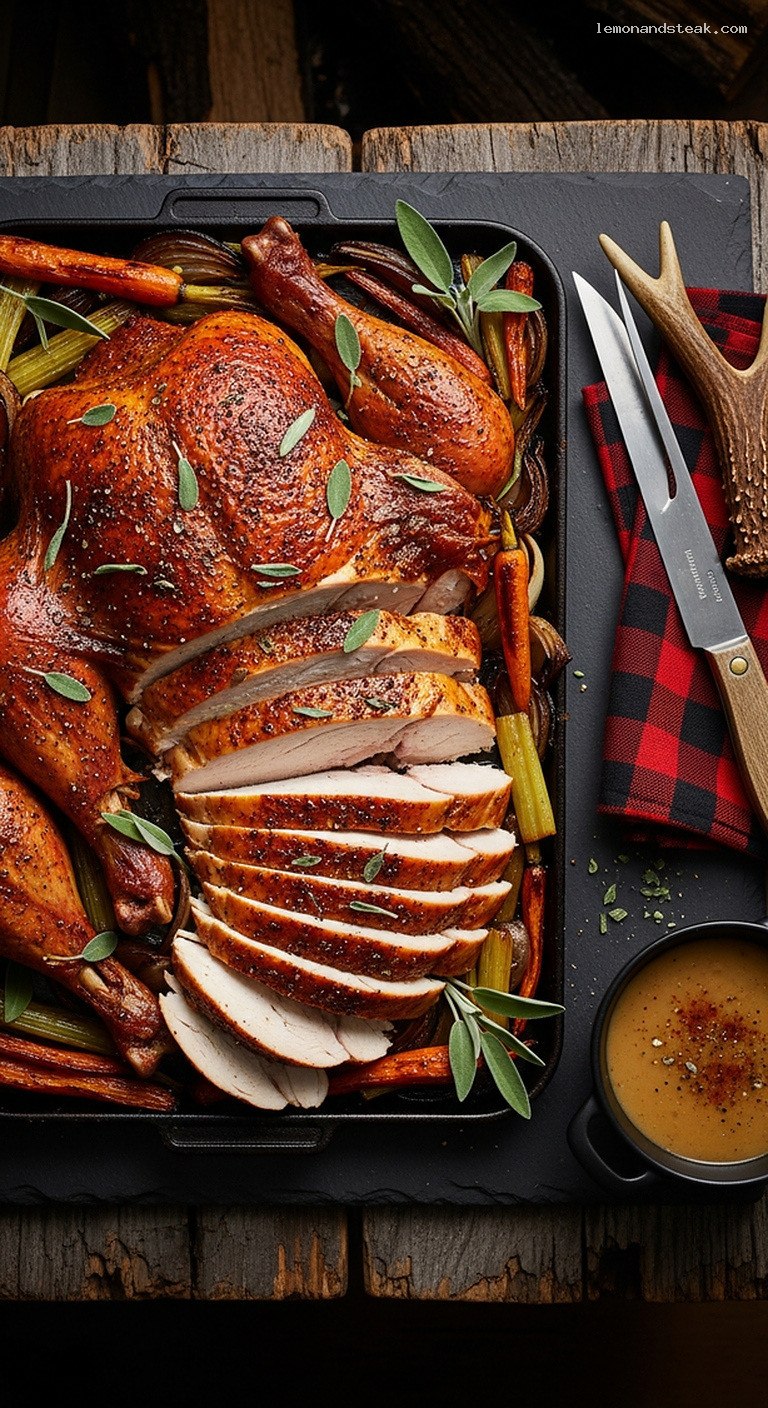
Quick Recipe Version (TL;DR)
Quick Ingredients
- 1 whole turkey (12–14 lb), thawed
- 8 cups buttermilk + 8 cups cold water
- 1/2 cup kosher salt (see note) + 1/4 cup brown sugar
- Garlic, onion, fresh sage, thyme, bay leaves
- 3 tbsp melted butter or olive oil
- 2 tbsp paprika, 2 tsp black pepper, 2 tsp dried sage
- Garlic powder, onion powder, extra salt
- Onion, celery, carrots, lemon, extra sage for roasting
- 1–3 cups low-sodium chicken or turkey broth
Do This
- 1. Pat the thawed turkey dry and remove giblets and neck. Set aside neck for stock if desired.
- 2. Whisk buttermilk, water, salt, brown sugar, paprika, pepper, garlic, onion, sage, thyme, and bay leaves. Submerge turkey in a large brining bag or pot. Chill 12–24 hours, turning once.
- 3. Remove turkey from buttermilk, discard marinade, and pat very dry. Air-dry on a rack 30–60 minutes in the fridge or at cool room temp.
- 4. Heat oven to 425°F (220°C). Place onion, celery, and carrots in a roasting pan with 1 cup broth. Stuff turkey cavity with lemon, onion, garlic, and sage. Tie legs and tuck wings.
- 5. Mix melted butter, paprika, pepper, sage, garlic powder, onion powder, and salt. Rub all over turkey, including under the breast skin if you can.
- 6. Roast 30 minutes at 425°F, then reduce to 325°F (165°C). Roast 2 1/2–3 hours more, basting occasionally and adding broth as needed, until breast reaches 160–165°F and thigh 170°F.
- 7. Rest turkey, loosely tented with foil, 30–45 minutes. Make simple pan gravy from drippings if desired, carve, and serve.
Why You’ll Love This Recipe
- Buttermilk and salt gently tenderize the turkey for incredibly moist, juicy meat from breast to drumstick.
- A cozy Southern spice profile of paprika, black pepper, and sage gives warm, comforting flavor without being spicy.
- The method is straightforward for home cooks, yet yields results that taste like a holiday showstopper.
- Built-in pan gravy instructions turn all those flavorful drippings into a rich, velvety sauce.
Grocery List
- Produce: 1 whole head garlic, 3–4 yellow onions, 1 lemon, 3 ribs celery, 2 large carrots, 1 small bunch fresh sage, 1 small bunch fresh thyme, 2–3 bay leaves
- Dairy: 8 cups (2 quarts) buttermilk, 3 tbsp unsalted butter (or use olive oil instead)
- Pantry: 1 whole turkey (12–14 lb), kosher salt, brown sugar, paprika (sweet or smoked), smoked paprika (optional), freshly ground black pepper, garlic powder, onion powder, dried sage, dried thyme, low-sodium chicken or turkey broth, all-purpose flour, aluminum foil, kitchen twine
Full Ingredients
For the Buttermilk Soak
- 1 whole turkey, 12–14 lb, thawed if frozen (remove giblets and neck)
- 8 cups (2 quarts) buttermilk (whole or low-fat)
- 8 cups (2 quarts) cold water
- 1/2 cup kosher salt (Diamond Crystal; if using Morton, use 1/3 cup)
- 1/4 cup packed light brown sugar
- 2 tsp smoked paprika (or regular paprika)
- 2 tsp freshly ground black pepper
- 6 cloves garlic, smashed
- 1 large yellow onion, thickly sliced
- 8 fresh sage leaves or 2 tsp dried sage
- 6 sprigs fresh thyme or 1 tsp dried thyme
- 2 bay leaves
For Roasting the Turkey
- 3 tbsp unsalted butter, melted or 3 tbsp olive oil
- 2 tbsp paprika (sweet or a mix of sweet and smoked)
- 2 1/2 tsp kosher salt (Diamond Crystal; 1 3/4 tsp if using Morton), plus more to taste
- 2 tsp freshly ground black pepper
- 2 tsp dried sage, crumbled or 1 1/2 tbsp finely chopped fresh sage
- 2 tsp garlic powder
- 1 tsp onion powder
- 1 tsp dried thyme (optional, for a deeper herb flavor)
- 1 large yellow onion, quartered (for cavity and pan)
- 1 lemon, halved (for cavity)
- 1 head garlic, halved crosswise (for cavity)
- 3 ribs celery, cut into 3-inch pieces
- 2 large carrots, cut into chunks
- 1–3 cups low-sodium chicken or turkey broth, as needed (1 cup for the pan to start, more if needed while roasting and for gravy)
For Simple Sage-Paprika Pan Gravy (Optional but Recommended)
- 3 tbsp fat from turkey drippings (top layer of the pan juices) or add butter to make 3 tbsp
- 3 tbsp all-purpose flour
- 2–3 cups combined turkey drippings and chicken/turkey broth
- Salt and freshly ground black pepper, to taste
- 1/4 tsp dried sage and a pinch of paprika (optional, to echo the turkey flavors)

Step-by-Step Instructions
Step 1: Thaw and Prep the Turkey
If your turkey is frozen, thaw it in the refrigerator (about 24 hours per 4–5 lb). For a 12–14 lb bird, this usually takes 3–4 days. When thawed, remove the plastic packaging and take out the neck and giblet packet from the cavity. Save the neck for stock or discard if you prefer.
Pat the turkey dry inside and out with paper towels. Trim away any large excess fat flaps around the cavity opening, but leave the skin intact over the breast and legs. Set the turkey aside while you mix the buttermilk soak.
Step 2: Mix the Southern-Style Buttermilk Soak
In a very large bowl, stockpot, or clean food-safe bucket, whisk together the buttermilk, cold water, kosher salt, brown sugar, smoked paprika, and black pepper until the salt and sugar have mostly dissolved.
Add the smashed garlic cloves, sliced onion, sage leaves, thyme sprigs, and bay leaves. Stir everything around so the aromatics are well distributed.
Step 3: Soak the Turkey for Ultra-Tender Meat
Place the turkey breast-side down into the buttermilk mixture. If you have a large brining bag, set the bag upright in a pot or roasting pan, add the turkey, then pour the buttermilk mixture over the top, squeezing out excess air before sealing. The turkey should be mostly submerged; if any area is peeking out, rotate it a few times during marinating.
Refrigerate for at least 12 hours and up to 24 hours. Turn the turkey once about halfway through so every part gets time soaking in the buttermilk. This gentle brine is what makes the meat so juicy and tender, so give it time to work.
Step 4: Dry and Air-Dry the Turkey
Remove the turkey from the buttermilk soak and let excess liquid drip off. Discard the soaking liquid and aromatics. Do not reuse the marinade.
Thoroughly pat the turkey dry with plenty of paper towels, including the cavity. For the best browning, place the turkey on a rack set over a rimmed baking sheet and refrigerate uncovered for 30–60 minutes, or leave it at cool room temperature for up to 30 minutes. This brief air-drying step helps the skin roast up crisp and golden instead of steaming.
Step 5: Season and Set Up the Roasting Pan
Preheat your oven to 425°F (220°C) with a rack in the lower third to make room for the turkey. In a roasting pan, scatter the celery, carrots, and about half of the quartered onion to form a bed. Pour in 1 cup of chicken or turkey broth.
In a small bowl, stir together the melted butter (or olive oil), paprika, kosher salt, black pepper, dried sage, garlic powder, onion powder, and dried thyme (if using). You should have a vivid brick-red, fragrant paste.
Place the turkey breast-side up on a roasting rack set in the pan (or directly on the vegetables if you do not have a rack). Rub a little of the seasoning mix inside the cavity. Stuff the cavity with the lemon halves, remaining onion, and the halved head of garlic, plus a few fresh sage sprigs if you have them.
Using your fingers, gently loosen the skin over the breast meat, being careful not to tear it. Rub some of the spice-butter mixture directly onto the breast meat under the skin. Then rub the rest all over the outside of the turkey, including legs, thighs, and wings, coating every surface well.
Tuck the wing tips back behind the shoulders so they do not burn, and tie the legs together with kitchen twine.
Step 6: Start Hot, Then Roast Low and Slow
Place the seasoned turkey in the preheated 425°F (220°C) oven. Roast for 30 minutes to get the skin browning and the fat starting to render. The kitchen should start to smell incredible from the paprika, sage, and black pepper.
After 30 minutes, reduce the oven temperature to 325°F (165°C). If any parts of the bird (often the tips of the drumsticks or wings) are already getting deeply brown, loosely cover those spots with small pieces of foil.
Continue roasting at 325°F, basting the turkey every 30–40 minutes with the pan juices. If the pan dries out at any point, add another 1/2–1 cup of broth or water. Rotate the pan once or twice during roasting for even browning.
As a rough guide, total roasting time will be about 13–15 minutes per pound at 325°F, including the initial hot stage. For a 12–14 lb turkey, plan on about 3 to 3 1/2 hours total in the oven, but always rely on a thermometer instead of just the clock.
Step 7: Check for Doneness and Rest
Begin checking the internal temperature about 45 minutes before you think the turkey will be done. Insert an instant-read thermometer into the thickest part of the breast (not touching bone) and the inner thigh.
The turkey is ready when:
- Breast meat reaches 160–165°F (71–74°C).
- Thigh meat reaches 170°F (77°C) or a bit higher.
Remove the turkey from the oven when it reaches these temperatures; carryover cooking will finish the job.
Transfer the turkey to a cutting board or serving platter, tent it loosely with foil, and let it rest for 30–45 minutes. This rest is essential; it allows juices to redistribute so every slice is moist instead of dry.
Step 8: Make the Sage-Paprika Pan Gravy and Serve
While the turkey rests, tilt the roasting pan and spoon off 3 tbsp of the fat from the top of the drippings into a saucepan. If you do not have enough, add butter to reach 3 tbsp. Place the roasting pan over medium heat (or do this step in a skillet), pour in a splash of broth, and scrape up the browned bits. Strain these pan juices into a measuring cup. Add enough broth to the cup to make 2–3 cups total liquid.
In the saucepan with the fat, sprinkle in the flour and cook over medium heat, whisking constantly, until the roux turns light golden and smells toasty, 2–3 minutes. Slowly whisk in the hot pan juices and broth mixture. Bring to a simmer and cook, whisking often, until thickened to your liking, 5–10 minutes.
Season the gravy with salt, black pepper, a pinch of dried sage, and a pinch of paprika to echo the turkey’s flavors. If it gets too thick, whisk in a bit more broth. Carve the turkey, arrange on a warm platter, garnish with fresh sage if you like, and serve with plenty of gravy over the top.
Pro Tips
- Mind the salt brand: Diamond Crystal kosher salt is lighter and flakier than Morton. If using Morton, reduce the amounts by about one-third to avoid an overly salty bird.
- Dry equals crisp: The drier the turkey skin before roasting, the better the browning. Do not rush the patting and brief air-drying step.
- Use a thermometer, not the pop-up: Ignore any built-in pop-up timers. An instant-read thermometer in the breast and thigh is the most reliable way to prevent overcooking.
- Shield as needed: Keep small pieces of foil handy. If the breast or wing tips brown too quickly, tent just those areas so the rest of the turkey can keep cooking.
- Rest generously: That 30–45 minute rest may feel long, but it is one of the secrets to incredibly juicy slices and easier carving.
Variations
- Smoky grill-roasted version: After the buttermilk soak, use the same rub but cook the turkey on a covered grill or smoker set to 325°F, using a drip pan and indirect heat. Add a small amount of hickory or applewood for gentle smoke that pairs beautifully with paprika and sage.
- Spicier Cajun twist: Add 1–2 tsp cayenne pepper and 1 tbsp Cajun seasoning to the rub, and stir 1 tbsp hot sauce into the buttermilk soak for a little Southern heat.
- Herb-forward holiday style: Increase fresh sage and thyme in the soak and rub, and add fresh rosemary sprigs to the cavity and pan for a more classic herb-roasted flavor.
Storage & Make-Ahead
Make-ahead: You can soak the turkey in buttermilk up to 24 hours before roasting. If you want to get ahead, mix the rub ingredients a day in advance and store them in an airtight container at room temperature. You can also chop the aromatics (onion, celery, carrots) up to 2 days ahead and refrigerate.
Leftovers: Store carved turkey in shallow airtight containers, ideally moistened with a few spoonfuls of gravy or pan juices to keep it from drying out. Refrigerate within 2 hours of cooking and use within 3–4 days.
Freezing: Turkey meat freezes well. Portion into freezer bags with a bit of broth or gravy, squeeze out the air, and freeze for up to 3 months. Thaw overnight in the refrigerator and reheat gently, covered, with a splash of broth.
Nutrition (per serving)
Approximate values for one serving (about 6 oz roasted turkey meat with some skin and a modest amount of gravy), based on 12 servings from a 12–14 lb turkey:
Calories: ~400 kcal; Protein: ~48 g; Fat: ~20 g; Carbohydrates: ~3 g; Fiber: 0 g; Sodium: ~750 mg. Actual values will vary depending on the specific turkey, how much skin is eaten, and how much gravy is served.
Leave a Reply