
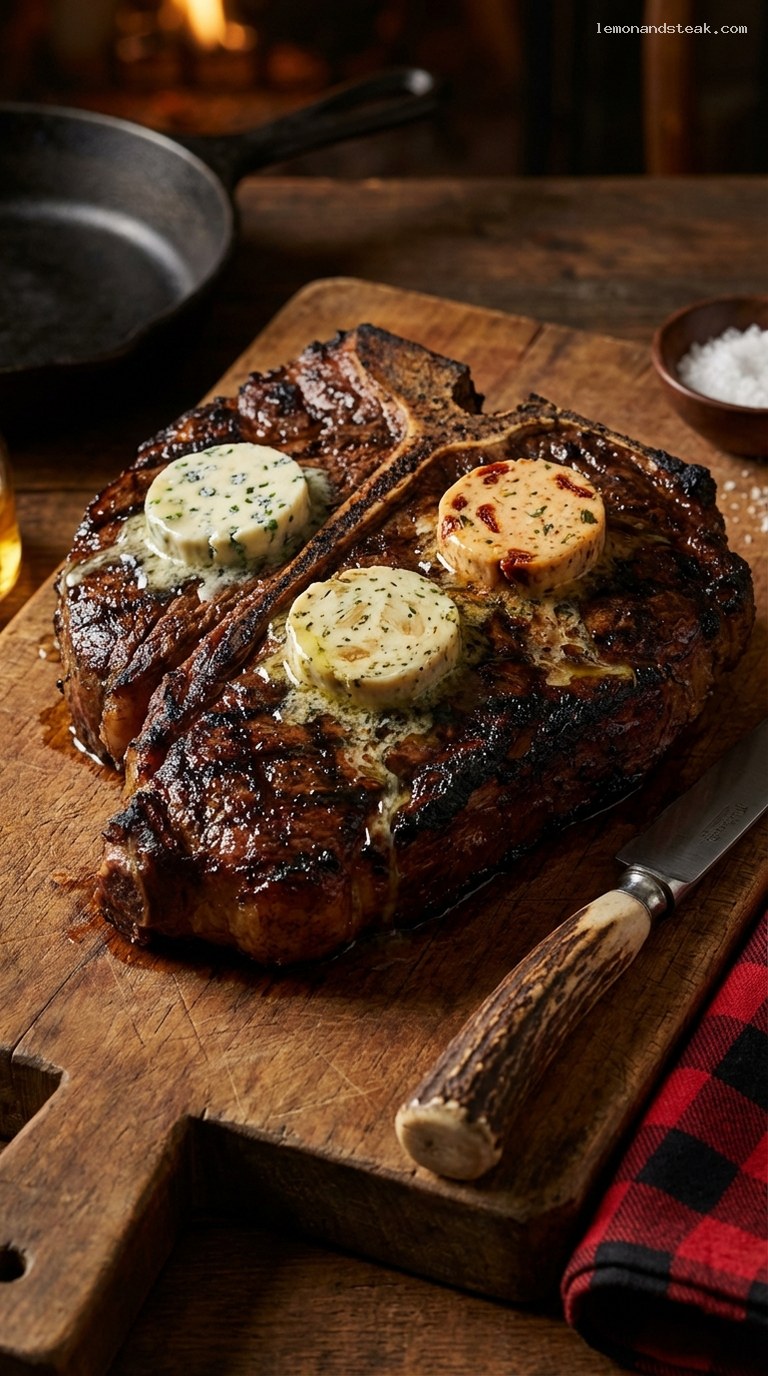
Quick Recipe Version (TL;DR)
Quick Ingredients
- 2 large T-bone steaks, 1 1/4–1 1/2 inch thick (about 1 1/4–1 1/2 lb each)
- 2 tsp kosher salt (plus more to taste)
- 1 tsp freshly ground black pepper
- 1 tsp garlic powder (optional)
- 1 Tbsp neutral high-heat oil (canola, avocado, or grapeseed)
- 12 Tbsp (1 1/2 sticks, 170 g) unsalted butter, softened (you will use 4 Tbsp per butter flavor)
- Blue cheese butter: 4 Tbsp butter, 2 Tbsp crumbled blue cheese, 1 tsp chopped chives/parsley, 1/4 tsp Worcestershire, pinch salt and pepper
- Roasted garlic herb butter: 1 small garlic head, 1/2 tsp olive oil, 4 Tbsp butter, 1 tsp each chopped thyme and rosemary, 1/2 tsp lemon juice, salt and pepper
- Sun-dried tomato basil butter: 4 Tbsp butter, 2 Tbsp finely chopped oil-packed sun-dried tomatoes, 1 tsp chopped basil, 1/4 tsp smoked paprika, pinch red pepper flakes, salt and pepper
Do This
- 1. Soften butter. Mix one of the compound butter variations, form into a small log on parchment or plastic wrap, and chill 30 minutes.
- 2. Pat steaks very dry. Season all over with salt, pepper, and optional garlic powder; let sit at room temperature 20–30 minutes.
- 3. Preheat grill to high, 450–500°F, setting up a hot direct zone and a cooler indirect zone if possible. Clean and oil the grates.
- 4. Lightly oil steaks. Sear over direct heat 3–4 minutes per side until a deep brown crust forms.
- 5. Move steaks to indirect heat and cook, covered, until internal temperature reaches 125–130°F for medium-rare (or to your preferred doneness).
- 6. Rest steaks 5–10 minutes. Slice thick coins of the chilled compound butter on top so it melts over the hot crust, then carve and serve.
Why You’ll Love This Recipe
- You get the best of both worlds: a tenderloin on one side of the bone and a rich strip steak on the other.
- Simple seasoning and direct high heat deliver a steakhouse-quality crust with very little fuss.
- Three different compound butters (blue cheese, roasted garlic herb, and sun-dried tomato basil) let you customize the flavor without complicating the cook.
- The recipe is straightforward for home cooks but impressive enough for date night or a special occasion dinner.
Grocery List
- Produce: 1 small head garlic; fresh thyme; fresh rosemary; fresh basil; fresh chives or flat-leaf parsley; 1 small lemon (for juice); optional fresh herbs and lemon wedges for serving.
- Dairy: Unsalted butter; blue cheese (crumbled).
- Pantry: 2 large T-bone steaks; kosher salt; freshly ground black pepper; garlic powder; neutral high-heat oil (canola, avocado, or grapeseed); olive oil; Worcestershire sauce; oil-packed sun-dried tomatoes; smoked paprika; red pepper flakes (optional).
Full Ingredients
For the T-Bone Steaks
- 2 large T-bone steaks, 1 1/4–1 1/2 inch thick (about 1 1/4–1 1/2 lb / 565–680 g each)
- 2 tsp kosher salt (or 1 1/2 tsp fine sea salt), plus more to finish
- 1 tsp freshly ground black pepper
- 1 tsp garlic powder (optional, for a light garlic note)
- 1 Tbsp neutral high-heat oil (canola, avocado, grapeseed, or similar), plus a little extra for the grill grates
Blue Cheese Compound Butter (Option 1)
- 4 Tbsp (1/2 stick, 56 g) unsalted butter, softened to room temperature
- 2 Tbsp (about 1 oz / 28 g) crumbled blue cheese
- 1 tsp finely chopped fresh chives or flat-leaf parsley
- 1/4 tsp Worcestershire sauce
- Pinch kosher salt (taste before adding; blue cheese is salty)
- Pinch freshly ground black pepper
Roasted Garlic Herb Butter (Option 2)
- 1 small head garlic
- 1/2 tsp olive oil
- Pinch kosher salt (for roasting the garlic)
- 4 Tbsp (1/2 stick, 56 g) unsalted butter, softened
- 1 tsp finely chopped fresh thyme leaves
- 1 tsp finely chopped fresh rosemary leaves
- 1/2 tsp fresh lemon juice
- Salt and freshly ground black pepper to taste
Sun-Dried Tomato Basil Butter (Option 3)
- 4 Tbsp (1/2 stick, 56 g) unsalted butter, softened
- 2 Tbsp finely chopped oil-packed sun-dried tomatoes, well drained
- 1 tsp finely chopped fresh basil
- 1/4 tsp smoked paprika
- Pinch red pepper flakes (optional, for gentle heat)
- Salt and freshly ground black pepper to taste
Optional for Serving
- Flaky sea salt (for finishing)
- Extra chopped fresh herbs (chives, parsley, or basil)
- Lemon wedges (especially nice with the herb or tomato butter)
Step-by-Step Instructions
Step 1: (Optional) Roast the Garlic for Roasted Garlic Butter
If you plan to make the roasted garlic herb butter and do not already have roasted garlic on hand, start here. Preheat your oven to 400°F (200°C). Slice just the top off the garlic head to expose the cloves. Place the head on a small piece of foil, drizzle with 1/2 teaspoon olive oil, and sprinkle with a pinch of salt. Wrap tightly in the foil and roast for 35–45 minutes, until the cloves are very soft and golden. Let cool until safe to handle, then squeeze out the soft cloves. Mash them with a fork before adding to the butter in Step 2.
You can also do this step on the grill: place the foil-wrapped garlic over indirect heat, cover, and cook for roughly the same amount of time until soft and fragrant.
Step 2: Mix Your Compound Butter of Choice
Choose one (or more) of the compound butter options. Place the softened butter for that variation in a small mixing bowl.
For the blue cheese butter, add the crumbled blue cheese, chopped chives or parsley, Worcestershire sauce, and a pinch of salt and pepper. Mash together with a fork until everything is evenly combined, leaving some small blue cheese bits for texture.
For the roasted garlic herb butter, add 2–3 mashed roasted garlic cloves (or more to taste), chopped thyme, chopped rosemary, lemon juice, and a pinch of salt and pepper. Mash until smooth and well blended.
For the sun-dried tomato basil butter, add the finely chopped sun-dried tomatoes, chopped basil, smoked paprika, red pepper flakes (if using), and a pinch of salt and pepper. Mix thoroughly so the tomatoes and herbs are evenly distributed.
Taste a small bit of the butter and adjust salt, pepper, or acidity (lemon juice) as needed. Remember it will be spread over a well-seasoned steak, so it does not need to be overly salty on its own.
Step 3: Shape and Chill the Butter
Transfer the mixed butter to a piece of parchment paper or plastic wrap. Shape it into a rough log about 1 to 1 1/2 inches in diameter. Roll it up tightly in the parchment or wrap, twisting the ends like a candy wrapper to compress and smooth the log.
Refrigerate for at least 30 minutes, or until firm enough to slice into coins. For faster chilling, you can place the wrapped log in the freezer for 10–15 minutes, but avoid fully freezing if you plan to slice it soon.
This step can be done hours or even a day in advance; the flavors only improve as they sit.
Step 4: Season the T-Bone Steaks
About 30–40 minutes before you plan to grill, remove the steaks from the refrigerator. Pat them very dry on all sides with paper towels; dry surfaces sear better and give you a better crust.
In a small dish, mix the kosher salt, black pepper, and garlic powder (if using). Sprinkle this mixture generously and evenly over both sides of each steak, as well as along the edges. Use your hands to gently press the seasoning into the meat so it adheres.
Let the seasoned steaks sit at room temperature for 20–30 minutes. This brief rest allows the salt to penetrate a bit and helps the steaks cook more evenly from edge to center.
Step 5: Preheat and Prepare the Grill
Preheat your grill to high heat, aiming for a grill grate temperature of 450–500°F (230–260°C). If you are using a gas grill, turn on all burners to high to preheat, then reduce one side to medium-low to create a cooler, indirect zone. If you are using charcoal, bank the hot coals to one side of the grill, leaving the other side with little or no direct heat.
Once the grill is hot, clean the grates thoroughly with a grill brush. Dip a folded paper towel in a bit of neutral oil, then use tongs to rub the oil over the grates lightly. This helps prevent sticking and encourages good grill marks.
Right before grilling, drizzle or brush the steaks very lightly with the neutral oil, just enough to coat, not to drench.
Step 6: Grill the T-Bone Steaks Over Direct Heat, Then Finish
Place the steaks over the hottest part of the grill (direct heat). Close the lid and cook for 3–4 minutes without moving them, until the first side develops a deep brown crust and pronounced grill marks. Flip and grill the second side for another 3–4 minutes.
At this point, check the internal temperature using an instant-read thermometer inserted into the center of the strip side, avoiding the bone. If the steaks are not yet at your desired doneness, move them to the cooler, indirect side of the grill. Close the lid and continue cooking, flipping once, until they reach:
- 120–125°F (49–52°C) for rare
- 130–135°F (54–57°C) for medium-rare (recommended)
- 135–140°F (57–60°C) for medium
Because they will continue to rise a few degrees as they rest, pull the steaks off the grill about 5°F below your target final temperature. Transfer them to a warm platter or cutting board.
Step 7: Rest, Slice, and Top with Compound Butter
Let the grilled T-bone steaks rest for 5–10 minutes. This resting period allows the juices to redistribute, resulting in a juicier steak when you cut into it.
While the steaks rest, slice thick coins (about 1/4–1/2 inch thick) from your chilled compound butter log. After the rest, place 1–2 butter coins on top of each steak, right over the strip and tenderloin sections. The residual heat will melt the butter, creating a glossy, flavorful sauce that runs down over the crust.
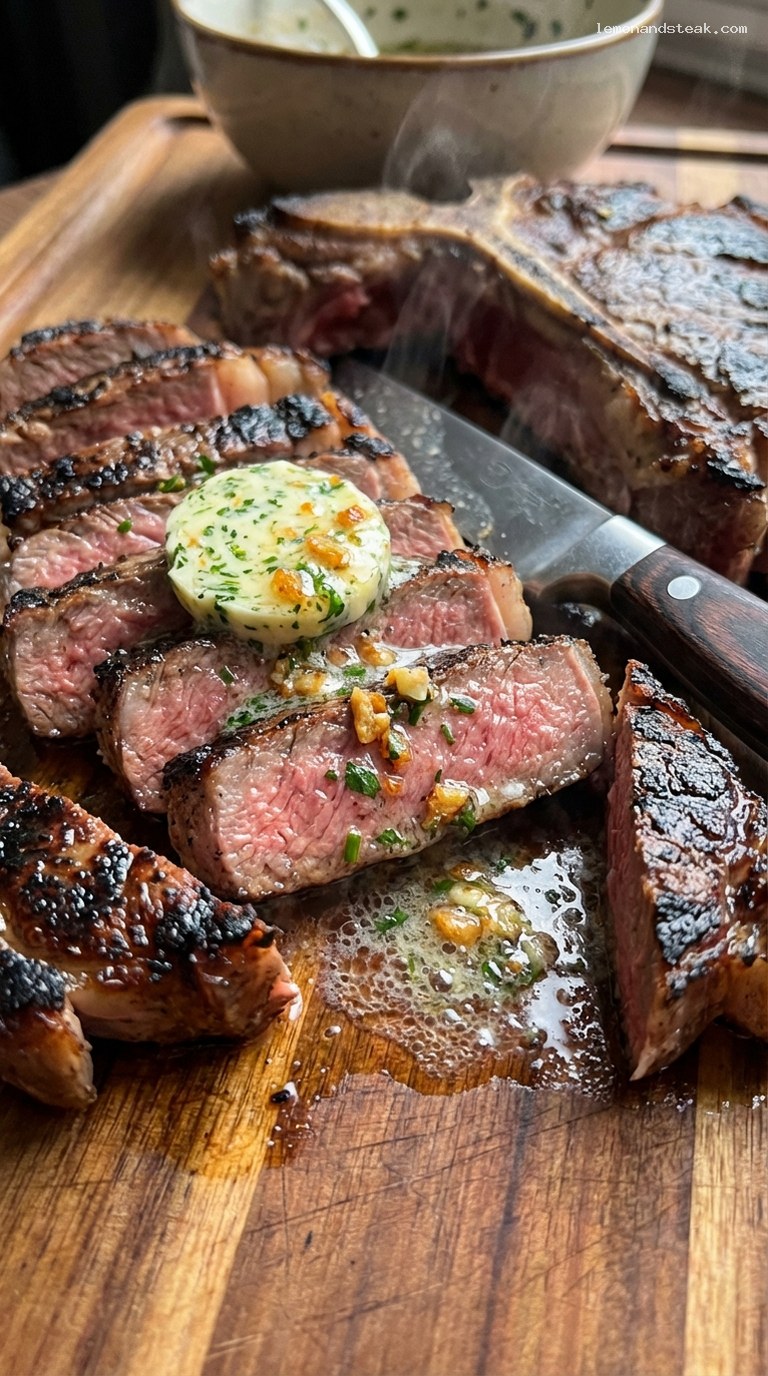
To serve family-style, run a sharp knife along each side of the bone to separate the strip and tenderloin, then slice each section crosswise into thick strips. Spoon any melted butter and juices from the board over the slices. Finish with a sprinkle of flaky salt and extra herbs if you like, and serve immediately.
Pro Tips
- For the best crust, start with very dry steaks and a very hot grill. Moisture is the enemy of browning.
- Use an instant-read thermometer. Visual cues are helpful, but temperature is the most reliable way to hit your preferred doneness.
- Do not skip the resting period. Cutting into the steak too early will cause flavorful juices to run out onto the board instead of staying in the meat.
- If your steaks are thinner than 1 inch, rely mostly on direct heat and shorten the grill time; very thick steaks benefit from a sear-over-direct followed by a finish-over-indirect method.
- Make extra compound butter and keep it on hand. It is fantastic on grilled chicken, pork chops, roasted vegetables, or baked potatoes.
Variations
- Mixed butter platter: Make all three compound butters and slice them into smaller coins. Serve a variety on a small board so everyone can try different flavors on each bite of steak.
- Smokier flavor: Add a small handful of wood chips (such as hickory or oak) to the charcoal or a smoker box on a gas grill for a gentle smoky note that pairs beautifully with the sun-dried tomato or blue cheese butters.
- Skillet version: If you do not have a grill, sear the steaks in a very hot cast-iron skillet on the stovetop with a bit of oil, then finish in a 400°F (200°C) oven until they reach your desired internal temperature. Top with the compound butter just as you would with grilled steaks.
Storage & Make-Ahead
Compound butter can be prepared well in advance. Keep the wrapped butter log in the refrigerator for up to 5 days, or freeze for up to 3 months. If frozen, let it soften just enough to slice before using. Leftover cooked steak will keep in an airtight container in the refrigerator for 3–4 days. Reheat gently in a low oven (275°F / 135°C) just until warmed through, or enjoy sliced cold over salads. Because the steak is best fresh from the grill, the main make-ahead opportunity is to prepare the compound butter and, if needed, roast the garlic a day or two beforehand.
Nutrition (per serving)
Approximate values for 1/4 of the recipe (about 1/2 of a large T-bone steak plus roughly 1 1/2 tablespoons compound butter): about 750 calories; 55 g protein; 57 g fat; 2 g carbohydrates; 0 g fiber; 1 g sugar; 165 mg cholesterol; 900 mg sodium (will vary depending on exact steak size, amount of butter used, and how heavily you season the meat).
Leave a Reply