
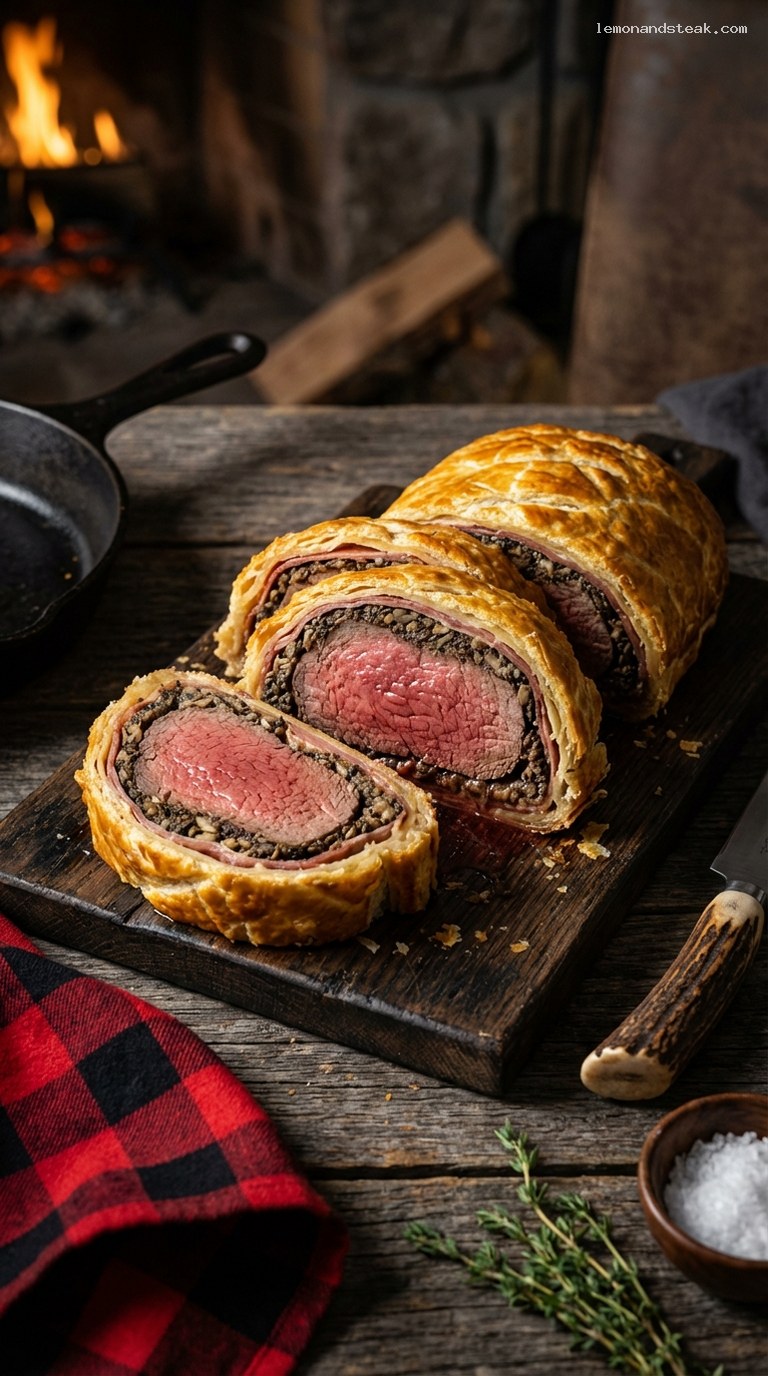
Quick Recipe Version (TL;DR)
Quick Ingredients
- 1 whole center-cut beef tenderloin, 2–2.5 lb (900–1,100 g), trimmed
- 2 tsp kosher salt + 1 tsp black pepper, divided
- 2 tbsp neutral oil (canola, vegetable, or grapeseed)
- 2 tbsp Dijon mustard
- 1.5 lb (680 g) cremini or button mushrooms, very finely chopped
- 2 medium shallots, minced
- 2 cloves garlic, minced
- 2 tbsp unsalted butter + 1 tbsp olive oil
- 2 tsp fresh thyme leaves (or 1 tsp dried)
- 1/4 cup (60 ml) dry white wine or dry sherry
- 6–8 thin slices prosciutto
- 3–4 oz (85–115 g) duck or chicken liver pâté, softened
- 1 sheet all-butter puff pastry (about 10 x 14 in / 25 x 35 cm), thawed but cold
- 1 large egg + 1 tbsp water (egg wash)
- Flour for dusting, flaky salt for finishing
Do This
- 1. Season and tie beef; sear in hot oil until deeply browned on all sides (6–8 minutes). Cool slightly, brush all over with Dijon, and chill.
- 2. Cook mushrooms, shallots, garlic, butter, oil, thyme, and wine in a skillet until very dry and paste-like (15–20 minutes). Cool completely.
- 3. On plastic wrap, overlap prosciutto slices into a rectangle. Spread pâté, then an even layer of cooled duxelles over prosciutto.
- 4. Place chilled beef on the duxelles and use the plastic wrap to roll it into a tight log. Chill 20–30 minutes to firm up.
- 5. Roll puff pastry on a lightly floured surface to fit around the beef. Unwrap beef and encase in pastry, sealing seams well. Chill 15–20 minutes.
- 6. Brush with egg wash, score lightly, sprinkle with flaky salt, and bake at 400°F (200°C) for 30–40 minutes, until pastry is deep golden and beef is 120–125°F (49–52°C) inside.
- 7. Rest 10–15 minutes, then slice thickly and serve.
Why You’ll Love This Recipe
- Impressive centerpiece: Golden puff pastry and rosy, tender beef make this perfect for holidays and special dinners.
- Doable at home: Clear steps break down a fancy restaurant classic into a project a confident home cook can tackle.
- Incredible flavor: Earthy mushroom duxelles, rich pâté, and salty prosciutto wrap the beef in layers of savory goodness.
- Make-ahead friendly: Much of the work is done in advance, so you can bake right before serving.
Grocery List
- Produce: Cremini or button mushrooms, shallots, garlic, fresh thyme.
- Dairy: Unsalted butter, egg, pâté (often in the refrigerated or deli section), all-butter puff pastry.
- Pantry: Center-cut beef tenderloin, prosciutto, Dijon mustard, olive oil, neutral oil, dry white wine or dry sherry, kosher salt, black pepper, flaky salt, all-purpose flour.
Full Ingredients
For the Beef
- 1 whole center-cut beef tenderloin, 2–2.5 lb (900–1,100 g), trimmed of silverskin and excess fat
- 2 tsp kosher salt
- 1 tsp freshly ground black pepper
- 2 tbsp neutral oil (canola, vegetable, or grapeseed)
- 2 tbsp Dijon mustard
For the Mushroom Duxelles
- 1.5 lb (680 g) cremini or button mushrooms, very finely chopped (by hand or food processor)
- 2 medium shallots, finely minced
- 2 cloves garlic, finely minced
- 2 tbsp unsalted butter
- 1 tbsp olive oil
- 2 tsp fresh thyme leaves (or 1 tsp dried thyme)
- 1/4 cup (60 ml) dry white wine or dry sherry
- 1/2 tsp kosher salt, plus more to taste
- 1/4 tsp freshly ground black pepper, plus more to taste
For Wrapping & Assembly
- 6–8 thin slices prosciutto
- 3–4 oz (85–115 g) duck or chicken liver pâté or mousse, softened at room temperature
- 1 sheet all-butter puff pastry (about 10 x 14 in / 25 x 35 cm), thawed according to package instructions but kept cold
- All-purpose flour, for dusting the work surface
- 1 large egg
- 1 tbsp water
- Flaky sea salt, for sprinkling on top
Special Equipment (Helpful but Optional)
- Kitchen twine (for tying the beef)
- Plastic wrap
- Instant-read thermometer
- Rimmed baking sheet
- Parchment paper
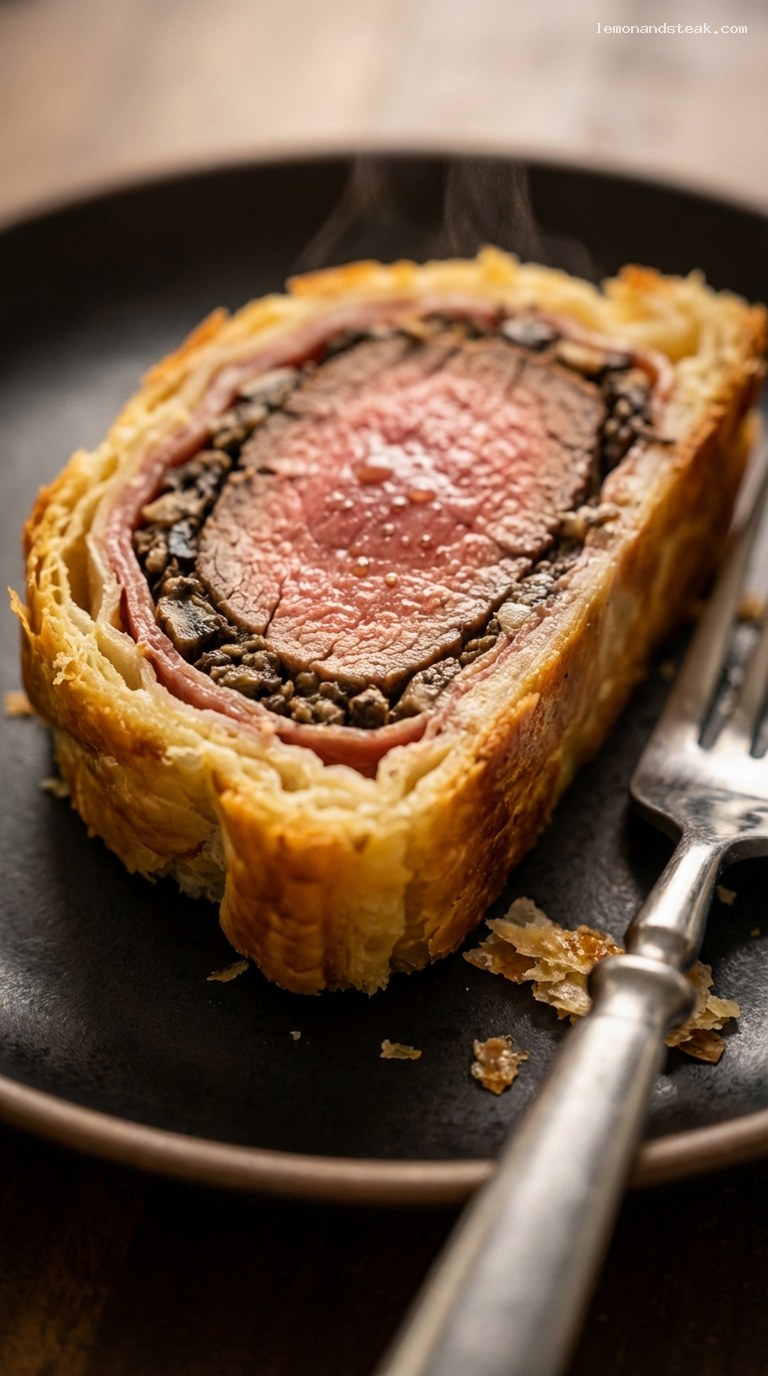
Step-by-Step Instructions
Step 1: Season, Tie, and Sear the Beef
Pat the beef tenderloin very dry with paper towels. If it is uneven in thickness, tuck the thinner tail end under so the roast is roughly uniform in diameter. Use kitchen twine to tie the tenderloin at 1.5–2 inch (4–5 cm) intervals; this helps it keep a nice round shape.
Season all over with the 2 tsp kosher salt and 1 tsp black pepper, pressing the seasoning into the meat. Let sit at room temperature for 20–30 minutes while you heat your pan.
Heat a heavy skillet (cast iron is ideal) over medium-high heat. Add the 2 tbsp neutral oil. When the oil is shimmering and just starting to smoke, add the beef. Sear until well browned on all sides, including the ends, about 6–8 minutes total. Adjust the heat as needed so the fond does not burn.
Transfer the seared beef to a plate or rack. While it is still warm, brush it all over with the 2 tbsp Dijon mustard. Let cool to room temperature, then refrigerate to chill completely, at least 30 minutes. This chilling step helps keep the beef from overcooking later.
Step 2: Make the Mushroom Duxelles
While the beef chills, make the duxelles. If you have not already, very finely chop the mushrooms. You can pulse them in a food processor in batches until they resemble coarse crumbs, but do not puree them. Finely mince the shallots and garlic.
In the same skillet (wipe out excess fat if needed), melt the 2 tbsp butter with 1 tbsp olive oil over medium heat. Add the minced shallots and cook, stirring, until softened and translucent, about 2–3 minutes. Add the garlic and cook 30 seconds more, just until fragrant.
Add the chopped mushrooms, thyme, 1/2 tsp kosher salt, and 1/4 tsp black pepper. At first, the pan will seem dry; then the mushrooms will release a lot of liquid. Cook, stirring frequently, until all the moisture has evaporated and the mixture looks almost paste-like and sizzles in the fat, 12–15 minutes.
Pour in the 1/4 cup white wine or sherry. Cook again, stirring, until all the liquid has evaporated and the pan is dry, 3–5 minutes. Taste and adjust seasoning with more salt and pepper if needed. Spread the duxelles on a plate or tray to cool completely. Cool duxelles are essential so they do not melt the pastry later.
Step 3: Wrap the Beef in Prosciutto, Pâté, and Duxelles
Once both the beef and duxelles are cool, lay out a large sheet of plastic wrap on your counter. Arrange the prosciutto slices on the plastic in a slightly overlapping shingle pattern to form a rectangle just larger than the length and circumference of your beef tenderloin.
Using a spatula or the back of a spoon, gently spread the softened pâté in a very thin, even layer over the prosciutto, leaving a small border around the edges. Then spread the cooled mushroom duxelles evenly over the pâté, pressing gently so it adheres. You are creating a flavorful “blanket” for the beef.
Place the chilled, mustard-coated beef along one long edge of the prosciutto rectangle. Use the plastic wrap to lift and roll the prosciutto-duxelles layer tightly around the beef, tucking in the sides as you go to fully enclose it. Roll it into a firm log, then twist the ends of the plastic wrap like a candy wrapper to tighten.
Refrigerate this wrapped beef log for 20–30 minutes. This helps it firm up and gives you a neat shape for wrapping in puff pastry.
Step 4: Prepare and Wrap in Puff Pastry
While the beef log chills, lightly dust your work surface with flour. Unfold the puff pastry sheet and roll it out into a rectangle about 1/8 inch (3 mm) thick, large enough to fully encase the beef with a little overlap (roughly 12 x 14 in / 30 x 35 cm, depending on the size of your tenderloin).
Beat the egg with 1 tbsp water to make an egg wash. Remove the wrapped beef from the fridge and carefully unwrap and discard the plastic. Lay the beef log near one long edge of the pastry, leaving at least 1 inch (2.5 cm) border at the ends.
Brush the exposed pastry edges lightly with egg wash. Gently but firmly roll the pastry around the beef, keeping it as tight as possible while avoiding tearing. Press the overlapping seam to seal. Trim excess pastry if needed, leaving a 1/2–1 inch (1–2.5 cm) overlap. Fold the ends like a gift and press to seal.
Place the wrapped Wellington seam side down on a parchment-lined baking sheet. If you have pastry scraps, you can cut them into thin strips or shapes for decoration and gently lay them on top. Brush the entire surface lightly with egg wash. Refrigerate the assembled Wellington for 15–20 minutes while you preheat the oven.
Step 5: Chill, Score, and Bake to Golden Perfection
Preheat your oven to 400°F (200°C). Make sure the oven is fully preheated before the Wellington goes in.
Remove the chilled Wellington from the fridge. With a sharp knife, lightly score the pastry in a decorative pattern (such as a crosshatch) without cutting all the way through. This is optional but gives a beautiful finish and helps steam escape. Brush once more with a thin, even layer of egg wash and sprinkle the top lightly with flaky sea salt.
Bake on the middle rack for 30–40 minutes, rotating the pan halfway through for even browning. The pastry should be a deep golden brown. Begin checking the internal temperature after about 25 minutes by inserting an instant-read thermometer into the very center of the beef from one end.
For medium-rare, remove the Wellington when the beef reaches 120–125°F (49–52°C). It will continue to rise to about 130–135°F (54–57°C) while resting. If you prefer medium, cook a little longer, removing at 130°F (54°C).
Step 6: Rest, Slice, and Serve
Transfer the baked Beef Wellington to a cutting board and let it rest, uncovered, for 10–15 minutes. Resting allows the juices to redistribute and helps the pastry stay crisp when sliced.
Using a sharp serrated or chef’s knife, slice the Wellington into thick rounds, about 1–1.5 inches (2.5–4 cm) wide. Wipe the knife between cuts if needed to keep the layers neat.
Serve immediately while the pastry is crisp, the duxelles is warm, and the beef is still rosy and juicy. Beef Wellington is wonderful with simple sides such as roasted potatoes, buttered green beans, or a crisp green salad. A spoonful of pan gravy, red wine reduction, or jus on the plate is a lovely but optional finishing touch.
Pro Tips
- Dryness is key for duxelles: Cook the mushrooms until completely dry and paste-like. Any excess moisture can make the pastry soggy.
- Chill between stages: Chilling after wrapping in prosciutto and again after wrapping in pastry helps maintain a tight, round shape and prevents overcooking.
- Use an instant-read thermometer: Every oven and tenderloin is different. Temperature, not time, is the best way to nail medium-rare.
- Keep the pastry cold: Warm puff pastry is hard to work with and will not puff as nicely. Work quickly and chill as needed.
- Trim and tie the beef: Removing silverskin and tying for even thickness helps the meat cook evenly and look restaurant-quality when sliced.
Variations
- Individual Wellingtons: Cut the tenderloin into 4–6 equal medallions, sear each, and wrap individually in smaller portions of prosciutto, duxelles, and pastry. Reduce baking time to about 18–25 minutes.
- Mushroom-forward version: Skip the pâté and double the duxelles for a slightly lighter but still very rich flavor. Add a splash of soy sauce or Worcestershire to deepen the mushroom taste.
- Crepe barrier (classic French touch): Wrap the beef in a very thin savory crepe spread with pâté and duxelles before adding the pastry. This extra layer helps keep the pastry crisp, especially if you are worried about moisture.
Storage & Make-Ahead
Make ahead (best option): Assemble the Wellington up through wrapping in puff pastry and giving it the first egg wash. Cover loosely with plastic wrap and refrigerate for up to 24 hours. Just before baking, remove the plastic, re-brush with egg wash, score, and bake as directed, adding a few extra minutes if going straight from very cold.
Leftovers: Store sliced leftover Beef Wellington in an airtight container in the refrigerator for up to 2 days. Reheat gently in a 300°F (150°C) oven on a parchment-lined tray until warmed through, about 15–20 minutes. The pastry will not be quite as crisp, but it will still be delicious.
Freezing: For best texture, freeze the assembled but unbaked Wellington (without egg wash) on a tray until firm, then wrap tightly in plastic and foil for up to 1 month. Bake from frozen at 400°F (200°C), adding 10–15 minutes to the baking time and checking the internal temperature carefully.
Nutrition (per serving)
Approximate values for 1 of 6 servings: about 750–850 calories; 45–55 g fat; 45–55 g protein; 40–50 g carbohydrates; 2–3 g fiber; 3–4 g sugars; 1,000–1,300 mg sodium. Actual values will vary based on the exact size of the tenderloin, thickness of pastry, and the specific brands of ingredients used.
Leave a Reply